For global buyers, insulated glass storage is not a warehouse afterthought. Each unit arrives as a sealed assembly, and poor support can place stress on its edges or seals. A well-planned Igu Glass Storage System helps teams manage orientation, spacing, movement, and access. Small details matter. Rack contact points, aisle width, and loading order shape everyday handling. Yet no single layout suits every facility. Unit dimensions, coatings, local climate, transport distance, and available lifting equipment all influence the right setup.
These seven tips focus on practical decisions buyers can check before ordering or changing a storage system. They cover rack capacity, suitable protective contact materials, stable positioning, clear handling routes, and coordination between warehouse and delivery teams. Ask suppliers for drawings, load information, and guidance for the specific glass configuration; then compare those details with actual site measurements. A rack that looks sturdy may still be awkward near a narrow doorway. That is easy to overlook. Storage plans also need review when product sizes or workflow change. No layout is perfect, and even careful teams may find gaps after installation. Treat those findings as useful feedback, not proof that the plan failed. With clear specifications and regular checks, buyers can reduce avoidable handling risks and make storage decisions with greater confidence.
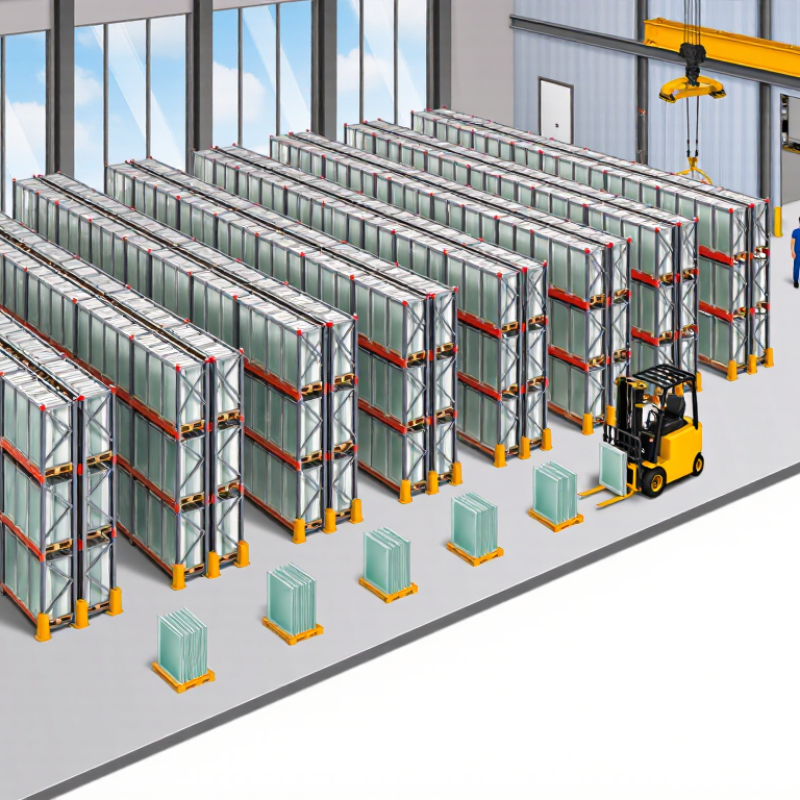
An insulating glass unit (IGU) combines multiple panes with a sealed space between them. Its edges and surfaces need protection during storage and movement. An IGU glass storage system provides a stable place to hold units upright, separate them, and reduce contact with hard surfaces. Small details matter.
A suitable rack supports the glass without placing pressure on vulnerable edges. Protective separators help prevent scratches, while restraints limit shifting during loading or transport. Staff should check that each unit is stable before moving the rack. A slight lean or a rough contact point can create damage that is difficult to spot at first.
The system also supports a clearer workflow. Units can be arranged by size, project, or delivery sequence, so workers spend less time searching and handling them. Keep the storage area dry, clean, and free of debris. Even a well-designed rack cannot compensate for careless loading. That is an uncomfortable truth. Storage practices vary between facilities, so buyers should assess unit dimensions, handling equipment, floor conditions, and daily throughput before choosing a system. A practical setup may not look perfect, but it should protect the glass and make each movement predictable.
For IGU storage, assess the complete build-up, not just the outer dimensions. Annealed, heat-treated, laminated, and coated panes need different handling controls. Laminated glass adds interlayers, while thicker plies increase mass. Keep coating surfaces protected from rubbing and separate units with suitable, non-abrasive spacers.
The National Glass Association’s glass-weight guidance uses approximately 2,500 kg/m³ for soda-lime glass, or about 2.5 kg per square metre per millimetre of thickness. A 6-12-6 mm IGU therefore weighs roughly 30 kg/m² in glass alone. At 2.4 by 3.2 metres, that is about 230 kg before framing, packaging, and handling forces. Useful, but incomplete.
Specify rack capacity against the heaviest planned unit, including packaging, and confirm the rating applies to the actual support angle and loading method. Record maximum width, height, thickness, and unit weight; a few oversized panes can change the load profile. Store units upright on stable, padded supports, with edges protected and loads secured. Small gaps matter. Recheck calculations when switching glass types or dimensions; estimates based on nominal sizes can miss real production tolerances.
Rack choice starts with the unit’s size, weight, and travel route. A rigid A-frame rack should hold IGUs upright, with padded contact points supporting the glass rather than pressing on its edges. Check the rack’s rated capacity against the heaviest load, not the average one. Keep units separated with clean, non-abrasive spacers. Dust and tiny chips can damage edge seals during movement. There is no perfect layout. A rack that fits the warehouse may still block a forklift turn.
Supports and handling gear protect both people and product. Use lifting equipment rated for the actual unit weight, and confirm suction pads suit the glass surface and dimensions. OSHA’s materials-handling rule, 29 CFR 1910.176, calls for stored materials to remain stable and secure against sliding or collapse. For sealed-unit quality, EN 1279-3 sets a gas-leakage limit of 1% per year in its durability assessment. That figure makes edge protection more than a cosmetic detail. Inspect pads, straps, and rack welds before each shift; small defects are easy to overlook. Record damage and near misses, then review whether the rack position or handling route contributed.
IGU storage begins with stable conditions, not just available floor space. Keep units upright on engineered A-frames, with padded separators and secure restraints. Store them in a dry, covered area away from direct sun, standing water, and sudden temperature changes. Moisture trapped between units can stain surfaces or damage edge seals. Leave clear inspection labels visible, and record delivery dates so older stock moves first. Small details matter.
Tip: Map a one-way route from unloading to storage and dispatch. Keep forklift lanes clear, mark pedestrian paths, and check floor capacity before adding racks. The U.S. Bureau of Labor Statistics reported a 4.8 recordable-injury rate per 100 full-time workers in transportation and warehousing for 2022. That figure is not specific to glass handling, but it supports careful traffic planning. A tidy aisle helps; it does not replace trained operators or suitable lifting equipment.
Tip: Set written limits for rack loading, unit height, and access. Inspect A-frames, straps, and protective pads at the start of each shift. Separate chipped or moisture-affected units for assessment instead of quietly returning them to usable stock. Storage plans can look perfect on paper, yet busy teams may still block an exit or skip a check. Review the layout after deliveries, and adjust it when actual handling differs from the plan.
For global buyers, confirm which insulating-glass-unit standard applies in the destination market. EN 1279 and ASTM E2190 cover performance and durability, but acceptance requirements can differ. Ask for current test reports, declared dimensions, and batch traceability—not just a certificate. Check that the tested build-up matches your order, including spacer, sealant, and glass thickness. Small mismatches matter.
Shipping deserves equal scrutiny. UNCTAD’s Review of Maritime Transport 2024 reports that over 80% of world trade by volume moves by sea. For IGUs, specify upright, well-braced crates, protective separators, and clear handling labels. Ask how the supplier controls container moisture and records loading damage. A damp crate corner can become an expensive surprise. No checklist catches every handling mistake.
Supplier support should continue after dispatch. Request named contacts, response times, packing photos, and a written process for transit claims or breakage. Confirm who arranges export documents and who checks destination-specific paperwork with your broker. Compare the quoted lead time with production, testing, and port handling—not merely factory readiness. I would still leave buffer days; schedules rarely behave perfectly. Ask for replacement-unit timing before placing a large order.
„Thanks to the LUVIR technology, the solder resist process could be switched directly from the previously used mask exposure to direct exposure. As an outstanding digital solution on the market, this technology has been able to demonstrate fast process times and superior quality on our certified conventional ink in production. This allowed us to fully digitize the solder mask process at low cost – without process or ink adjustments. An excellent benefit to our production in Rot am See.“
Ralf Göhringer (Head of Production WE Rot am See)
I would definitely recommend the Limata machine and team for a future company purchase
Michael Greenaway
Compunetics Inc.
“The Limata ldi has been amazing!! Best thing we did was buy this machine”
Richard Brady
GM
Circuitlabs
“Since 2019, we have been running the Limata X1000 LDI system (including LUVIR for solder mask imaging) in daily production as an addition to our current process with film. The machine was capable of properly exposing Taiyo PSR-4000 BN (DI) solder mask types on normal to high-copper boards using a new and unique direct imaging process. The machine operating interface is very user friendly which allowed for a quick technical training curve. The pre-registration processing reduced several seconds of production time at every print. Limata support and service staff is incomparable. They supported our team every step of the way at basically any time of the day or night, with literally, an immediate response time, customizing the software interface to best fit our Operations and needs.
We have exposed more than 8,000 prints since end of October, on various solder mask colors and some resist film panels. Limata, has proven to be very capable and innovative. They are a strong contender in the industry.
We have very much enjoyed this project, and working with the team!
Thank you Limata for the continued support and being a part of our growth.”
Bill Sezate
Vice President, GM
Summit Interconnect
As a replacement to our current contact exposure process with film, the LIMATA X2000 system including LUVIR-Technology was capable of properly exposing non-LDI solder mask types using a direct imaging process. The machine offers cutting edge software with a very intuitive operating interface which allowed for quick technician training curve. The dual drawer system combined with pre-registration processing reduced several seconds of production time at every machine cycle. Limata support and service staff is world class. They added software patches to keep production running at shortest possible response times, customized the software interface to best fit our in-house Operations system, and even wrote a step-by-step machine processing manual. As a result of the project, we have exposed more than 16,000 times on various product types and solder mask brands/colors. Limata, in a very short timeframe as a company, has definitely shown they are truly innovative and will be challenging the industry of direct imaging for the top spot.
Kevin Beattie
Process Engineer
TTM Technologies
Forest Grove Division