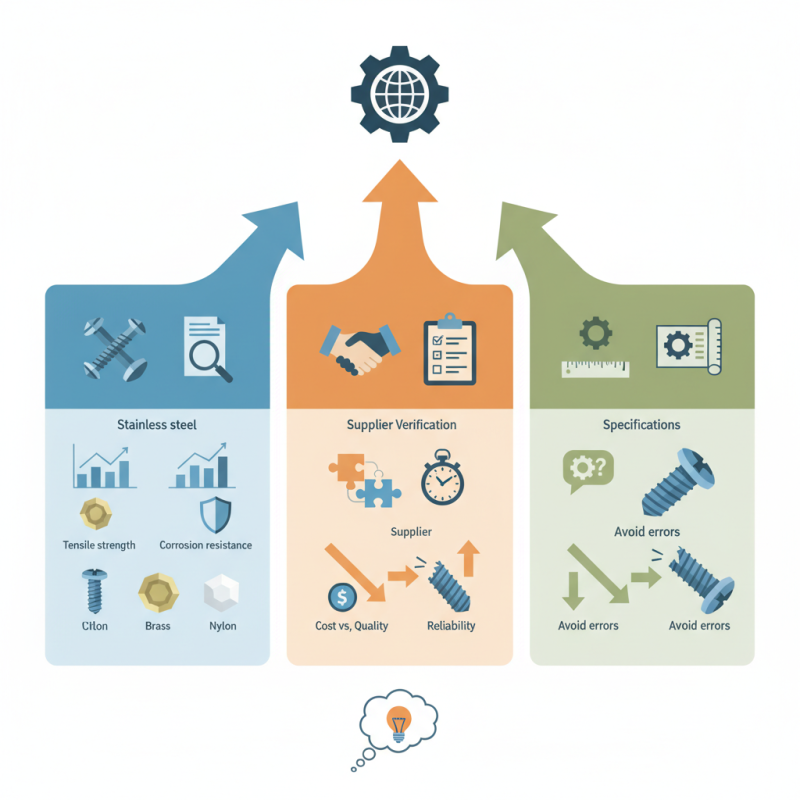
When it comes to sourcing Machine Screws, global importers face unique challenges. Understanding the various types and applications is crucial. Whether you are looking for stainless steel, brass, or nylon machine screws, each has distinct properties. It is essential to evaluate factors like tensile strength, corrosion resistance, and compatibility with the materials being used.
While many suppliers offer machine screws, not all maintain high-quality standards. Importers must verify supplier credentials and their track records. Quality assurance and reliability are paramount. It can be tempting to focus solely on price, but cheaper options may lead to long-term failures. This approach could affect your operational efficiency.
Moreover, knowing the correct specifications is vital. Miscommunication about sizes and threading can result in costly errors. Reflecting on the right questions to ask suppliers could prevent future issues. Machine screws may seem simple, but the right choice requires careful consideration and knowledge. Attention to detail and a solid understanding of your specific needs will set you apart in the competitive market.
When importing machine screws, understanding their various types is essential. These screws are categorized into several groups, including flat head, pan head, and hex head, each serving specific functions. According to the Fastener Quality Act, each type must adhere to quality standards. For instance, flat head screws are ideal for applications where a flush surface is necessary, while hex head screws provide excellent torque management.
Selecting the right machine screw can significantly affect your project. Here are some quick tips:
- Always check the material. Stainless steel offers corrosion resistance, but carbon steel is stronger.
- Understand thread types. Coarse threads grip better in softer materials, while fine threads work well in harder materials.
- Consider the screw length. Too long can damage materials, too short can compromise connections.
Proper application of machine screws depends on their characteristics. The global market for fasteners, including machine screws, is expected to reach $116 billion by 2025, as per industry reports. With a growing demand, knowledge of screw types and their applications is vital for importers looking to meet market needs effectively.
When sourcing machine screws globally, key factors are critical to ensure quality and reliability. The global fasteners market is projected to reach USD 120 billion by 2027, according to industry reports. This growth highlights the importance of understanding your specific requirements, such as material type, corrosion resistance, and tensile strength.
Tip: Always clarify your specifications. The choice between stainless steel, carbon steel, or plastic can significantly impact performance. Each material has unique properties that affect durability and application suitability. Always request samples before making bulk purchases to evaluate quality firsthand.
Common pitfalls in the import process include not verifying supplier credentials. Ensuring manufacturers meet ISO standards or equivalent certifications reduces the risk of defective products. An alarming 30% of international shipments fail quality checks, leading to costly returns and delays.
Tip: Conduct thorough due diligence. Collaborate with trusted suppliers who have positive track records. This can mitigate risks associated with shipping and compliance. Understanding local regulations related to fasteners also aids in smoother transactions.
When sourcing machine screws globally, evaluating quality standards and certifications is crucial. The global fastener industry has seen consistent growth, projected to reach $110 billion by 2024, according to a recent report by MarketsandMarkets. This emphasizes the importance of choosing suppliers that adhere to strict quality controls.
Many importers overlook certifications like ISO 9001, which signifies a commitment to quality management. Additionally, industry standards such as ASTM and DIN provide benchmarks for performance and reliability. Without these certifications, the risks associated with product failure can increase significantly. The Council for Exceptional Children highlights that 37% of defective products in the fastener industry stem from inadequate quality assurance processes.
Proper documentation verifies that machine screws meet international testing criteria. Recognizing compliance labels can be challenging, yet non-compliance can lead to costly recalls or reparations. Importers should also consider the potential for supply chain disruptions if quality issues arise. It's clear that ensuring quality is not just a regulatory obligation; it impacts operational efficiency and customer satisfaction. Focusing on quality standards can ultimately safeguard against future pitfalls.
When selecting suppliers for machine screws, a comparative analysis is essential. Look for suppliers with proven reliability and quality. According to a recent report by the International Fastener Association, 70% of importers prioritize supplier certifications. These certifications often indicate superior quality standards.
Price is crucial, but don’t overlook service and support. A supplier with excellent after-sales support can save costs in the long run. Remember, 87% of businesses reported that strong communication with suppliers directly impacted their satisfaction levels. Assessing a supplier's responsiveness can provide insights into their business practices.
Tip: Validate supplier claims through third-party audits. This step helps ensure the reliability and quality of their products. Also, consider local industry reviews to gauge their reputation.
Another factor is production capabilities. Major suppliers can meet bulk orders but may compromise on custom specifications. A balance is necessary. Engaging smaller firms may yield better customization but could lead to delivery delays. Always verify their production timelines before making commitments.
When budgeting for machine screws in international imports, cost factors are paramount. According to industry reports, raw material prices constitute nearly 60% of the total manufacturing cost. Steel, for example, can fluctuate based on market demand and geopolitical events. Importers should stay updated on these trends to avoid unexpected expenses.
Freight charges also play a critical role. A study by the International Maritime Organization highlighted that shipping costs have risen by 300% in recent years due to supply chain disruptions. Importers must factor in these fluctuating costs while choosing suppliers. Understanding the full cost structure is vital for ensuring profit margins remain intact.
Finally, quality assurance cannot be overlooked. According to the American Society for Quality, defects in fasteners can result in losses exceeding $1 million for manufacturers. Investing in reliable quality assessments might increase initial costs, but it saves money in the long run. Not addressing potential quality issues upfront can lead to larger financial challenges down the road. Importers should weigh short-term savings against long-term impacts on their operations.
„Thanks to the LUVIR technology, the solder resist process could be switched directly from the previously used mask exposure to direct exposure. As an outstanding digital solution on the market, this technology has been able to demonstrate fast process times and superior quality on our certified conventional ink in production. This allowed us to fully digitize the solder mask process at low cost – without process or ink adjustments. An excellent benefit to our production in Rot am See.“
Ralf Göhringer (Head of Production WE Rot am See)
I would definitely recommend the Limata machine and team for a future company purchase
Michael Greenaway
Compunetics Inc.
“The Limata ldi has been amazing!! Best thing we did was buy this machine”
Richard Brady
GM
Circuitlabs
“Since 2019, we have been running the Limata X1000 LDI system (including LUVIR for solder mask imaging) in daily production as an addition to our current process with film. The machine was capable of properly exposing Taiyo PSR-4000 BN (DI) solder mask types on normal to high-copper boards using a new and unique direct imaging process. The machine operating interface is very user friendly which allowed for a quick technical training curve. The pre-registration processing reduced several seconds of production time at every print. Limata support and service staff is incomparable. They supported our team every step of the way at basically any time of the day or night, with literally, an immediate response time, customizing the software interface to best fit our Operations and needs.
We have exposed more than 8,000 prints since end of October, on various solder mask colors and some resist film panels. Limata, has proven to be very capable and innovative. They are a strong contender in the industry.
We have very much enjoyed this project, and working with the team!
Thank you Limata for the continued support and being a part of our growth.”
Bill Sezate
Vice President, GM
Summit Interconnect
As a replacement to our current contact exposure process with film, the LIMATA X2000 system including LUVIR-Technology was capable of properly exposing non-LDI solder mask types using a direct imaging process. The machine offers cutting edge software with a very intuitive operating interface which allowed for quick technician training curve. The dual drawer system combined with pre-registration processing reduced several seconds of production time at every machine cycle. Limata support and service staff is world class. They added software patches to keep production running at shortest possible response times, customized the software interface to best fit our in-house Operations system, and even wrote a step-by-step machine processing manual. As a result of the project, we have exposed more than 16,000 times on various product types and solder mask brands/colors. Limata, in a very short timeframe as a company, has definitely shown they are truly innovative and will be challenging the industry of direct imaging for the top spot.
Kevin Beattie
Process Engineer
TTM Technologies
Forest Grove Division
