micro switches are small but crucial components in various devices. They are widely used in appliances and machinery. According to a recent market report, the global micro switch market is projected to reach $1.5 billion by 2025. This data illustrates their growing importance.
Micro switches operate with minimal force, ensuring precise control. They engage quickly, making them ideal for applications such as safety interlocks and home appliances. The manufacturing process has become more advanced, but challenges remain. Quality control is critical, as faulty switches can lead to malfunctions.
Despite their reliability, micro switches sometimes face issues. Wear and tear over time can affect performance. Engineers must consider various factors, like environmental conditions, when designing circuits. These aspects showcase the complexity of seemingly simple components. Understanding micro switches is essential for innovation and safety in modern design.
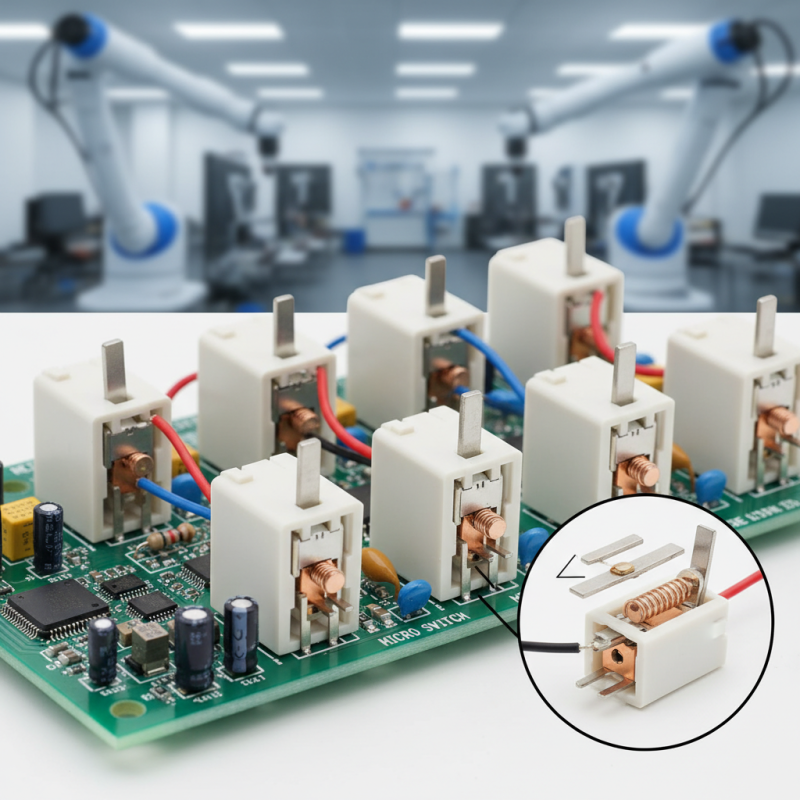
Micro switches are small, but essential components found in many devices. They are designed to detect physical changes, enabling various electrical functions. When a mechanical force is applied, the internal mechanism moves, creating a bridge in the circuit. This simple action translates into a complex response, allowing switches to control lights, appliances, and more.
The functionality of micro switches lies in their sensitivity and reliability. They require minimal force to activate. This makes them suitable for various applications, from household items to industrial machines. You may find them in doorbells, elevators, and automotive systems. However, challenges arise too. Micro switches can wear out over time. Dust and moisture can impact performance. Regular maintenance is often overlooked, leading to failures when least expected.
While they are efficient, micro switches also come with limitations. Their tiny size can restrict their integration into larger systems. Sometimes, finding the right switch for a specific application can be daunting. The simplicity of design belies the importance of selecting appropriate specifications. Numerous options exist, and not all are suitable for every situation. So, it’s crucial to reflect on your specific needs before making a choice.
Micro switches are essential components used in various applications, such as consumer electronics and industrial machinery. These switches operate using a simple yet effective mechanism. At their core, they have a spring-loaded actuator that responds to minimal force. When activated, the actuator deflects, closing or opening the electrical circuit. This elegant design allows for precise control and is critical in safety mechanisms.
The response time of micro switches is noteworthy. Standard micro switches can have a response time as low as 1 millisecond, depending on the design and materials used. This rapid response is vital in applications requiring immediacy and reliability. Reports indicate that high-quality micro switches can withstand over 10 million operations without failure. However, some studies highlight that environmental factors can affect performance. Moisture, dust, and temperature fluctuations can lead to unpredicted failures. It's crucial to understand these limitations for better reliability.
In practice, not all micro switches perform equally. While many boast long lifetimes, inconsistent manufacturing practices can lead to variability. Reports suggest that nearly 20% of switches fail prematurely due to poor quality control. Analyzing these aspects provides insight into the critical nature of micro switch selection. It reflects the need for rigorous testing and evaluation in the manufacturing process to ensure they meet required standards.
Micro switches play a vital role in various industries due to their reliability and efficiency. These small devices are often found in household appliances, industrial machines, and automotive systems. They act as triggers for actions, making them indispensable in everyday applications. For example, in a vending machine, a micro switch detects when a coin has been inserted, allowing the user to select their desired product.
In the automotive sector, micro switches are used in door locks and seatbelt reminders, enhancing safety and convenience. Their compact size allows for easy integration into tight spaces. Meanwhile, in industrial settings, these switches are vital for machine safety, ensuring that equipment only operates when safety guards are in place.
However, their small size can be a double-edged sword. Misalignment or dirt can hinder performance. Regular maintenance is essential to ensure proper functioning and avoid unexpected breakdowns.
The use of micro switches extends to medical devices as well. In devices like blood glucose monitors, they provide precise readings. However, the need for accuracy is critical; even a small error can lead to significant consequences. Industries need to pay attention to the placement and maintenance of these switches to ensure quality and reliability.
Micro switches are crucial components in various devices. Their robustness and reliability make them popular in many applications. Understanding key specifications is essential for optimal performance.
One primary specification is the operating force. This is the amount of force needed to activate the switch. Typically, micro switches require a force in the range of 100 to 500 grams. The reset travel distance is also vital. It determines how far the switch must move to return to its original position. This distance can be as small as 0.25 millimeters.
Performance standards vary significantly among different types of micro switches. For instance, some are rated for millions of cycles, while others are suited for lighter-duty applications. Environmental factors also play a role. Temperature range affects functionality. It’s not uncommon for switches to fail outside their specified temperature limits. Thus, selecting the right micro switch requires careful consideration of these aspects. Make sure to review specifications meticulously to avoid potential failures.
Micro switches are small, but their impact on technology is significant. They are widely used in appliances, automotive, and industrial applications. The future of micro switch technology is evolving rapidly. Innovations in materials and design are pushing the boundaries of what these devices can do.
One exciting trend is the integration of smart technology. Micro switches can now connect to IoT systems, providing real-time data. This opens new avenues for automation and monitoring. However, the challenge remains in ensuring reliability and longevity. While some implementations work seamlessly, others face issues with durability. It's crucial to address these concerns to maximize benefits.
Another trend is the miniaturization of micro switches. As devices shrink, so do the components inside them. This can lead to design constraints. Engineers need to balance size with functionality. Many prototypes may not perform as expected. Testing is essential to refine designs. The future is bright, but it is filled with challenges that require thoughtful solutions.
„Thanks to the LUVIR technology, the solder resist process could be switched directly from the previously used mask exposure to direct exposure. As an outstanding digital solution on the market, this technology has been able to demonstrate fast process times and superior quality on our certified conventional ink in production. This allowed us to fully digitize the solder mask process at low cost – without process or ink adjustments. An excellent benefit to our production in Rot am See.“
Ralf Göhringer (Head of Production WE Rot am See)
I would definitely recommend the Limata machine and team for a future company purchase
Michael Greenaway
Compunetics Inc.
“The Limata ldi has been amazing!! Best thing we did was buy this machine”
Richard Brady
GM
Circuitlabs
“Since 2019, we have been running the Limata X1000 LDI system (including LUVIR for solder mask imaging) in daily production as an addition to our current process with film. The machine was capable of properly exposing Taiyo PSR-4000 BN (DI) solder mask types on normal to high-copper boards using a new and unique direct imaging process. The machine operating interface is very user friendly which allowed for a quick technical training curve. The pre-registration processing reduced several seconds of production time at every print. Limata support and service staff is incomparable. They supported our team every step of the way at basically any time of the day or night, with literally, an immediate response time, customizing the software interface to best fit our Operations and needs.
We have exposed more than 8,000 prints since end of October, on various solder mask colors and some resist film panels. Limata, has proven to be very capable and innovative. They are a strong contender in the industry.
We have very much enjoyed this project, and working with the team!
Thank you Limata for the continued support and being a part of our growth.”
Bill Sezate
Vice President, GM
Summit Interconnect
As a replacement to our current contact exposure process with film, the LIMATA X2000 system including LUVIR-Technology was capable of properly exposing non-LDI solder mask types using a direct imaging process. The machine offers cutting edge software with a very intuitive operating interface which allowed for quick technician training curve. The dual drawer system combined with pre-registration processing reduced several seconds of production time at every machine cycle. Limata support and service staff is world class. They added software patches to keep production running at shortest possible response times, customized the software interface to best fit our in-house Operations system, and even wrote a step-by-step machine processing manual. As a result of the project, we have exposed more than 16,000 times on various product types and solder mask brands/colors. Limata, in a very short timeframe as a company, has definitely shown they are truly innovative and will be challenging the industry of direct imaging for the top spot.
Kevin Beattie
Process Engineer
TTM Technologies
Forest Grove Division
