Choosing a MIG welder for international use involves more than comparing prices. Mig Welding performance depends on the job, available power, consumables, and support after delivery. A machine that runs smoothly in one workshop may not suit another site’s voltage supply or production schedule. Small details matter.
This guide presents seven practical checks for global buyers. It covers output range, duty cycle, wire compatibility, shielding-gas options, torch and connector details, documentation, and service access. For example, confirm that the stated duty cycle matches the intended workload, and check which wire diameters the feeder accepts. Ask the supplier for a clear specification sheet, operating manual, and information about spare parts. Verify electrical requirements with the manufacturer and a qualified local technician before ordering. Specs can be easy to misread.
Price still matters, of course, but an unusually low quote may leave important questions unanswered. Does the package include the torch, regulator, and ground lead? Are replacement contact tips readily available? Those are not glamorous questions. Yet they can affect setup time and operating costs. No checklist removes every uncertainty, and product claims should be verified rather than assumed. A careful comparison helps buyers choose equipment that fits their process, workshop, and support needs.
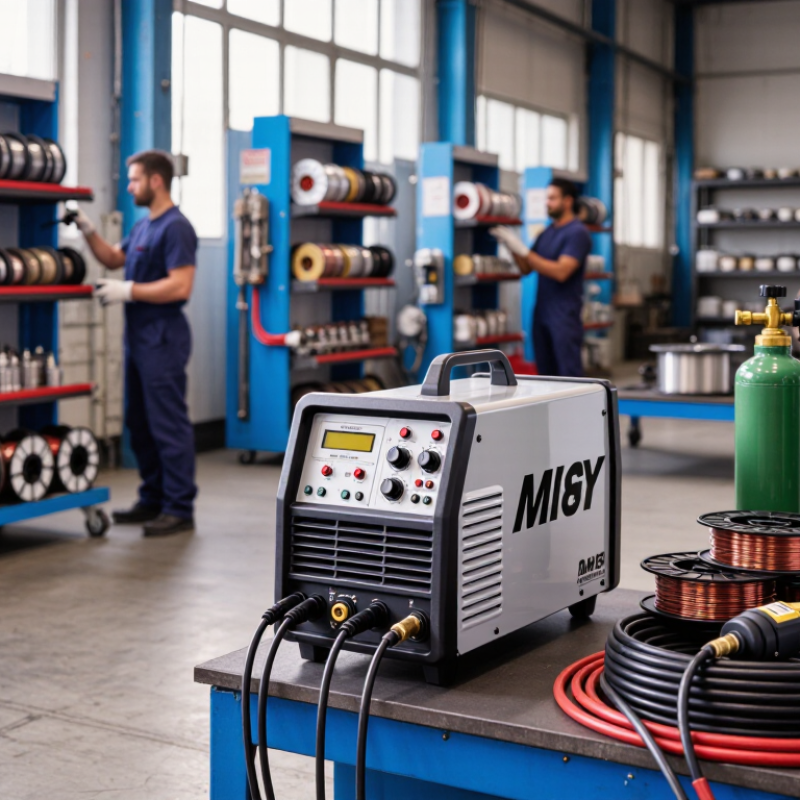
MIG welding, commonly called gas metal arc welding, uses a continuously fed wire electrode to create an arc and join metal. A shielding gas protects the molten weld pool from contamination. That sounds simple. Yet the process depends on coordinated equipment, not just a welding machine. Typical components include a power source, wire feeder, welding gun, work clamp, gas cylinder, regulator, and suitable cables. Wire diameter and gas choice should match the base metal, thickness, and welding position. Thin sheet often needs controlled, low heat; heavier sections may require higher output and slower travel.
For global buyers, input voltage and phase matter as much as rated amperage. Confirm the local power supply, plug type, frequency, and available shielding gas before comparing prices. Check duty cycle at the amperage you expect to use; a headline rating alone can mislead. Also verify that the machine accepts the wire spool sizes and torch connections used in your workshop. During evaluation, run a bead on scrap matching the intended material, then inspect its shape, spatter, and penetration. A neat sample is not proof of every setting. Operator technique and fit-up still affect results, and a specification sheet cannot show how smoothly wire feeds through a long shift.
These typical current ranges help buyers compare wire sizes when selecting a MIG power source and wire-feeding equipment. Actual settings depend on wire type, shielding gas, transfer mode, material thickness, and the welding procedure; always check the wire and equipment specifications.
A MIG welder’s headline amperage does not tell the whole story. Match output to the thickest material you regularly weld, then check the duty cycle at that current. A machine rated for 200 amps may deliver that output only briefly before cooling. Check the duty cycle. For repeated frame repairs or long production seams, sustained output matters more than a momentary peak.
Material thickness and wire size also shape capacity. The American Welding Society’s Welding Handbook describes GMAW wire diameters across roughly 0.6 to 2.4 mm, reflecting different current and deposition needs. Thin sheet often calls for smaller wire and lower heat; heavy plate may need larger wire, higher current, or multiple passes. Aluminum pulls heat away quickly, so a setting that works on mild steel can produce a cold-looking bead. Test on a matching offcut.
Workload changes the buying decision. Count arc-on hours, start-stop frequency, and the longest likely weld—not just daily job totals. A small shop doing short repairs may value portability and a stable low-amp arc. A busy fabrication cell needs cooling capacity and wire-feed consistency. I’ve seen buyers focus too much on peak amps; it’s an easy mistake. Compare ratings at the voltage and duty cycle you will actually use, and leave some headroom for future material changes.
7 MIG Welding Tips for Global Buyers
Power compatibility is more than matching a plug. IEC 60038:2009 specifies nominal 230/400 V systems at 50 Hz, while other markets may use different voltages and frequencies. Check the machine’s input range, phase, frequency, and required circuit before ordering. A plug adapter cannot correct an electrical mismatch. Also confirm the wire feeder accepts the wire diameter and spool size you can source locally; test feed smoothness and polarity during commissioning.
Tip: Request a nameplate photo and a written compatibility check before shipment. Small details matter.
Gas setup needs equal care. ISO 14175 classifies shielding gases by composition, so compare the cylinder label with the process and wire specifications rather than relying on a familiar color. TWI guidance commonly cites about 10–15 L/min as a starting range for indoor MIG shielding; drafts, nozzle size, and joint shape can change the requirement. Confirm whether the flowmeter reads L/min or CFH, and check that the regulator matches the cylinder connection. I would still verify the flow at the torch, not trust the dial alone.
Judge a MIG welder by repeatable performance, not a polished brochure. Ask for test records showing output stability, wire-feed consistency, and duty cycle at specified amperage. Request a sample weld on your intended material and thickness. Inspect the bead for even shape, spatter, and starts that do not hesitate. Small details matter. Check whether the test conditions match your workshop; otherwise, the comparison may mislead.
Verify certificates by scope, issuing body, and validity. ISO’s 2022 Survey of Management System Standard Certifications recorded 1,265,216 ISO 9001 certificates worldwide. That figure signals broad adoption, not proof that a particular machine passes your quality checks. Ask for serial-number traceability, inspection records, and applicable electrical-safety documentation. A certificate alone is not enough. Keep the distinction clear.
Supplier support deserves the same scrutiny as the machine. The American Welding Society’s 2023 workforce projections estimated that the industry would need 360,000 welding professionals by 2027, making clear technical guidance valuable. Before buying, test the supplier’s response with a real question about torch compatibility or feed-roller setup. Request a parts list, troubleshooting steps, and realistic delivery times for consumables. Their answer may be uneven. That is useful evidence, too: note what was vague, then ask who handles warranty claims and service after delivery.
Before ordering a MIG welding system, confirm that its input voltage, phase, frequency, and plug arrangement match the workshop. Check the rated duty cycle against the expected workload; a small unit may overheat during long production runs. Keep the work area dry, clear of flammable materials, and well ventilated. Operators should use suitable eye, hand, and body protection, and follow the equipment manual. Small details matter. A tidy setup helps, but it cannot replace training or a pre-use inspection.
Build a maintenance routine around actual use. Inspect the torch liner, contact tip, gas hose, and earth clamp for wear or damage. Clean the drive rolls and check wire-feed tension; erratic feeding can spoil a weld and waste wire. Record faults and service dates, even if the log is not perfect at first. Before international delivery, ask for a protective packing plan that secures the torch, cables, and control panel against movement and moisture. Confirm the crate dimensions, gross weight, included accessories, and export documents with the supplier. Request clear setup instructions and spare-part details before dispatch. Shipping delays happen, so allow time for inspection and commissioning after arrival.
„Thanks to the LUVIR technology, the solder resist process could be switched directly from the previously used mask exposure to direct exposure. As an outstanding digital solution on the market, this technology has been able to demonstrate fast process times and superior quality on our certified conventional ink in production. This allowed us to fully digitize the solder mask process at low cost – without process or ink adjustments. An excellent benefit to our production in Rot am See.“
Ralf Göhringer (Head of Production WE Rot am See)
I would definitely recommend the Limata machine and team for a future company purchase
Michael Greenaway
Compunetics Inc.
“The Limata ldi has been amazing!! Best thing we did was buy this machine”
Richard Brady
GM
Circuitlabs
“Since 2019, we have been running the Limata X1000 LDI system (including LUVIR for solder mask imaging) in daily production as an addition to our current process with film. The machine was capable of properly exposing Taiyo PSR-4000 BN (DI) solder mask types on normal to high-copper boards using a new and unique direct imaging process. The machine operating interface is very user friendly which allowed for a quick technical training curve. The pre-registration processing reduced several seconds of production time at every print. Limata support and service staff is incomparable. They supported our team every step of the way at basically any time of the day or night, with literally, an immediate response time, customizing the software interface to best fit our Operations and needs.
We have exposed more than 8,000 prints since end of October, on various solder mask colors and some resist film panels. Limata, has proven to be very capable and innovative. They are a strong contender in the industry.
We have very much enjoyed this project, and working with the team!
Thank you Limata for the continued support and being a part of our growth.”
Bill Sezate
Vice President, GM
Summit Interconnect
As a replacement to our current contact exposure process with film, the LIMATA X2000 system including LUVIR-Technology was capable of properly exposing non-LDI solder mask types using a direct imaging process. The machine offers cutting edge software with a very intuitive operating interface which allowed for quick technician training curve. The dual drawer system combined with pre-registration processing reduced several seconds of production time at every machine cycle. Limata support and service staff is world class. They added software patches to keep production running at shortest possible response times, customized the software interface to best fit our in-house Operations system, and even wrote a step-by-step machine processing manual. As a result of the project, we have exposed more than 16,000 times on various product types and solder mask brands/colors. Limata, in a very short timeframe as a company, has definitely shown they are truly innovative and will be challenging the industry of direct imaging for the top spot.
Kevin Beattie
Process Engineer
TTM Technologies
Forest Grove Division