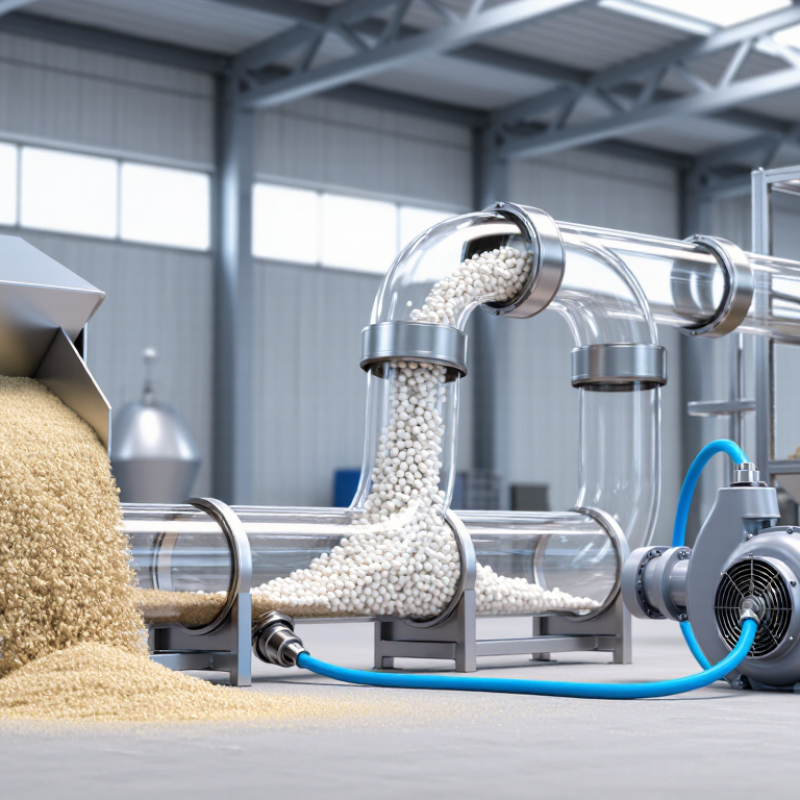
| Basic operating principle | A blower or compressor supplies air that pushes material through a pipeline from the feed point toward the destination. | A vacuum pump or exhauster lowers pressure in the conveying line, drawing air and material from the pickup point toward the receiver. |
| Typical system pressure | The conveying line operates above atmospheric pressure. The required pressure depends on the material, route, throughput, and system design. | The conveying line operates below atmospheric pressure. The achievable vacuum is limited by the air mover and system design. |
| Material pickup and discharge | Material is introduced into the pressurized air stream through a suitable feeder, such as a rotary valve or pressure vessel, and separated at the destination. | Material is drawn from a pickup point or feeding device into the line, then separated from the conveying air in a receiver or filter unit. |
| Common conveying direction | Often selected to move material from one feed point to one or more discharge points. | Often selected to collect material from one or more pickup points and deliver it to a central receiver. |
| Typical applications | Moving dry bulk solids over longer routes, feeding multiple destinations, or conveying from a central supply point. | Collecting material from multiple sources, transferring powders from bags or bins, and handling material where containing dust at pickup points is important. |
| Leakage behavior | A leak can allow conveying air and dust to escape from the line, so joints and seals require appropriate containment. | A leak generally draws ambient air into the line, which can help limit outward dust escape; leaks still reduce conveying performance and can affect product handling. |
| Air and material separation | A receiving vessel or separator removes the conveyed solids from the pressurized air before the air is vented or filtered. | A receiver with a filter separates solids from the air before the air reaches the vacuum equipment. Filter selection and maintenance are important. |
| Material considerations | Suitable for many dry, free-flowing powders and granules. Fragile, abrasive, or heat-sensitive materials may require careful system and velocity selection. | Suitable for many dry bulk materials, especially where suction pickup is convenient. Material density, particle size, moisture, and flowability affect performance. |
| Key design factors | Material properties, required throughput, pipeline length and layout, pressure drop, feeder choice, air velocity, and destination separation. | Material properties, pickup method, required throughput, pipeline length and layout, vacuum level, air leakage, receiver capacity, and filter performance. |
| Main limitation to consider | Positive pressure can drive dust outward at a leak, and the feeder must introduce solids into the pressurized line reliably. | Vacuum level and air leakage constrain system performance; the receiver and filter must be sized to handle the material and airflow. |
| Choosing between configurations | Consider this arrangement when material needs to be pushed from a feed location toward one or more delivery points. | Consider this arrangement when material needs to be drawn from one or more pickup locations toward a receiver, particularly when containing dust at pickup points is a priority. |