Global sourcing often makes a small lighting product surprisingly complex. A Portable Light Strip may look simple in a product photo, yet performance depends on power, heat, controls, and installation conditions. Buyers comparing factories across regions need more than attractive packaging or a low unit price. They need evidence that the strip performs consistently after shipping, storage, and repeated use. Small details matter.
This guide examines ten practical buying tips for global buyers. It considers LED brightness, color consistency, battery capacity, charging methods, adhesive quality, flexibility, water resistance, and control options. It also addresses packaging, sample testing, supplier communication, and documentation. An experienced buyer should request measurable specifications, not vague claims such as “super bright” or “long lasting.” Photos help, but test records, material details, and clear warranty terms provide stronger evidence. Check the connector twice.
Regional requirements can differ. A responsible supplier should explain applicable electrical, battery, labeling, and recycling expectations for the destination market. Independent inspection may be worthwhile when order quantities are high or product risks are unclear. Still, no checklist can replace hands-on evaluation. A sample can reveal dim corners, weak magnets, stiff wires, or adhesive that fails overnight. That is the uncomfortable part. Some purchasing decisions remain uncertain, especially when suppliers provide incomplete data. Careful comparison, documented questions, and realistic testing can reduce surprises without pretending that risk disappears.
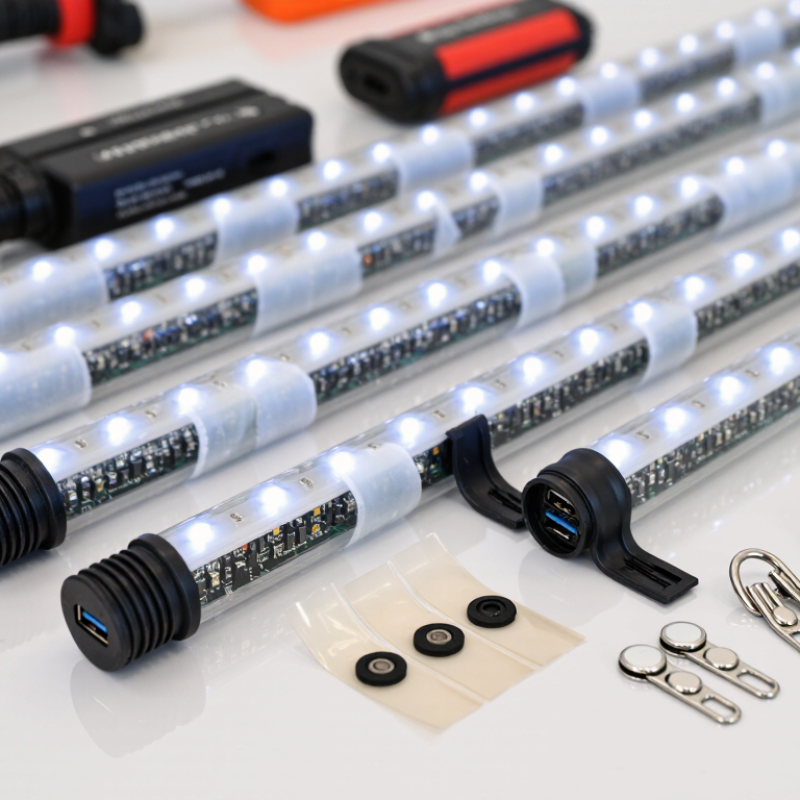
When buying portable light strips, define brightness by lumens per meter, not wattage alone. More watts do not always create more useful light. Check the product’s measured output and test it beside your intended surface. A reading area needs stronger, more even illumination than a decorative shelf.
Color temperature changes the entire mood. Warm white, around 2700–3000K, suits bedrooms and hospitality spaces. Neutral white, near 3500–4000K, works well for desks and kitchens. Cool white, around 5000–6500K, can feel sharp in small rooms.
I once chose a cool strip for a workbench and found the blue cast tiring after an hour. My mistake was trusting a product photo.
CRI shows how naturally the strip renders colors. Target CRI 80 or higher for general use, and consider 90 or above near clothing, food, artwork, or product samples.
Red objects often reveal weak color rendering. Ask for the CRI test method, not only a bold number on a sales page. Check whether the rating applies across the full color range. It may not.
Request a sample, inspect skin tones and printed colors, and compare the strip under daylight. Small differences become obvious. A reliable supplier should provide consistent specifications, voltage details, and testing records.
When buying a portable light strip, LED density is a practical starting point. A 60-LED-per-meter strip places diodes roughly 17 millimeters apart, while 120 LEDs per meter reduces the spacing to about 8 millimeters. The denser option usually creates smoother light through a shallow diffuser and fewer visible bright spots. It may also consume more power. Check watts per meter, not only the LED count.
Efficacy matters more than impressive brightness claims. The U.S. Department of Energy reported that commercial LED products commonly reached about 100–150 lumens per watt in recent SSL technology reviews. However, a flexible strip’s real output can fall after adding a diffuser, flexible circuit, connector, and portable battery losses. Ask whether the stated lm/W value refers to the bare LEDs or the complete strip assembly. That detail changes the comparison.
For example, a 5-meter strip with 120 LEDs per meter contains 600 LEDs, but quantity alone does not prove better performance. Compare delivered lumens, watts per meter, color temperature, and heat behavior at the intended operating voltage. The International Energy Agency’s 2024 lighting analysis continues to identify LED efficiency as a major energy-saving factor, yet efficiency is not everything for close-range task lighting. I would test a one-meter sample beside a white card before ordering bulk quantities. Small gaps may still appear. Lab figures can feel optimistic in a real tent, cabinet, or emergency kit.
| Tip | Typical LED Density | Typical Power | Typical Output | Estimated Efficiency | Recommended Evaluation |
|---|---|---|---|---|---|
| 1. Match density to brightness needs | 30 LEDs/m | 4.8 W/m | 350 lm/m | 73 lm/W | Suitable for accent lighting where moderate brightness and low energy use are priorities. |
| 2. Choose a balanced general-purpose option | 60 LEDs/m | 9.6 W/m | 800 lm/m | 83 lm/W | A practical choice for shelves, cabinets, coves, and other general indoor applications. |
| 3. Consider high-density strips for smoother light | 120 LEDs/m | 14.4 W/m | 1,200 lm/m | 83 lm/W | Higher density reduces visible bright and dark spots, especially with shallow aluminum profiles. |
| 4. Compare output, not LED count alone | 60 LEDs/m | 14.4 W/m | 1,350 lm/m | 94 lm/W | A lower-density strip can outperform a higher-density strip when its LED package and thermal design are better. |
| 5. Check efficiency at the stated color temperature | 120 LEDs/m | 19.2 W/m | 1,650 lm/m | 86 lm/W | Request test data for the exact CCT; warm-white versions commonly produce less lumens than cool-white versions. |
| 6. Allow for thermal management | 60 LEDs/m | 19.2 W/m | 1,700 lm/m | 89 lm/W | High-wattage strips should normally be installed on an aluminum channel to limit heat-related lumen depreciation. |
| 7. Verify voltage drop on long runs | 60 LEDs/m | 9.6 W/m | 780 lm/m | 81 lm/W | For longer installations, compare voltage options, copper width, feed points, and brightness uniformity at the far end. |
| 8. Use high-density COB construction when dot-free light is needed | 480 light points/m | 10 W/m | 700 lm/m | 70 lm/W | Continuous-looking illumination can be valuable even when lm/W is lower than conventional SMD strips. |
| 9. Balance color quality with efficiency | 120 LEDs/m | 12 W/m | 850 lm/m | 71 lm/W | High color-rendering products may deliver fewer lumens per watt, so compare CRI, R9, and visual quality together. |
| 10. Confirm the complete system rating | 60 LEDs/m | 12 W/m | 1,000 lm/m | 83 lm/W | Check strip, power supply, controller, enclosure, ambient temperature, and IP rating as one matched system. |
10 Portable Light Strip Buying Tips for Global Buyers
When choosing a portable light strip, calculate power before checking appearance. A 5V strip rated at 2 watts draws about 0.4 amps. Use this formula: current equals watts divided by volts. Check the label, not only the seller’s image. Some ratings describe maximum brightness, while normal use may be lower.
Tip:
Measure your real setup. A 1-meter strip using 2 watts for four hours needs 8 watt-hours. Add conversion losses from the battery and cable. With 85% efficiency, choose at least 9.4 watt-hours. A small safety margin is sensible. Temperature, brightness settings, and aging can increase demand. Do not treat mAh as watt-hours without conversion. For example, a 10,000mAh battery rated internally at 3.7V stores roughly 37Wh, before output losses.
Tip:
Confirm the power source can supply steady 5V. A strip needing 0.4 amps may flicker with a weak port. Test it while moving the strip, because a thin cable can cause voltage drops. I once trusted a calculated runtime and overlooked a bright animation mode. The battery lasted far less than expected. That mistake still matters. Recheck the wattage at your preferred setting, and allow extra capacity for cold conditions or repeated charging. A portable design is useful only when its power figures match real travel conditions.
When buying portable light strips globally, check the IEC 60529 IP rating before comparing brightness or battery life. The rating has two digits. The first measures protection against solids and dust. The second measures water resistance. IP20 offers basic protection against fingers, but no water protection. It suits dry indoor spaces only.
IP44 handles splashing water from several directions, while IP65 is dust-tight and resists water jets. For outdoor paths, IP65 can be practical, but exposed connectors still need protection. IP67 allows temporary immersion, usually up to one meter under specified test conditions. IP68 supports deeper or longer immersion, but the exact limits must come from the supplier. “Waterproof” alone is too vague.
I once checked the strip body and ignored the connector. That was a mistake. The connector failed first after rain. Ask for an IEC 60529 test report covering the complete assembly, not only the flexible strip. Confirm cable glands, switches, charging ports, and end caps carry the same rating. Look for test conditions, sample details, and laboratory information. A rating can change after cutting or adding an unsealed connector. It may also weaken through bending, heat, and repeated installation. Keep that in mind. For humid locations, inspect seals regularly and avoid sharp folds. Test the product before large-scale purchasing. Small details often decide whether a light strip survives one season or several years.
Portable light strips need more than bright LEDs and attractive packaging. Check the destination market before ordering. CE marking supports applicable European Union requirements, while FCC rules address radio-frequency emissions in the United States. RoHS restricts ten hazardous substances in electrical and electronic equipment. The European Commission’s Safety Gate 2023 report recorded 3,412 alerts, showing why compliance evidence deserves careful attention.
Ask for a Declaration of Conformity, test reports, and clear product identification. Match the strip’s rated voltage with the power adapter. A 12-volt strip connected to a 24-volt supply can fail quickly and create excessive heat. Inspect plug type, insulation, polarity, and adapter markings. Do not rely only on a printed CE symbol. It can be copied. The EU’s 2023 Safety Gate report also identified electrical appliances among products requiring corrective action, reinforcing the value of traceable documentation.
Controls require another practical check. Confirm whether the controller uses infrared, radio, Bluetooth, or a proprietary protocol. Test range, dimming stability, timer memory, and mobile compatibility in the target environment. Warranty language should state coverage duration, excluded installation errors, replacement procedures, and support response times. The International Energy Agency’s 2024 report on energy efficiency emphasizes the importance of efficient, well-managed electrical use, but efficiency claims still need measured evidence. I have seen buyers accept vague “low power” promises. That is a weak decision. Request wattage per meter, operating temperature limits, and sample test results before approving a large shipment.
„Thanks to the LUVIR technology, the solder resist process could be switched directly from the previously used mask exposure to direct exposure. As an outstanding digital solution on the market, this technology has been able to demonstrate fast process times and superior quality on our certified conventional ink in production. This allowed us to fully digitize the solder mask process at low cost – without process or ink adjustments. An excellent benefit to our production in Rot am See.“
Ralf Göhringer (Head of Production WE Rot am See)
I would definitely recommend the Limata machine and team for a future company purchase
Michael Greenaway
Compunetics Inc.
“The Limata ldi has been amazing!! Best thing we did was buy this machine”
Richard Brady
GM
Circuitlabs
“Since 2019, we have been running the Limata X1000 LDI system (including LUVIR for solder mask imaging) in daily production as an addition to our current process with film. The machine was capable of properly exposing Taiyo PSR-4000 BN (DI) solder mask types on normal to high-copper boards using a new and unique direct imaging process. The machine operating interface is very user friendly which allowed for a quick technical training curve. The pre-registration processing reduced several seconds of production time at every print. Limata support and service staff is incomparable. They supported our team every step of the way at basically any time of the day or night, with literally, an immediate response time, customizing the software interface to best fit our Operations and needs.
We have exposed more than 8,000 prints since end of October, on various solder mask colors and some resist film panels. Limata, has proven to be very capable and innovative. They are a strong contender in the industry.
We have very much enjoyed this project, and working with the team!
Thank you Limata for the continued support and being a part of our growth.”
Bill Sezate
Vice President, GM
Summit Interconnect
As a replacement to our current contact exposure process with film, the LIMATA X2000 system including LUVIR-Technology was capable of properly exposing non-LDI solder mask types using a direct imaging process. The machine offers cutting edge software with a very intuitive operating interface which allowed for quick technician training curve. The dual drawer system combined with pre-registration processing reduced several seconds of production time at every machine cycle. Limata support and service staff is world class. They added software patches to keep production running at shortest possible response times, customized the software interface to best fit our in-house Operations system, and even wrote a step-by-step machine processing manual. As a result of the project, we have exposed more than 16,000 times on various product types and solder mask brands/colors. Limata, in a very short timeframe as a company, has definitely shown they are truly innovative and will be challenging the industry of direct imaging for the top spot.
Kevin Beattie
Process Engineer
TTM Technologies
Forest Grove Division
