The Portable Metal Analyzer is an essential tool in various industries. It enables quick and accurate analysis of metal compositions on-site. This device benefits engineers, manufacturers, and quality control specialists alike.
Portable Metal Analyzers are designed for ease of use. They provide real-time results, allowing for immediate decision-making. These analyzers utilize advanced technology, such as X-ray fluorescence, to deliver reliable data. Users can conduct tests without needing a laboratory setting.
Despite their advantages, Portable Metal Analyzers have limitations. Factors like surface contamination can affect accuracy. As users become more familiar with this technology, understanding these limitations is crucial. A deeper grasp of the device enhances its effectiveness in practical applications.
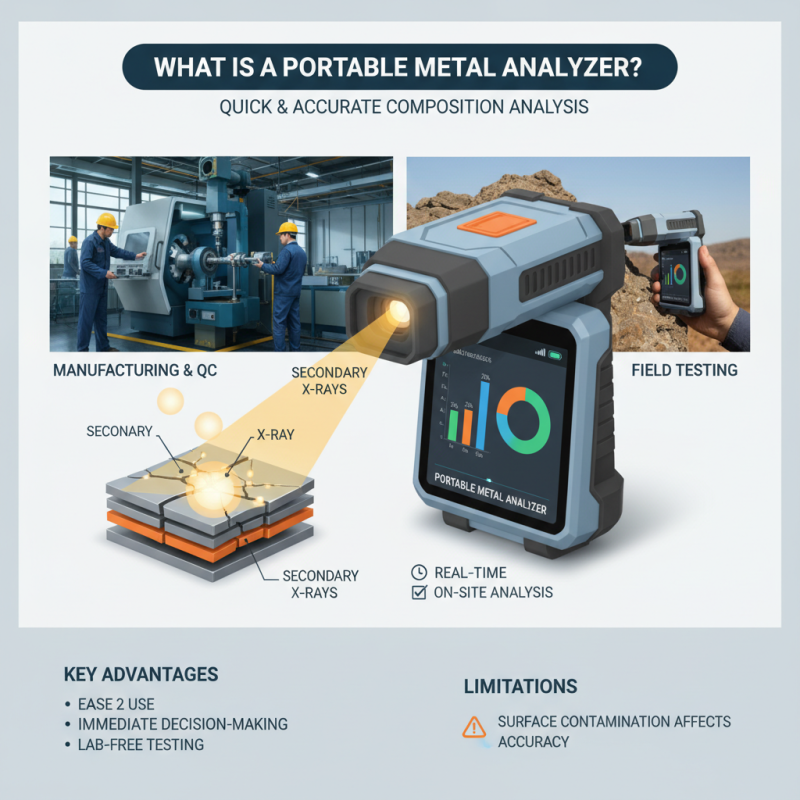
A portable metal analyzer is an essential tool for numerous industries. It allows for quick and accurate analysis of metals on-site. These devices typically use X-ray fluorescence (XRF) technology. This method helps detect elemental composition without damaging the sample. According to research from the Metal Testing Institute, portable analyzers have a reliability rate of over 95%. They enhance productivity by reducing the need for lab testing.
The versatility of portable metal analyzers makes them valuable in recycling, manufacturing, and construction. These machines can identify alloys and contaminants in metal samples. They provide instant feedback, which is critical for quality control. The data collected can help prevent costly errors. However, operators must be trained to interpret results accurately.
**Tip:** Always calibrate your analyzer before use for optimal accuracy. Regular maintenance is crucial. Users should also be aware of the device's detection limits. While these tools are highly effective, they may not catch every impurity. This is where a combination of techniques could improve reliability.
Portable metal analyzers are undoubtedly convenient. Yet, their effectiveness depends on the user's skill and understanding. Continuous learning about new features and functionalities can lead to better results.
Portable metal analyzers are essential for various industries, providing quick and accurate results in metal composition analysis. These devices have key components that contribute to their efficiency and effectiveness. One major component is the excitation source. It generates energy that interacts with the sample. This interaction helps determine the elemental composition of the metal. Common sources include X-ray tubes and plasma sources.
Another significant part is the detector. It captures the emitted signals from the excited sample. These signals vary depending on the elements present. Typically, energy-dispersive detectors and CCDs are utilized for their sensitivity. The software processes the data collected, converting it into readable information. This seamless integration is crucial for accurate results in real-time applications.
Portability is a game changer. Many analyzers are compact, enabling users to conduct on-site testing. This accessibility can improve decision-making but may introduce issues like environmental interference. Users must understand these limitations. Mismatched readings can arise from various factors, including surface contamination. Regular calibration and awareness of these pitfalls enhance reliability in field conditions.
| Component | Description | Function |
|---|---|---|
| X-Ray Tube | Generates X-rays for excitation of the sample | Initiates the emission of secondary radiation from metals |
| Detector | Captures emitted radiation from the metal sample | Measures intensity, which helps determine the composition |
| Control Unit | Contains the software and hardware for analysis | Processes data and displays results to the user |
| Sample Holder | Secures the metal sample during analysis | Ensures accurate readings by stabilizing the sample |
| Power Supply | Provides energy to the X-ray tube and electronics | Ensures proper functioning of the analyzer |
| Calibration Standards | Reference materials for ensuring measurement accuracy | Used to calibrate the analyzer for precise results |
Portable metal analyzers have become essential tools in metal testing across various industries. These devices allow for quick and accurate analysis of metal materials on-site. They utilize advanced technologies like X-ray fluorescence (XRF) and optical emission spectrometry (OES) to deliver reliable results, often within seconds. Reports indicate that the portable metal analyzer market is expected to grow from $780 million in 2022 to over $1 billion by 2026, highlighting the increasing demand for on-the-go analysis.
The functionality of portable metal analyzers revolves around the interaction between metal samples and emitted radiation. XRF analyzers, for instance, expose the metal to X-rays, causing the atoms to emit secondary X-rays, which are then analyzed to determine the elemental composition. OES, on the other hand, vaporizes the metal sample, generating a plasma that emits light at specific wavelengths. By measuring these wavelengths, operators can identify the metal's composition accurately. However, the effectiveness of these methods can vary based on the sample's surface and condition, indicating that proper calibration and maintenance are crucial.
It's important to note that while portable metal analyzers provide quick results, they may not always match the accuracy of laboratory testing. Disturbances like environmental conditions or surface contamination can affect outcomes. Continuous upgrades in technology aim to enhance accuracy and reduce such discrepancies. As professionals seek greater efficiency, the choice of technology must balance convenience with the need for precise data.
Portable metal analyzers play a crucial role in various industries. They are essential tools for quality control, material identification, and compliance assessments. In manufacturing, these devices help ensure that the materials used meet specified standards. This reduces the risk of defects that could lead to costly recalls or safety issues.
In the recycling industry, portable metal analyzers aid in accurately sorting metals. They provide immediate analysis, allowing recyclers to quickly identify metal types. This efficiency can lead to better pricing and processing strategies. In construction, these analyzers are invaluable for verifying the composition of materials. Workers can check the integrity of steel beams and structural components on-site, promoting safety and reliability.
Despite their effectiveness, challenges remain. User error can occur, affecting the accuracy of readings. Training for operators is often necessary to minimize mistakes. Additionally, environmental factors can interfere with performance. Ensuring that these devices are maintained and calibrated is vital for optimal operation. Each industry must continually strive for improvement to fully utilize these powerful tools.
Portable metal analyzers offer significant advantages over traditional analysis methods. These devices provide quick and accurate results. They can analyze materials on-site, eliminating the need for lengthy laboratory processes. This is particularly beneficial for manufacturers and recyclers who require immediate feedback on metal composition.
One key benefit is portability. Users can easily carry these analyzers to various locations, enhancing flexibility. This reduces downtime and improves efficiency in production and recycling activities. In traditional setups, samples often sit idle waiting for analysis. This can lead to production delays, which impact output.
When using these devices, ensure proper calibration. Regular checks maintain accuracy. Also, consider varying environmental conditions, as they can influence results. Always clean the device after use to maintain its functionality.
Another tip is to train staff thoroughly. Familiarity with the equipment maximizes its potential. Users should understand operational limits and possible inaccuracies. Awareness of these factors enhances the effectiveness of portable metal analyzers.
This chart demonstrates the average time taken for metal analysis using portable metal analyzers compared to traditional laboratory methods. Portable analyzers significantly reduce analysis time, making them more efficient for on-site applications.
„Thanks to the LUVIR technology, the solder resist process could be switched directly from the previously used mask exposure to direct exposure. As an outstanding digital solution on the market, this technology has been able to demonstrate fast process times and superior quality on our certified conventional ink in production. This allowed us to fully digitize the solder mask process at low cost – without process or ink adjustments. An excellent benefit to our production in Rot am See.“
Ralf Göhringer (Head of Production WE Rot am See)
I would definitely recommend the Limata machine and team for a future company purchase
Michael Greenaway
Compunetics Inc.
“The Limata ldi has been amazing!! Best thing we did was buy this machine”
Richard Brady
GM
Circuitlabs
“Since 2019, we have been running the Limata X1000 LDI system (including LUVIR for solder mask imaging) in daily production as an addition to our current process with film. The machine was capable of properly exposing Taiyo PSR-4000 BN (DI) solder mask types on normal to high-copper boards using a new and unique direct imaging process. The machine operating interface is very user friendly which allowed for a quick technical training curve. The pre-registration processing reduced several seconds of production time at every print. Limata support and service staff is incomparable. They supported our team every step of the way at basically any time of the day or night, with literally, an immediate response time, customizing the software interface to best fit our Operations and needs.
We have exposed more than 8,000 prints since end of October, on various solder mask colors and some resist film panels. Limata, has proven to be very capable and innovative. They are a strong contender in the industry.
We have very much enjoyed this project, and working with the team!
Thank you Limata for the continued support and being a part of our growth.”
Bill Sezate
Vice President, GM
Summit Interconnect
As a replacement to our current contact exposure process with film, the LIMATA X2000 system including LUVIR-Technology was capable of properly exposing non-LDI solder mask types using a direct imaging process. The machine offers cutting edge software with a very intuitive operating interface which allowed for quick technician training curve. The dual drawer system combined with pre-registration processing reduced several seconds of production time at every machine cycle. Limata support and service staff is world class. They added software patches to keep production running at shortest possible response times, customized the software interface to best fit our in-house Operations system, and even wrote a step-by-step machine processing manual. As a result of the project, we have exposed more than 16,000 times on various product types and solder mask brands/colors. Limata, in a very short timeframe as a company, has definitely shown they are truly innovative and will be challenging the industry of direct imaging for the top spot.
Kevin Beattie
Process Engineer
TTM Technologies
Forest Grove Division
