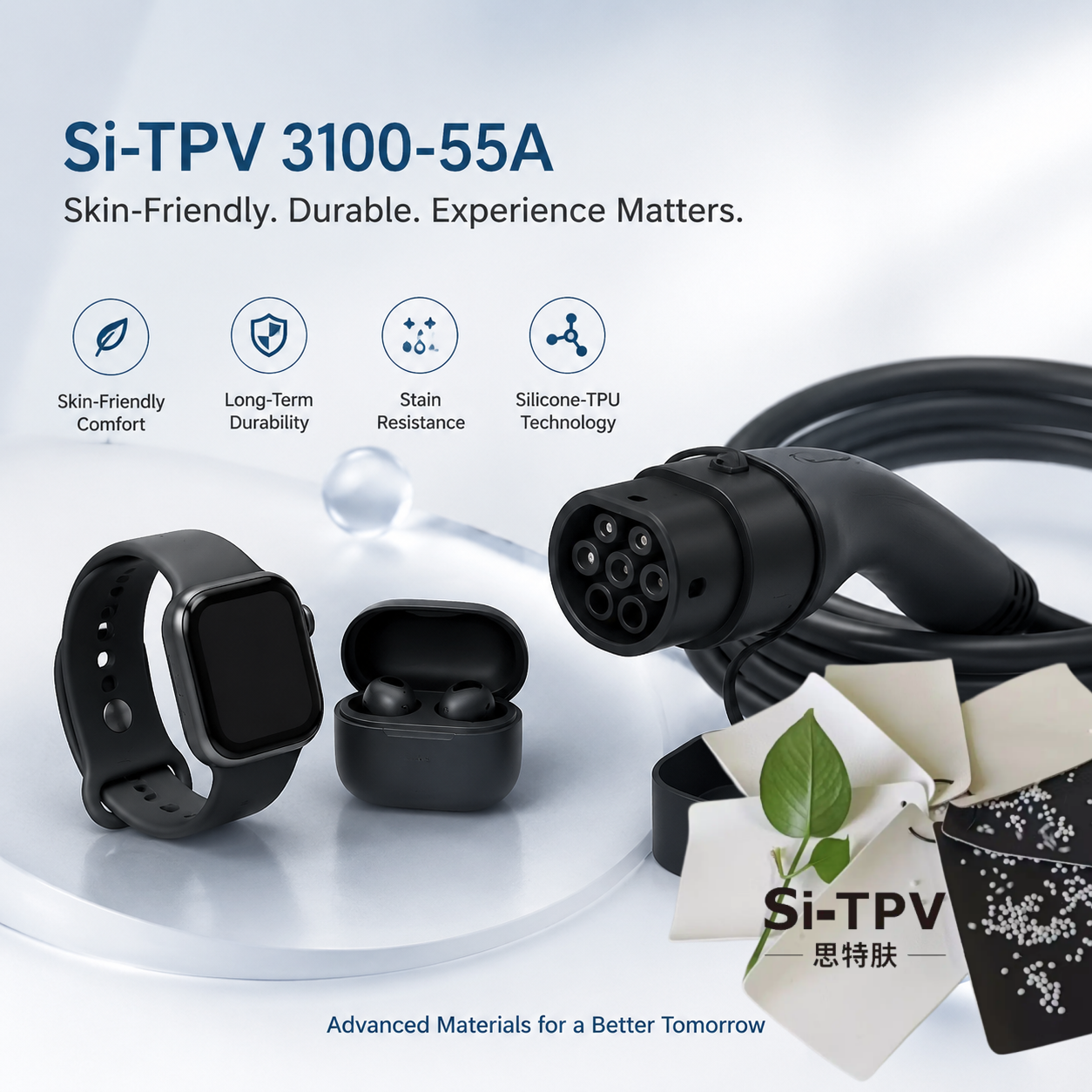
Recent industry developments in 2026 highlight a clear transition in material requirements:
Smart wearable devices are increasingly designed for all-day skin contact comfort
l EV charging systems demand high abrasion resistance and long-term weather stability
l Consumer electronics emphasize premium tactile aesthetics and surface durability
While traditional TPU materials provide strong mechanical properties and processability, they often face challenges such as surface stickiness, inconsistent tactile performance, and reduced stain resistance over time, especially under long-term use conditions.
This gap is driving demand for advanced modification technologies that can enhance both performance and user experience.
Si-TPV 3100-55A is built on a dynamic vulcanization system, where fully crosslinked silicone rubber particles are uniformly dispersed within a TPU matrix. The silicone domains are typically in the micron scale (approximately 2–3 μm), forming a stable two-phase structure that combines the strengths of both materials.
Key structural advantages include:
TPU continuous phase providing mechanical strength and processability
Silicone rubber dispersed phase delivering soft-touch and low surface energy properties
Non-migrating architecture ensuring long-term stability
Compatibility with standard TPU processing methods (injection molding and extrusion)
This structure enables manufacturers to achieve silicone-like surface feel without coatings or secondary finishing processes.
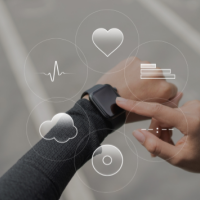
Si-TPV 3100-55A delivers a silky, skin-like tactile experience, making it suitable for applications involving prolonged skin contact such as wearable devices and handheld electronics.
Unlike conventional soft-touch materials, the system is designed to maintain consistent tactile performance over time, reducing issues such as surface degradation or stickiness.
The material demonstrates improved resistance to sweat, sebum, and environmental contaminants, helping maintain a clean and premium appearance in daily-use scenarios.
Si-TPV technology enables a balance between softness and mechanical durability, ensuring resistance to abrasion, deformation, and repeated flexing.
Beyond wearables and EVs, the material is increasingly relevant for soft-touch components in consumer electronics, tool grips, and automotive interior components where tactile experience plays a key role in product differentiation.
Wearable Electronics
In smartwatches, fitness bands, and other wearable devices, Si-TPV 3100-55A is used to improve comfort, hygiene, and long-term wearability, supporting the industry’s shift toward 24/7 wearable design requirements.
With the rapid expansion of EV infrastructure, charging cables are exposed to frequent bending, dragging, and outdoor environmental stress. Si-TPV-modified TPU materials help improve abrasion resistance while enhancing grip comfort and surface longevity.
Beyond wearables and EVs, the material is increasingly relevant for soft-touch components in consumer electronics, tool grips, and automotive interior components where tactile experience plays a key role in product differentiation.
Wearable Electronics
In smartwatches, fitness bands, and other wearable devices, Si-TPV 3100-55A is used to improve comfort, hygiene, and long-term wearability, supporting the industry’s shift toward 24/7 wearable design requirements.
The growing adoption of Si-TPV 3100-55A reflects a broader materials science trend:
Material innovation is no longer defined solely by mechanical strength, but by the ability to deliver a consistent user experience throughout the product lifecycle.
This shift is particularly evident in sectors where users directly interact with surfaces for extended periods, making tactile comfort and surface durability critical competitive factors.
Si-TPV 3100-55A represents a new generation of silicone-TPU hybrid elastomers designed to bridge the gap between skin-friendly comfort and industrial durability. As wearable technology and electric mobility continue to expand, demand for materials that combine long-term tactile stability with high-performance processing capability is expected to grow significantly.
With its dynamic silicone dispersion architecture and TPU compatibility, Si-TPV 3100-55A is positioned as a key enabling material in the transition toward experience-driven material design.
SILIKE Silicone Materials Team
Website: https://www.si-tpv.com/
Email: sale@reytechmachine.com
Inquiry: Available via official website contact form
„Thanks to the LUVIR technology, the solder resist process could be switched directly from the previously used mask exposure to direct exposure. As an outstanding digital solution on the market, this technology has been able to demonstrate fast process times and superior quality on our certified conventional ink in production. This allowed us to fully digitize the solder mask process at low cost – without process or ink adjustments. An excellent benefit to our production in Rot am See.“
Ralf Göhringer (Head of Production WE Rot am See)
I would definitely recommend the Limata machine and team for a future company purchase
Michael Greenaway
Compunetics Inc.
“The Limata ldi has been amazing!! Best thing we did was buy this machine”
Richard Brady
GM
Circuitlabs
“Since 2019, we have been running the Limata X1000 LDI system (including LUVIR for solder mask imaging) in daily production as an addition to our current process with film. The machine was capable of properly exposing Taiyo PSR-4000 BN (DI) solder mask types on normal to high-copper boards using a new and unique direct imaging process. The machine operating interface is very user friendly which allowed for a quick technical training curve. The pre-registration processing reduced several seconds of production time at every print. Limata support and service staff is incomparable. They supported our team every step of the way at basically any time of the day or night, with literally, an immediate response time, customizing the software interface to best fit our Operations and needs.
We have exposed more than 8,000 prints since end of October, on various solder mask colors and some resist film panels. Limata, has proven to be very capable and innovative. They are a strong contender in the industry.
We have very much enjoyed this project, and working with the team!
Thank you Limata for the continued support and being a part of our growth.”
Bill Sezate
Vice President, GM
Summit Interconnect
As a replacement to our current contact exposure process with film, the LIMATA X2000 system including LUVIR-Technology was capable of properly exposing non-LDI solder mask types using a direct imaging process. The machine offers cutting edge software with a very intuitive operating interface which allowed for quick technician training curve. The dual drawer system combined with pre-registration processing reduced several seconds of production time at every machine cycle. Limata support and service staff is world class. They added software patches to keep production running at shortest possible response times, customized the software interface to best fit our in-house Operations system, and even wrote a step-by-step machine processing manual. As a result of the project, we have exposed more than 16,000 times on various product types and solder mask brands/colors. Limata, in a very short timeframe as a company, has definitely shown they are truly innovative and will be challenging the industry of direct imaging for the top spot.
Kevin Beattie
Process Engineer
TTM Technologies
Forest Grove Division
