Stair-Climbing Robots Tracks represent a significant advancement in robotic technology. These specialized tracks empower robots to navigate challenging environments, especially where stairs or uneven terrain pose obstacles. The design focuses on optimizing traction and stability, allowing robots to perform tasks that standard wheeled models cannot.
The benefits of these tracks are vast. They enhance mobility and efficiency in various applications, from helping the elderly to delivering goods in multi-level buildings. The unique configuration supports weight distribution, ensuring safety and reliability during operation. However, challenges remain in perfecting their design and adaptability for diverse settings.
Emerging technologies promise improvements. Designers must constantly refine their approach to create more versatile solutions. Learning from past mistakes and inconsistencies can lead to innovations that better serve users' needs and expectations. Embracing a cycle of feedback and iteration will ultimately enhance the effectiveness of Stair-Climbing Robots Tracks.
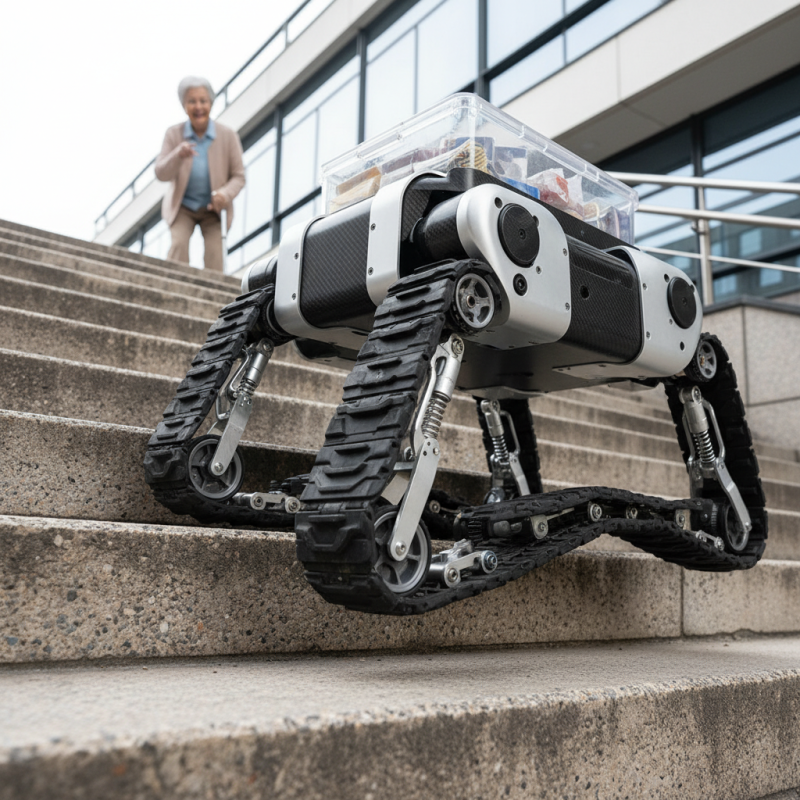
Stair climbing robot tracks are specialized devices designed to help robots navigate stairs and uneven surfaces. Unlike traditional wheels, these tracks provide better traction and stability. The unique design adapts to different stair types, making it effective in various environments. They can handle steep stairs, curved steps, and even slippery surfaces. This versatility allows robots to assist in settings like hospitals, homes, and warehouses efficiently.
The mechanics behind stair climbing tracks involve a combination of tracks and wheels. These tracks grip the surface while allowing the robot to ascend or descend smoothly. They distribute weight evenly, preventing the robot from tipping over. However, the design can have limitations. For instance, some tracks may struggle with wider stairs or certain textures. This can lead to performance issues, affecting the robot's overall efficiency.
Incorporating these tracks requires careful consideration of the robot's weight and motor strength. A mismatch can lead to inefficiency or even malfunction. Additionally, continual advancements in technology are needed to address these challenges. As robots become more integral to daily tasks, refining their stair-climbing capabilities will be crucial.
| Track Type | Terrain Compatibility | Weight Capacity (kg) | Main Benefits |
|---|---|---|---|
| Rubber Tracks | Indoor and Outdoor | 150 | Durable, good grip |
| Steel Tracks | Outdoor | 200 | High strength, stability |
| Composite Tracks | Indoor | 100 | Lightweight, flexible |
| Tracked Wheel System | Mixed | 120 | Versatile, good traction |
Stair climbing robots are revolutionizing how we navigate multi-level environments. They utilize specialized tracks designed to tackle stairs efficiently. These tracks come in various types, each offering distinct advantages for different applications.
One common type is the rubber track. This design provides excellent grip on stairs, reducing the risk of slipping. The flexibility of rubber allows the robot to adapt to irregular stair surfaces. Another option is the caterpillar-style track. It ensures stability by distributing the robot's weight evenly. This design is beneficial on steep or uneven stairs.
For indoor use, some robots employ smaller, articulated tracks. These allow for tight maneuverability in confined spaces. However, they may struggle with larger stairs or obstacles. Each design has its pros and cons. Understanding these can help choose the right system for specific needs. The technology is continually evolving, presenting both challenges and opportunities.
Stair climbing robots are innovative machines designed to tackle stairs effortlessly. They feature specialized tracks that provide stability and mobility on various surfaces. These tracks are often made of durable materials that grip steps securely, allowing the robot to ascend and descend safely.
Understanding how these tracks function is crucial. They utilize a combination of wheels and tracks to distribute weight evenly. This design helps prevent tipping and enhances balance. The robots often integrate sensors to detect step heights and angles, adjusting their movement accordingly. The technology mimics how humans navigate stairs, ensuring a smooth journey.
Tips: When choosing a stair climbing robot, consider its weight capacity and track material. Durability is vital for long-term use. Regular maintenance can prevent mechanical failures, keeping it operational. Test the robot on different stair types to understand its capabilities better.
Stair climbing robot tracks represent a significant advancement in mobility solutions. They are designed to navigate stairs and uneven surfaces with ease. This innovative technology supports various industries, including healthcare and logistics. According to a report from the Mobility Robotics Institute, over 30% of injuries in warehouses stem from manual handling. Using stair climbing robots can decrease these risks significantly.
One key benefit of these tracks is their efficiency. Many models can ascend stairs at an average speed of 0.7 meters per second. This speed is faster than human assistants in similar tasks. Moreover, robots can carry loads exceeding 150 kilograms, reducing physical strain on workers. This reduces fatigue and increases productivity. A study by Robotics Age showed that companies using stair climbing robots reported a 25% increase in task completion rates.
Despite their advantages, there are challenges. Users should consider the initial investment costs. The complexity of these devices requires routine maintenance and training. Some robots may struggle in very narrow spaces, leading to operational delays. Therefore, careful evaluation of needs is essential before deployment. As technology evolves, enhancements are expected to address these limitations.
Stair climbing robots are gaining traction across various industries. Their ability to navigate vertical surfaces makes them highly valuable. In healthcare, for example, hospitals use these robots to transport supplies efficiently. According to a 2022 market report, the demand for medical logistics robots is expected to grow by 34% through 2027.
In construction, stair climbing robots assist in moving heavy materials. They reduce the risk of injury significantly. Industry studies show that over 30% of workplace injuries occur due to lifting and carrying loads. The efficiency gained by using these robots can also help speed up project timelines.
Logistics companies are exploring these robots as well. They enhance delivery capabilities in multi-floor buildings. A report from the International Robotic Logistics Association indicates that integrating these robots can boost operational efficiency by 25% in urban environments. However, challenges remain, such as adapting to different stair types. It’s essential to address these limitations for broader applications in diverse contexts.
This chart illustrates the distribution of applications of stair climbing robots across different industries, highlighting their utility in enhancing efficiency and safety.
„Thanks to the LUVIR technology, the solder resist process could be switched directly from the previously used mask exposure to direct exposure. As an outstanding digital solution on the market, this technology has been able to demonstrate fast process times and superior quality on our certified conventional ink in production. This allowed us to fully digitize the solder mask process at low cost – without process or ink adjustments. An excellent benefit to our production in Rot am See.“
Ralf Göhringer (Head of Production WE Rot am See)
I would definitely recommend the Limata machine and team for a future company purchase
Michael Greenaway
Compunetics Inc.
“The Limata ldi has been amazing!! Best thing we did was buy this machine”
Richard Brady
GM
Circuitlabs
“Since 2019, we have been running the Limata X1000 LDI system (including LUVIR for solder mask imaging) in daily production as an addition to our current process with film. The machine was capable of properly exposing Taiyo PSR-4000 BN (DI) solder mask types on normal to high-copper boards using a new and unique direct imaging process. The machine operating interface is very user friendly which allowed for a quick technical training curve. The pre-registration processing reduced several seconds of production time at every print. Limata support and service staff is incomparable. They supported our team every step of the way at basically any time of the day or night, with literally, an immediate response time, customizing the software interface to best fit our Operations and needs.
We have exposed more than 8,000 prints since end of October, on various solder mask colors and some resist film panels. Limata, has proven to be very capable and innovative. They are a strong contender in the industry.
We have very much enjoyed this project, and working with the team!
Thank you Limata for the continued support and being a part of our growth.”
Bill Sezate
Vice President, GM
Summit Interconnect
As a replacement to our current contact exposure process with film, the LIMATA X2000 system including LUVIR-Technology was capable of properly exposing non-LDI solder mask types using a direct imaging process. The machine offers cutting edge software with a very intuitive operating interface which allowed for quick technician training curve. The dual drawer system combined with pre-registration processing reduced several seconds of production time at every machine cycle. Limata support and service staff is world class. They added software patches to keep production running at shortest possible response times, customized the software interface to best fit our in-house Operations system, and even wrote a step-by-step machine processing manual. As a result of the project, we have exposed more than 16,000 times on various product types and solder mask brands/colors. Limata, in a very short timeframe as a company, has definitely shown they are truly innovative and will be challenging the industry of direct imaging for the top spot.
Kevin Beattie
Process Engineer
TTM Technologies
Forest Grove Division
