steel wire mesh fencing has become a popular choice for various applications in recent years. According to industry reports, the global market for wire mesh fencing is projected to reach USD 5.9 billion by 2027, demonstrating significant growth. This increase can be attributed to its durability, ease of installation, and affordability. Steel wire mesh fencing offers a practical solution for security, agriculture, and residential use.
The design of steel wire mesh fencing allows for versatility, making it suitable for different environments. Its resistance to corrosion and harsh weather conditions ensures longevity. However, it's essential to consider installation factors. Incorrect installation may lead to structural weaknesses. Additionally, while it provides security, it’s not entirely foolproof. Some users report challenges with climbing, making it imperative to assess the fencing’s height and installation method.
Incorporating steel wire mesh fencing into projects can enhance safety and aesthetics. Many find it visually appealing due to its clean lines. Yet, costs can vary significantly based on material quality. Low-cost options may not stand the test of time. It's crucial for buyers to evaluate their needs carefully. Understanding the trade-offs will lead to more informed decisions regarding steel wire mesh fencing.
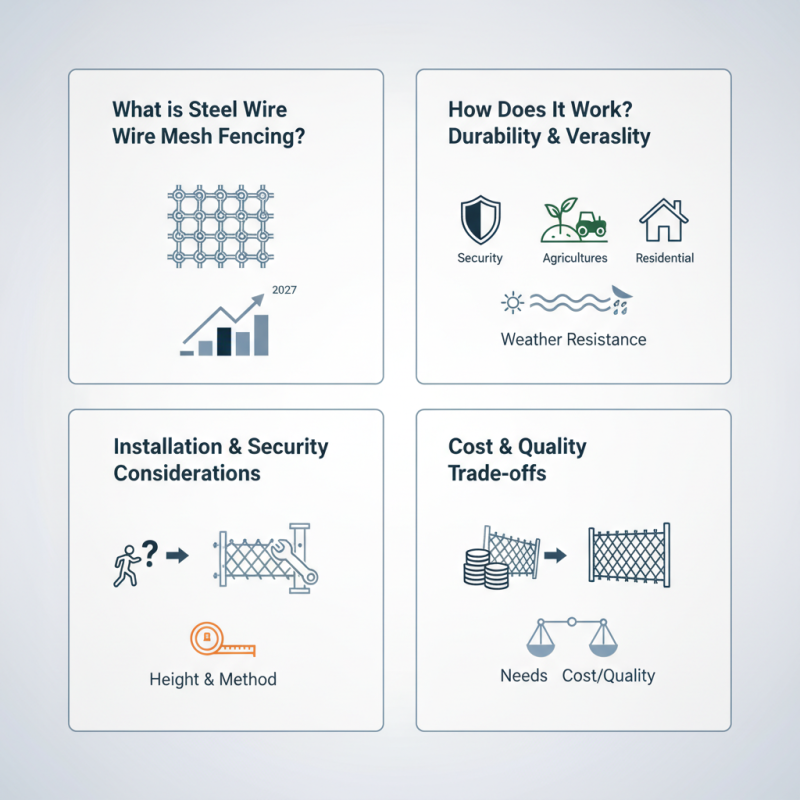
Steel wire mesh fencing is a versatile solution used in various applications. It consists of woven steel wires that create a strong and durable barrier. This type of fencing is common in residential, agricultural, and industrial settings. The mesh design allows visibility while maintaining security. It's often galvanized to resist rust and weathering.
The installation process can be straightforward. However, some may encounter challenges when aligning the fence posts or cutting the mesh to the desired length. It is essential to measure properly to avoid gaps or overlaps. Additionally, improper installation may lead to weak spots, compromising the entire structure.
People appreciate steel wire mesh fencing for its durability and cost-effectiveness. It requires minimal maintenance but can bend or warp over time. Some users find it necessary to reinforce the fence with additional supports. Others may wish to paint it for aesthetic purposes. Ultimately, understanding the strengths and weaknesses of this fencing is crucial for effective use.
Steel wire mesh fencing is a robust solution for a variety of applications. Its components each play a pivotal role in enhancing its functionality. The primary material used is steel, often galvanized for rust prevention. This treatment extends the lifespan of the mesh. According to a report by ResearchAndMarkets, the global fencing market is expected to reach $106.50 billion by 2025, highlighting the demand for reliable fencing options.
The mesh itself typically consists of interconnected wires, forming a grid pattern. These grids vary in size, providing flexibility in usage. Smaller openings help keep out small animals, while larger ones allow for visibility and ventilation. Posts make up another essential component. They support the mesh and provide stability. Made from heavy-duty materials, these posts must withstand harsh weather conditions.
Moreover, accessories like tension bands and wire clips are vital. They secure the mesh to the posts. Without these elements, the entire structure could fail under pressure. However, installation can be challenging. Misalignment or improper tensioning can compromise the fence. This illustrates the need for careful planning and execution. Regular maintenance is equally important; neglect could lead to premature wear. Ultimately, understanding these components helps in making informed decisions for effective fencing solutions.
| Component | Description | Material | Typical Use |
|---|---|---|---|
| Wire Mesh | A grid-like structure made of steel wires that provides strength and durability. | Galvanized Steel | Fencing, security barriers |
| Posts | Vertical supports that hold the wire mesh in place. | Steel or Concrete | Fencing integration, stability |
| Barbed Wire | Additional wire twisted with sharp edges for enhanced security. | Steel | Perimeters, security fences |
| Gates | Entry points that allow access while maintaining security. | Steel or Composite Materials | Entrances to properties |
| Fasteners | Hardware used to attach wire mesh to posts. | Steel | Installation and assembly |
Installing steel wire mesh fencing requires careful planning and execution. The first step involves measuring the designated area. Accurate measurements are crucial to avoid any misalignment. Mark the spots for the posts; this ensures a straight line for your fence. Use stakes and string to visualize the layout.
Next, you’ll need to dig post holes. These should be deep enough for stability. A depth of at least two feet is generally recommended. Place the posts in holes and check their alignment. You might find some posts lean slightly. This is where you should double-check your work. It’s better to fix it now than later.
Once the posts are secure, it’s time to attach the mesh. Unroll the wire mesh and align it with the posts. Use wire ties or clamps to fasten it into place. Some find it tricky to get the mesh tight. Striving for a uniform appearance takes practice. A few adjustments might be necessary to achieve the right tension. Regular checks during this process ensure the fence is not only functional but also visually appealing.
Steel wire mesh fencing is an effective solution for both security and property delineation. Its robust construction offers comprehensive protection while remaining visually appealing. One of the key benefits is its durability. Unlike traditional wooden fences, steel wire mesh resists weathering and corrosion. This makes it suitable for various environments, from urban settings to rural landscapes.
Another significant advantage is its versatility. Steel wire mesh fencing can be used in diverse applications, such as gardens, livestock enclosures, and industrial sites. It is easy to install and requires minimal maintenance. The open mesh design allows for air circulation, preventing the build-up of moisture and mildew. However, it is important to consider the potential for rust if not properly treated.
Additionally, steel wire mesh fencing enhances visibility. This can be particularly useful in residential areas, providing security without creating a sense of isolation. While it offers many benefits, some users report challenges with installation on uneven terrain. Proper planning and layout are essential to avoid future adjustments. Overall, the advantages of steel wire mesh fencing are evident, but careful consideration is vital to maximize its effectiveness.
Steel wire mesh fencing has a wide array of applications across various industries. In agriculture, it is often used to protect crops from animals. Farmers rely on this fencing to keep livestock contained while allowing proper airflow and sunlight. The visibility of the mesh lets farmers monitor their fields easily.
Construction sites also benefit from steel wire mesh fencing. It serves as a reliable barrier to keep unauthorized individuals out. This not only enhances security but also helps to prevent theft and vandalism. However, if not properly maintained, these fences can degrade, leading to potential breaches. Regular inspections are essential to ensure their integrity.
In the industrial sector, steel wire mesh is used for safety enclosures around machinery. It helps to prevent accidental contact with moving parts. While effective, it requires careful installation and ongoing checks. A poorly installed mesh can be a safety hazard. Overall, the versatility of steel wire mesh fencing makes it a valuable asset, but attention to detail is crucial for optimal performance.
„Thanks to the LUVIR technology, the solder resist process could be switched directly from the previously used mask exposure to direct exposure. As an outstanding digital solution on the market, this technology has been able to demonstrate fast process times and superior quality on our certified conventional ink in production. This allowed us to fully digitize the solder mask process at low cost – without process or ink adjustments. An excellent benefit to our production in Rot am See.“
Ralf Göhringer (Head of Production WE Rot am See)
I would definitely recommend the Limata machine and team for a future company purchase
Michael Greenaway
Compunetics Inc.
“The Limata ldi has been amazing!! Best thing we did was buy this machine”
Richard Brady
GM
Circuitlabs
“Since 2019, we have been running the Limata X1000 LDI system (including LUVIR for solder mask imaging) in daily production as an addition to our current process with film. The machine was capable of properly exposing Taiyo PSR-4000 BN (DI) solder mask types on normal to high-copper boards using a new and unique direct imaging process. The machine operating interface is very user friendly which allowed for a quick technical training curve. The pre-registration processing reduced several seconds of production time at every print. Limata support and service staff is incomparable. They supported our team every step of the way at basically any time of the day or night, with literally, an immediate response time, customizing the software interface to best fit our Operations and needs.
We have exposed more than 8,000 prints since end of October, on various solder mask colors and some resist film panels. Limata, has proven to be very capable and innovative. They are a strong contender in the industry.
We have very much enjoyed this project, and working with the team!
Thank you Limata for the continued support and being a part of our growth.”
Bill Sezate
Vice President, GM
Summit Interconnect
As a replacement to our current contact exposure process with film, the LIMATA X2000 system including LUVIR-Technology was capable of properly exposing non-LDI solder mask types using a direct imaging process. The machine offers cutting edge software with a very intuitive operating interface which allowed for quick technician training curve. The dual drawer system combined with pre-registration processing reduced several seconds of production time at every machine cycle. Limata support and service staff is world class. They added software patches to keep production running at shortest possible response times, customized the software interface to best fit our in-house Operations system, and even wrote a step-by-step machine processing manual. As a result of the project, we have exposed more than 16,000 times on various product types and solder mask brands/colors. Limata, in a very short timeframe as a company, has definitely shown they are truly innovative and will be challenging the industry of direct imaging for the top spot.
Kevin Beattie
Process Engineer
TTM Technologies
Forest Grove Division
