Choosing an Electric Hoist Winch requires more than comparing prices and lifting speeds. A reliable purchase begins with the real working conditions. Consider the load weight, lifting height, duty cycle, power supply, and available installation space. A unit lifting steel components in a workshop faces different demands from one used for occasional equipment maintenance.
The rated capacity matters, but it should not be treated as a target. Leave a sensible safety margin. Check the manufacturer’s technical data, operating instructions, brake system, control method, and emergency features. Look closely at the hook, wire rope, drum, limit switch, and overload protection. Small details can prevent expensive downtime. They also reveal product quality.
The seven tips in this guide focus on practical buying decisions. They cover selecting the correct capacity, checking motor performance, confirming compatibility, evaluating safety features, and understanding maintenance support. Noise, lifting speed, and portability also deserve attention. They can strongly affect daily use. A compact hoist may fit neatly into a crowded workshop, yet its duty rating might be too limited for repeated lifting. That is an easy mistake.
Reliable advice should come from manufacturer specifications, qualified suppliers, and recognized inspection practices. Still, no checklist replaces a site assessment. Conditions change. Dust, humidity, uneven power, or inexperienced operators can alter equipment performance. A cheaper model may appear attractive at first. Later, replacement parts and service delays can cost more. Careful comparison is worthwhile, even when the decision feels straightforward.
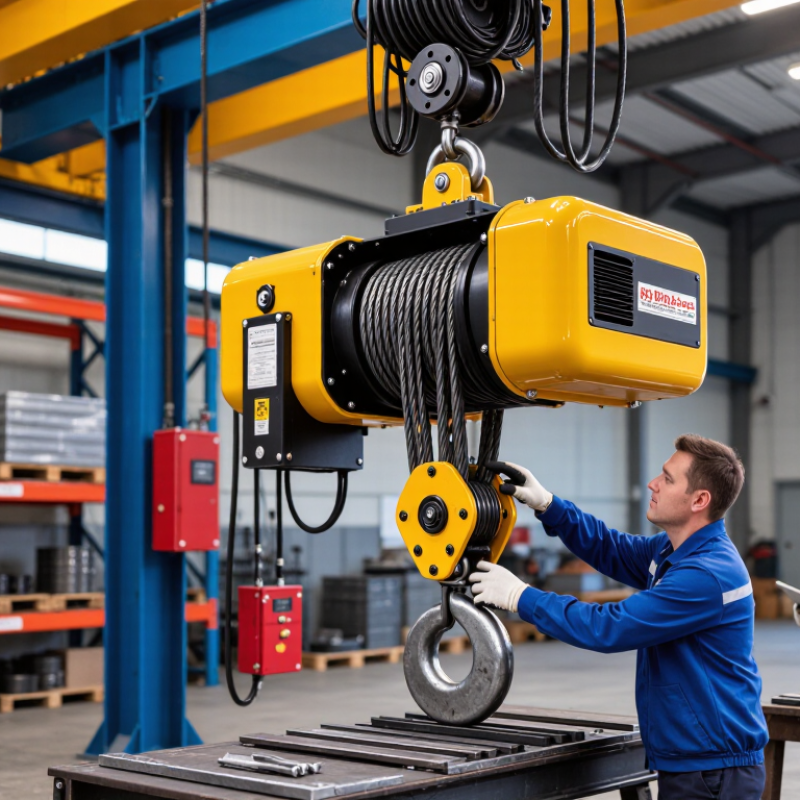
7 Tips for Buying an Electric Hoist Winch?
Define Your Lifting Needs and Operating Conditions
Start with the load, not the catalog photograph. Record the maximum weight, lifting height, lifting speed, and daily duty cycle. Include pallets, slings, hooks, and sudden load shifts. A 1,000-kilogram load may require a higher-capacity hoist when accessories add significant weight. Never select capacity from the average load. Peak conditions matter.
Check whether the equipment will lift, position, or pull materials. A hoist is designed for controlled vertical lifting. A winch may serve pulling tasks, but it is not automatically suitable for suspended loads. Confirm the working load limit, rated duty class, brake performance, and load-chain or wire-rope configuration. OSHA’s 2022 Severe Injury Reports recorded 20,460 hospitalizations and 849 amputations across U.S. workplaces. These figures are not hoist-specific, but they show why assumptions deserve scrutiny.
Operating conditions can change the selection completely. Measure ambient temperature, humidity, dust, corrosive exposure, available voltage, and floor clearance. Outdoor sites may need weather protection and improved controls. Frequent starts require a motor and brake rated for repeated cycles. HSE reported 138 worker fatalities in Great Britain during 2023/24, including deaths linked to workplace movement and falls. The setting matters.
Leave room for mistakes. A rough load estimate is better than guessing, but it should be reviewed by a qualified lifting professional. Consider inspection access, emergency stopping, operator visibility, and realistic maintenance intervals. If the hoist will work near people, redesign the task before increasing capacity.
Choosing an electric hoist winch starts with the load, not the price. Check the rated capacity on the data plate and technical manual. Never match the rating to the average load alone. Include the hook, sling, spreader, and material moving with it. A 500-kilogram load may become heavier during an awkward lift. I prefer a clear working margin, but I do not guess it. A qualified lifting professional should confirm the setup and duty requirements.
Lift height sounds simple until the cable or chain reaches its limit. Measure from the lowest load position to the highest required point. Allow room for the hook block, drum wraps, and safe clearance above the load. Short travel can force repeated repositioning. Excess travel may add cost and unnecessary weight. Check whether the listed height means usable height or total rope length. Manuals can be easy to misread.
Lifting speed affects control, productivity, and load swing. A fast winch saves time only when the operator can stop smoothly. For fragile or uneven loads, slower movement may be safer. Check speed under rated load, not only the unloaded figure. Review the duty cycle, brake response, controls, and power supply together. I once focused too much on speed and overlooked restart behavior. That mistake changed my selection process. Test the controls with a light, stable load before regular work, and record unusual noise, heat, or drift.
7 Tips for Buying an Electric Hoist Winch?
Compare Motor Power, Controls, and Safety Features
Start by matching motor power to the real load, not the heaviest load imaginable. A stronger motor may lift faster, but it can increase energy use and mechanical stress. Check the rated capacity, lifting speed, duty cycle, and available voltage. If operators lift near the limit every day, choose extra capacity. If use is occasional, oversized equipment may waste money. This distinction is easy to miss.
Compare control systems carefully. A wired pendant gives direct feedback and simple operation. A wireless controller improves visibility around large equipment, but it needs secure pairing, battery checks, and clear status signals. Look for emergency-stop access, intuitive buttons, and controls that prevent accidental activation. Test the response while wearing gloves. Small buttons can become a real problem.
Safety features deserve more attention than attractive specifications. Select a hoist with overload protection, an automatic brake, upper and lower limit switches, and a visible load indicator. Inspect the hook latch, chain or wire rope, mounting point, and electrical enclosure before installation. The enclosure should suit dust and moisture at the worksite. Ask for test records, maintenance instructions, and spare-part availability. I would not rely on a brochure alone; practical testing sometimes exposes weaknesses that specifications overlook. Consider noise, heat, inspection access, and operator training too. A perfect purchase on paper can still perform poorly when the controls feel confusing.
Compare motor power, controls, and safety features before selecting a hoist.
The reference values assume an 8 m/min lifting speed and approximately 75% overall mechanical efficiency. Actual motor ratings vary with duty cycle, lifting speed, reeving, and thermal design.
Compare pendant and radio controls, emergency-stop access, control-circuit voltage, travel direction labeling, and resistance to dust or moisture.
Look for a mechanical load brake, upper-limit switch, overload protection, emergency stop, thermal protection, and clearly stated rated-load limits.
Reference motor-power values are engineering estimates calculated from rated load, lifting speed, gravity, and 75% efficiency. Always verify the complete technical specification and applicable local lifting regulations.
7 Tips for Buying an Electric Hoist Winch
Inspect the housing, hooks, gears, and cable before comparing prices. Thick steel, clean welds, sealed bearings, and a responsive brake indicate better build quality. Check the rated load, lifting speed, duty cycle, and available overload protection. A unit that feels powerful may still overheat under repeated lifting. I once underestimated duty cycle during a workshop upgrade. The motor needed longer cooling periods than expected.
Study the mounting options carefully. Ceiling plates, trolley systems, wall brackets, and portable frames suit different work areas. Confirm the structure can handle the combined load of the hoist, lifted object, and dynamic movement. Measure beam width and clearance before ordering. Misalignment can cause noisy operation and uneven cable winding. Mounting hardware should match the structural material and include secure locking methods. Never rely on appearance alone.
Maintenance requirements affect long-term cost. Look for accessible grease points, replaceable cables, clear inspection guidance, and protected electrical controls. Examine the emergency stop, pendant, limit switches, and power connections before regular use. Keep the cable clean, evenly wound, and free from crushed sections. Record unusual vibration, brake delay, or oil leakage. Short inspections help. Still, maintenance schedules can be too optimistic in dusty workshops, so adjust them to real working conditions. A qualified technician should inspect critical repairs and structural changes.
Start with certification. Check whether the electric hoist winch has recognized safety testing and traceable documentation. A certificate alone proves little if it does not match the exact model. Ask for test reports, rated capacity details, and inspection records. Look closely. During practical checks, examine the hook latch, brake response, cable condition, and emergency controls. Small defects can reveal poor quality earlier than a polished brochure.
Warranty terms deserve equal attention. Confirm the coverage period, exclusions, repair process, and response time. Ask whether labor, replacement parts, and shipping are included. Keep every promise in writing. Price should reflect more than the purchase invoice. Compare capacity, lifting speed, duty cycle, controls, noise, and included accessories. A cheaper unit may cost more after frequent repairs. I have found that buyers sometimes focus too heavily on the initial price.
Supplier support can prevent serious downtime. Send a technical question before ordering and measure the reply’s clarity. Ask about spare-part availability, manuals, maintenance intervals, and operator guidance. A capable supplier should explain limitations without exaggeration. Request serial-number traceability and written recommendations for inspections. If answers remain vague, reconsider the purchase. That is a warning. Even experienced buyers can overlook support details when delivery pressure is high. A dependable supplier makes those details easy to verify.
„Thanks to the LUVIR technology, the solder resist process could be switched directly from the previously used mask exposure to direct exposure. As an outstanding digital solution on the market, this technology has been able to demonstrate fast process times and superior quality on our certified conventional ink in production. This allowed us to fully digitize the solder mask process at low cost – without process or ink adjustments. An excellent benefit to our production in Rot am See.“
Ralf Göhringer (Head of Production WE Rot am See)
I would definitely recommend the Limata machine and team for a future company purchase
Michael Greenaway
Compunetics Inc.
“The Limata ldi has been amazing!! Best thing we did was buy this machine”
Richard Brady
GM
Circuitlabs
“Since 2019, we have been running the Limata X1000 LDI system (including LUVIR for solder mask imaging) in daily production as an addition to our current process with film. The machine was capable of properly exposing Taiyo PSR-4000 BN (DI) solder mask types on normal to high-copper boards using a new and unique direct imaging process. The machine operating interface is very user friendly which allowed for a quick technical training curve. The pre-registration processing reduced several seconds of production time at every print. Limata support and service staff is incomparable. They supported our team every step of the way at basically any time of the day or night, with literally, an immediate response time, customizing the software interface to best fit our Operations and needs.
We have exposed more than 8,000 prints since end of October, on various solder mask colors and some resist film panels. Limata, has proven to be very capable and innovative. They are a strong contender in the industry.
We have very much enjoyed this project, and working with the team!
Thank you Limata for the continued support and being a part of our growth.”
Bill Sezate
Vice President, GM
Summit Interconnect
As a replacement to our current contact exposure process with film, the LIMATA X2000 system including LUVIR-Technology was capable of properly exposing non-LDI solder mask types using a direct imaging process. The machine offers cutting edge software with a very intuitive operating interface which allowed for quick technician training curve. The dual drawer system combined with pre-registration processing reduced several seconds of production time at every machine cycle. Limata support and service staff is world class. They added software patches to keep production running at shortest possible response times, customized the software interface to best fit our in-house Operations system, and even wrote a step-by-step machine processing manual. As a result of the project, we have exposed more than 16,000 times on various product types and solder mask brands/colors. Limata, in a very short timeframe as a company, has definitely shown they are truly innovative and will be challenging the industry of direct imaging for the top spot.
Kevin Beattie
Process Engineer
TTM Technologies
Forest Grove Division
