Choosing the right Laser Equipment is rarely a simple price comparison. The best decision begins with a clear application, measurable targets, and an honest assessment of operating conditions. A marking system for stainless steel needs different power, wavelength, and control features than a cutting system for acrylic or a treatment device. Small details matter. A poorly matched lens can create uneven results, wasted material, and frustrating delays.
This guide presents ten practical tips for evaluating laser systems with greater confidence. It considers output stability, beam quality, software usability, cooling requirements, maintenance access, safety features, training, warranty coverage, and supplier support. Specifications should be verified through technical documents, demonstrations, and realistic sample testing. Ask for test results under conditions similar to your own workplace. Do not rely on polished videos alone. They can hide noise, heat, setup time, and operator skill.
Experience helps, but it does not remove uncertainty. Even experienced buyers get this wrong. A lower purchase price may conceal expensive consumables or limited service access. A powerful machine may also be excessive for a smaller workload. Reliable suppliers explain limitations, document compliance, and provide traceable support. Independent reviews and qualified technicians can add useful perspective. Still, every workshop has different needs. Use these recommendations as a structured starting point, then challenge each assumption before committing your budget. A careful choice should improve quality, safety, productivity, and long-term confidence.
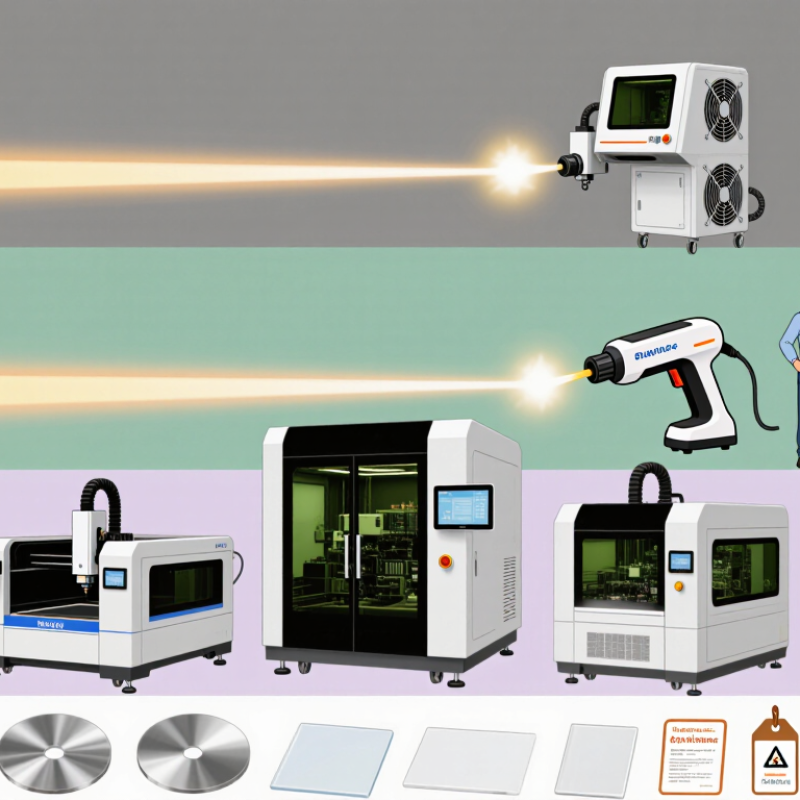
Choosing laser equipment starts with the job, not the machine. Identify the material, thickness, surface condition, required tolerance, and expected production volume. Cutting stainless steel demands different power and wavelength choices than marking plastic or welding thin electronics. Write down the smallest feature and the largest workpiece. Small details matter.
According to Fortune Business Insights, the global laser technology market reached about USD 18.44 billion in 2023. That growth reflects wider adoption, but it does not make every system suitable. Match pulse duration, spot size, beam quality, and duty cycle to the application. A high-power system may waste energy on delicate parts. An undersized system may create slow cycles and rough edges. Test samples before approving specifications.
Integration also deserves attention. The International Federation of Robotics reported 541,302 industrial robot installations worldwide in 2023. If your process includes automation, check communication protocols, loading space, guarding, extraction, and maintenance access.
Keep operators in mind. Can they change lenses safely? Can they inspect the focal point without awkward movement?
My first equipment specification focused too heavily on maximum power. That was a mistake. Actual throughput depended more on fixturing and repeatable setup. Leave room for uncertainty, because laboratory results rarely match a dusty production floor.
Choosing laser equipment starts with the material, not the advertised wattage. In practical testing, wavelength often matters more than raw power. Fiber lasers suit many metals, while CO2 systems handle wood, acrylic, and selected nonmetallic materials. Diode systems can be efficient for lighter engraving, but their limits appear on dense or reflective surfaces. Ask what you will process daily. Not occasionally.
Power should match thickness, speed, and duty cycle. A high-power machine may cut faster, yet it can waste energy on delicate engraving. Check rated output, pulse control, spot size, and cooling design. For cutting, compare maximum thickness at a stated speed, not a promotional maximum. For engraving, inspect line sharpness at low power. A small test grid reveals banding, scorching, and uneven depth. It is simple evidence.
Performance requirements should also include work area, repeatability, software compatibility, extraction, and operator training. Reliability depends on stable calibration and accessible service documentation. Ask for test data, warranty terms, replacement-part availability, and electrical requirements. Compliance with local safety rules is non-negotiable. In workshop evaluations, buyers sometimes overlook ventilation because the machine looks enclosed. That assumption can fail. Build samples using real materials and production hours. If results vary after warm-up, the specification is incomplete. Leave room for honest uncertainty.
Typical industrial output-power ranges by laser type
The ranges shown are representative specifications commonly found in industrial marking, engraving, and light-cutting equipment. Fiber and Nd:YAG lasers are often selected for metals, CO₂ lasers for non-metals, and diode lasers for lower-power engraving and small-format applications. Actual requirements depend on material, thickness, spot size, pulse characteristics, duty cycle, accuracy, and production speed.
Evaluate safety features before comparing power, speed, or price. A reliable system should include a functional emergency stop, key control, and protected beam paths. Door interlocks should pause emission when access panels open. Test them during inspection, not only during installation.
Check whether the equipment follows recognized electrical, optical, and medical-device standards applicable to your region. Request current compliance documents, test reports, and maintenance records. Certification labels alone may not prove safe performance. Ask who performed the testing and when. Verify that protective eyewear matches the laser’s wavelength, power, and operating mode. Eyewear should fit securely without damaging visibility. Keep a spare pair nearby.
User protection also depends on the room. Controlled access, warning indicators, reflective-surface checks, and clear operating procedures reduce avoidable exposure. Training should cover alignment, emergency response, cleaning, and fault reporting. Short practical drills are valuable. Very valuable.
During an evaluation, observe how easily staff can bypass safeguards. If a protective feature feels inconvenient, users may ignore it. That possibility deserves attention. A checklist can help, but it can also create false confidence. Ask an experienced safety officer or qualified technician to review the setup independently. Record every inspection, repair, and unusual event. Small gaps in documentation often reveal larger weaknesses.
Choosing laser equipment requires more than inspecting cutting speed or a polished demonstration. Build quality appears in small details: rigid frames, sealed cable routes, accessible filters, and coolant lines without sharp bends. Check the enclosure doors. They should close firmly and align without force. Ask for service records, component lifecycles, and documented test procedures. The U.S. Department of Energy’s Operations & Maintenance Best Practices guide reports that preventive maintenance can cost 12–18% less than reactive maintenance. That difference matters when a failed chiller stops production.
Maintenance needs should be measurable. Request a schedule for optics cleaning, calibration, filter replacement, and cooling-system checks. Ask how long each task takes. McKinsey’s maintenance research estimates that predictive maintenance can reduce machine downtime by 30–50% and extend equipment life by 20–40%. Those figures are useful benchmarks, not promises. Technical support deserves the same scrutiny. Confirm response targets, remote diagnostic access, spare-parts availability, and technician coverage in your region. A phone number is not support. Require escalation contacts and written troubleshooting steps. During one equipment review, I focused too heavily on output power and overlooked software recovery procedures. That was a costly mistake. Ask for a sample service report. It should show fault codes, corrective actions, replaced parts, and verification results. Keep the questions uncomfortable. They often reveal the real equipment quality.
| Tip | Evaluation Dimension | What to Assess | Practical Evidence to Request | Risk if Overlooked | Priority |
|---|---|---|---|---|---|
| 1 | Frame and enclosure quality | Check whether the frame is rigid, level, properly aligned, and protected against vibration. Inspect panel fit, access doors, fasteners, cable routing, and the overall finish. | Request a factory or site demonstration, inspect internal welds and mounting points where accessible, and confirm that the enclosure meets applicable safety requirements. | Misalignment, excess vibration, inconsistent cutting or marking, and premature wear. | High |
| 2 | Laser source and optical path | Confirm the laser type, rated output, wavelength, beam-delivery method, focusing system, and compatibility with the intended materials and process. | Review technical specifications, optical diagrams, service intervals, output verification procedures, and test results using representative materials. | Poor process results, limited material capability, and higher replacement costs. | High |
| 3 | Motion and positioning accuracy | Evaluate the drive system, guideways, encoders, repeatability, working envelope, acceleration, and achievable tolerance for the planned applications. | Ask for documented accuracy and repeatability tests, sample parts, calibration procedures, and the recommended operating conditions for those figures. | Dimensional errors, rework, scrap, and inconsistent production quality. | High |
| 4 | Cooling and thermal management | Check the cooling method, temperature control, alarms, filtration, operating limits, and heat removal requirements for the laser source and other critical components. | Review cooling specifications, water or air quality requirements, alarm functions, maintenance schedules, and installation conditions. | Thermal drift, unstable output, unplanned shutdowns, and shortened component life. | High |
| 5 | Maintenance workload | Identify routine tasks such as cleaning optics, replacing filters, checking alignment, lubricating moving parts, inspecting extraction systems, and updating software. | Request a preventive-maintenance checklist, estimated labor time, required tools, consumable list, and recommended maintenance frequency. | Unexpected downtime, degraded performance, and avoidable service expenses. | High |
| 6 | Consumables and spare parts | Assess the expected service life, availability, interchangeability, and cost of lenses, nozzles, filters, windows, seals, lamps, and other wear components. | Obtain a spare-parts catalog, recommended stock levels, typical lead times, storage requirements, and indicative lifecycle costs. | Production delays and higher total cost of ownership. | Medium |
| 7 | Safety systems and compliance | Verify interlocks, emergency stops, protective housing, warning indicators, key controls, fume extraction, fire-risk controls, and operator access protection. | Request conformity documentation, risk-assessment information, safety manuals, interlock test procedures, and details of required site controls. | Operator injury, regulatory non-compliance, equipment damage, and business interruption. | High |
| 8 | Software and usability | Evaluate workflow, file compatibility, parameter management, diagnostics, user permissions, data backup, remote access controls, and operator training requirements. | Run a representative job, test error messages and recovery steps, review release notes, and confirm the availability of user documentation. | Longer setup times, operator errors, inconsistent results, and difficult troubleshooting. | Medium |
| 9 | Technical support and training | Assess support hours, response channels, diagnostic capability, technician coverage, installation assistance, operator training, and escalation procedures. | Request service-level terms, training scope, support response targets, escalation contacts, maintenance documentation, and references from comparable users without relying solely on promotional claims. | Extended downtime, incorrect repairs, and slow adoption by operators. | High |
| 10 | Total cost and lifecycle value | Compare purchase price with installation, utilities, ventilation, cooling, tooling, consumables, preventive maintenance, training, software, warranty, and disposal costs. | Build a multi-year cost model using written quotations, warranty exclusions, service rates, energy requirements, expected utilization, and realistic production assumptions. | Budget overruns, low return on investment, and unsuitable production capacity. | High |
The purchase price rarely reflects the real investment. Look beyond the invoice. Include installation, operator training, calibration, cooling systems, consumables, software updates, and electricity use. In my equipment reviews, maintenance often changes the budget more than expected. A low-cost unit may require frequent lamp replacement or specialized servicing. Ask for a five-year cost estimate, not only a quotation.
Compatibility deserves careful testing. Confirm the laser’s wavelength, power range, handpiece options, electrical requirements, ventilation needs, and control software. Fit matters. The equipment should work with your existing treatment rooms and workflow. Request written specifications and test sample materials before committing. A technician should also verify safety interlocks, emergency controls, and calibration procedures. Small omissions matter.
Long-term value depends on dependable support. Review the warranty, service response time, spare-parts availability, and training format. Speak with experienced users about downtime, not just performance. Plan for downtime. A service delay can affect schedules, staffing, and client confidence. Documentation should include maintenance logs and clear operating limits. I have seen teams choose advanced features they rarely use. That decision looked impressive, but it increased training time and operating costs. Reconsider features that do not solve a daily problem. Look for measurable reliability, practical compatibility, and predictable ownership expenses.
„Thanks to the LUVIR technology, the solder resist process could be switched directly from the previously used mask exposure to direct exposure. As an outstanding digital solution on the market, this technology has been able to demonstrate fast process times and superior quality on our certified conventional ink in production. This allowed us to fully digitize the solder mask process at low cost – without process or ink adjustments. An excellent benefit to our production in Rot am See.“
Ralf Göhringer (Head of Production WE Rot am See)
I would definitely recommend the Limata machine and team for a future company purchase
Michael Greenaway
Compunetics Inc.
“The Limata ldi has been amazing!! Best thing we did was buy this machine”
Richard Brady
GM
Circuitlabs
“Since 2019, we have been running the Limata X1000 LDI system (including LUVIR for solder mask imaging) in daily production as an addition to our current process with film. The machine was capable of properly exposing Taiyo PSR-4000 BN (DI) solder mask types on normal to high-copper boards using a new and unique direct imaging process. The machine operating interface is very user friendly which allowed for a quick technical training curve. The pre-registration processing reduced several seconds of production time at every print. Limata support and service staff is incomparable. They supported our team every step of the way at basically any time of the day or night, with literally, an immediate response time, customizing the software interface to best fit our Operations and needs.
We have exposed more than 8,000 prints since end of October, on various solder mask colors and some resist film panels. Limata, has proven to be very capable and innovative. They are a strong contender in the industry.
We have very much enjoyed this project, and working with the team!
Thank you Limata for the continued support and being a part of our growth.”
Bill Sezate
Vice President, GM
Summit Interconnect
As a replacement to our current contact exposure process with film, the LIMATA X2000 system including LUVIR-Technology was capable of properly exposing non-LDI solder mask types using a direct imaging process. The machine offers cutting edge software with a very intuitive operating interface which allowed for quick technician training curve. The dual drawer system combined with pre-registration processing reduced several seconds of production time at every machine cycle. Limata support and service staff is world class. They added software patches to keep production running at shortest possible response times, customized the software interface to best fit our in-house Operations system, and even wrote a step-by-step machine processing manual. As a result of the project, we have exposed more than 16,000 times on various product types and solder mask brands/colors. Limata, in a very short timeframe as a company, has definitely shown they are truly innovative and will be challenging the industry of direct imaging for the top spot.
Kevin Beattie
Process Engineer
TTM Technologies
Forest Grove Division
