Choosing the right Spring Tensioner can determine whether an assembly runs smoothly or fails under repeated movement. A small component may control belt tension, cable return, latch pressure, or vibration resistance. Its performance depends on more than advertised load capacity. Material, spring rate, travel distance, corrosion exposure, mounting space, and cycle life must match the real application.
This guide shares seven practical tips for sourcing a reliable Spring Tensioner. The recommendations reflect common engineering and procurement lessons, including checking technical drawings, reviewing supplier experience, requesting samples, and validating performance through testing. A tensioner that looks suitable on paper may behave differently after thousands of cycles. That detail is easy to miss.
Look closely at the working environment. Heat, moisture, dust, chemicals, and side loading can change service life. Ask suppliers for material specifications, tolerances, inspection records, and traceability documents. Confirm whether their quoted force applies at installation, maximum extension, or another measurement point. These terms are not always presented clearly.
Do not rely on price alone.
A dependable sourcing process compares prototype results with production capability. It also considers communication speed, corrective action, packaging, and delivery consistency. In my experience, suppliers who explain limitations openly are often more valuable than those promising perfect performance. I may overlook a hidden variable, such as unexpected friction or an uneven mounting surface. That is why application testing remains essential. The following tips help buyers question assumptions, reduce selection errors, and choose a Spring Tensioner that performs reliably in its intended equipment.
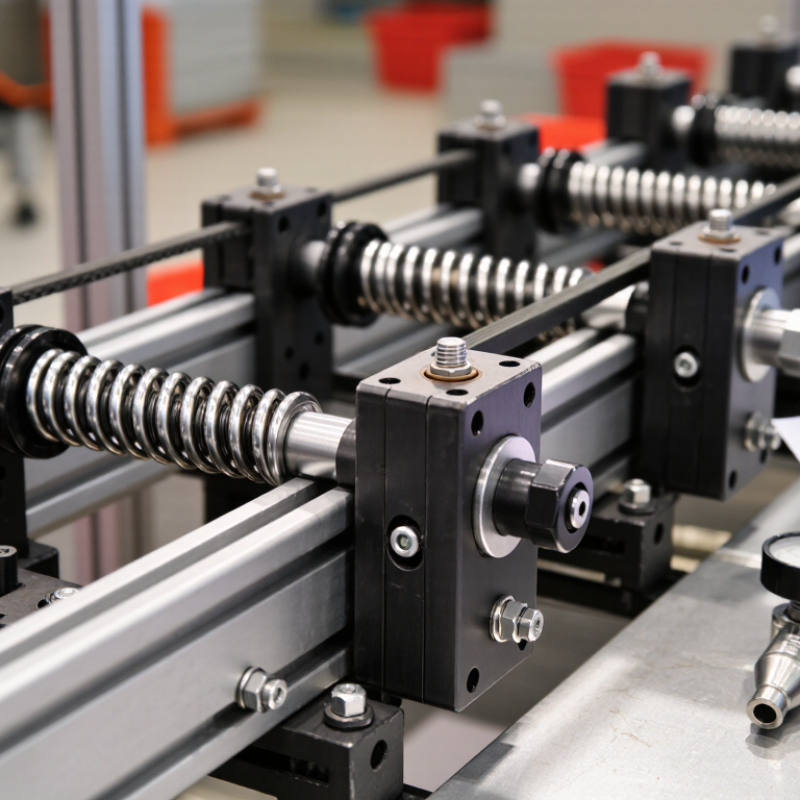
Define Load, Stroke, and 10,000-Cycle Fatigue Requirements A spring tensioner should be selected from measured requirements, not catalog appearance. Define the working load at installation, normal operation, and peak extension. Record whether the load is constant, changing, or shock-driven. These conditions can demand different materials and safety margins. A simple load estimate is often too optimistic. I have seen prototypes pass a bench check, then sag after repeated cycling. That mistake began with an unclear load definition.
Measure the actual stroke, including alignment changes and end-position movement. Do not rely only on a drawing. Test the real motion. Small errors matter. A tensioner may reach its rated extension but bind when mounted at an angle. Note the available space, attachment direction, and required return force. Also specify acceptable permanent deformation after operation. Leaving this unstated creates arguments later.
For fatigue validation, require at least 10,000 operating cycles under representative load and stroke. Record cycle speed, temperature, mounting condition, and inspection intervals. Check for cracks, hook opening, coating damage, force loss, and permanent set. Ten thousand cycles is a screening target, not proof of unlimited service life. A qualified engineer should compare test results with expected field use. If the test fixture is easier than the real assembly, the result may be misleading. Keep raw measurements, photographs, and failed samples in the sourcing record.
Choosing the right spring tensioner starts with its working conditions. Check load, extension, cycle rate, temperature, and corrosion exposure. Measure twice. A tensioner for a clean indoor fixture may suit ASTM A228 piano wire. This high-carbon wire offers strong tensile performance and consistent spring action. However, it may need protection in humid or corrosive environments.
Match the wire grade to the application, not just the catalog description. ASTM A313 stainless spring wire is often better for moisture, washdown areas, or chemical exposure. Its strength and forming behavior can differ from carbon spring wire. EN 10270-1 covers spring steel wire grades used widely in European specifications. Verify the exact grade, surface condition, and delivery class. These standards are not automatically interchangeable. That assumption causes avoidable redesigns.
Ask the supplier for current material certificates and dimensional inspection records. Confirm wire diameter, free length, coil diameter, hook geometry, and rated load. Request fatigue or cycle data when the tensioner moves repeatedly. Inspect sample parts for uneven coils, sharp hook transitions, and surface marks. I have seen small scratches become early failure points. A practical sourcing mistake is accepting a familiar grade without checking the operating environment. Recheck the standard revision, too. Old drawings can hide outdated requirements. Make the supplier explain any substitution in writing before production approval.
A suitable spring tensioner begins with initial tension, not its appearance. Initial tension is the force needed before the spring starts extending. Measure it at the installed length, using a calibrated force gauge. ISO 7500-1 provides guidance for verifying force-measuring machines. Small measurement errors can change the selection.
Spring rate shows how quickly force increases with extension. Record force at two defined lengths, then calculate the change in force divided by the change in length. A tensioner with a low rate absorbs movement gently. A higher rate controls movement more firmly. Do not confuse maximum load with working load. They serve different purposes.
The ±5% load tolerance deserves careful checking. Confirm whether it applies to initial tension, spring rate, or the complete assembly. Ask for test results from multiple samples, not one attractive data sheet. The Spring Manufacturers Institute handbook emphasizes controlled dimensions, material checks, and functional testing in spring production. These steps improve repeatability, but they cannot remove every variation.
Use stainless or coated materials when moisture, salt, or cleaning chemicals are present. ASTM A228/A228M data can help verify music-wire requirements, but the material standard alone does not guarantee field performance. I have seen teams choose a tensioner from catalog load alone. That shortcut failed after temperature changes. A neat spreadsheet can still lie. Measure the real installation, and question any specification that lacks test conditions.
When sourcing a spring tensioner, inspect the hook before admiring its load rating. The hook often becomes the weakest section. Check inside radius, opening angle, wire diameter, and contact marks. A tight radius concentrates stress near the bend. Side loading can worsen it.
Use a minimum 4:1 safety factor for the hook. The verified failure load should be at least four times the maximum service load. Calculate this ratio from the weakest hook section, not the spring body. NASA-STD-5001B lists baseline factors of 1.25 for yield and 1.4 for ultimate strength in many metallic structural applications. The four-to-one screen is more conservative, but it is not a substitute for fatigue testing. The Spring Manufacturers Institute’s Spring Design and Engineering Handbook also emphasizes curvature, stress concentration, and repeated loading in spring-hook design.
Ask suppliers for load-deflection curves, dimensional inspection records, material certificates, and proof-test results. Request testing with the actual hook geometry. Straight-pull testing alone may hide side-load weakness. A useful check is a slow pull test followed by repeated cycling near the working load. Watch for permanent opening, surface cracking, or rising displacement.
Do not trust a polished sample. One overlooked radius can change the result. Real assemblies are rarely perfectly aligned. A cautious sourcing decision may reject a cheaper tensioner when its hook data is incomplete. That is not overdesign. It is an honest response to uncertainty.
A spring tensioner can look excellent and still fail early in a humid environment. Inspect the coating, edges, threaded areas, and contact points before approval. These small details often expose weak surface preparation. In practical sourcing work, I have found that a bright finish can create false confidence. Appearance is only one signal.
Tip: Request a 96-hour ASTM B117 salt-spray test report for the exact finish and material combination. Check the test date, sample identification, exposure duration, and visible corrosion results. Ask for photographs taken after cleaning and inspection. Salt spray is a comparison tool, not a perfect prediction of field life. That limitation matters.
Tip: Review where corrosion appeared. Red rust near cut edges may indicate insufficient protection. Blistering can suggest poor adhesion. White corrosion on plated surfaces needs careful interpretation. Do not accept vague claims such as “high corrosion resistance.” Require measurable evidence and clear acceptance criteria. This step may feel slow, but replacement costs are slower.
Use the test result with dimensional checks, spring-load testing, and cyclic movement trials. A tensioner may resist salt exposure yet lose force during repeated operation. That was an easy point to overlook in an earlier evaluation. Recheck the finish after testing, then compare performance against the intended environment, cleaning routine, and service interval.
„Thanks to the LUVIR technology, the solder resist process could be switched directly from the previously used mask exposure to direct exposure. As an outstanding digital solution on the market, this technology has been able to demonstrate fast process times and superior quality on our certified conventional ink in production. This allowed us to fully digitize the solder mask process at low cost – without process or ink adjustments. An excellent benefit to our production in Rot am See.“
Ralf Göhringer (Head of Production WE Rot am See)
I would definitely recommend the Limata machine and team for a future company purchase
Michael Greenaway
Compunetics Inc.
“The Limata ldi has been amazing!! Best thing we did was buy this machine”
Richard Brady
GM
Circuitlabs
“Since 2019, we have been running the Limata X1000 LDI system (including LUVIR for solder mask imaging) in daily production as an addition to our current process with film. The machine was capable of properly exposing Taiyo PSR-4000 BN (DI) solder mask types on normal to high-copper boards using a new and unique direct imaging process. The machine operating interface is very user friendly which allowed for a quick technical training curve. The pre-registration processing reduced several seconds of production time at every print. Limata support and service staff is incomparable. They supported our team every step of the way at basically any time of the day or night, with literally, an immediate response time, customizing the software interface to best fit our Operations and needs.
We have exposed more than 8,000 prints since end of October, on various solder mask colors and some resist film panels. Limata, has proven to be very capable and innovative. They are a strong contender in the industry.
We have very much enjoyed this project, and working with the team!
Thank you Limata for the continued support and being a part of our growth.”
Bill Sezate
Vice President, GM
Summit Interconnect
As a replacement to our current contact exposure process with film, the LIMATA X2000 system including LUVIR-Technology was capable of properly exposing non-LDI solder mask types using a direct imaging process. The machine offers cutting edge software with a very intuitive operating interface which allowed for quick technician training curve. The dual drawer system combined with pre-registration processing reduced several seconds of production time at every machine cycle. Limata support and service staff is world class. They added software patches to keep production running at shortest possible response times, customized the software interface to best fit our in-house Operations system, and even wrote a step-by-step machine processing manual. As a result of the project, we have exposed more than 16,000 times on various product types and solder mask brands/colors. Limata, in a very short timeframe as a company, has definitely shown they are truly innovative and will be challenging the industry of direct imaging for the top spot.
Kevin Beattie
Process Engineer
TTM Technologies
Forest Grove Division
