China’s Commercial Display Tv industry is entering 2026 with stronger demand from retail, hospitality, education, transport, and corporate facilities. Commercial screens now serve more than basic image playback. They support wayfinding, menu updates, meeting collaboration, remote monitoring, and audience engagement.
Industry reports provide useful context. Omdia’s Public Display Market Tracker follows professional display shipments, screen sizes, technologies, and regional demand. Its research shows that large-format LED and LCD solutions remain central to commercial visual communication. IDC’s Worldwide Quarterly Smart TV Device Tracker also helps explain panel trends, connected-device adoption, and shipment pressure across display markets. AVIXA’s Industry Outlook and Trends Analysis offers another perspective, linking display investment with broader professional AV growth.
This “China Top 10 Commercial Display TV Manufacturers 2026” overview evaluates manufacturers through practical business criteria. These include product range, display reliability, brightness performance, operating-system stability, certification, customization, production capacity, and international service coverage. Warranty response matters. So does a screen that remains readable in a bright shopping mall at noon.
The selected companies represent different strengths, from commercial LCD panels and interactive displays to fine-pitch LED walls and digital signage platforms. Their capabilities are not identical. That difference matters for buyers.
No ranking is perfect. Project results depend on installation quality, software integration, local support, and total ownership cost. Reported market data can also vary by definition. Readers should verify current specifications, compliance documents, service terms, and deployment references before purchasing. This approach aims to provide a balanced, evidence-informed starting point rather than a simple popularity list.
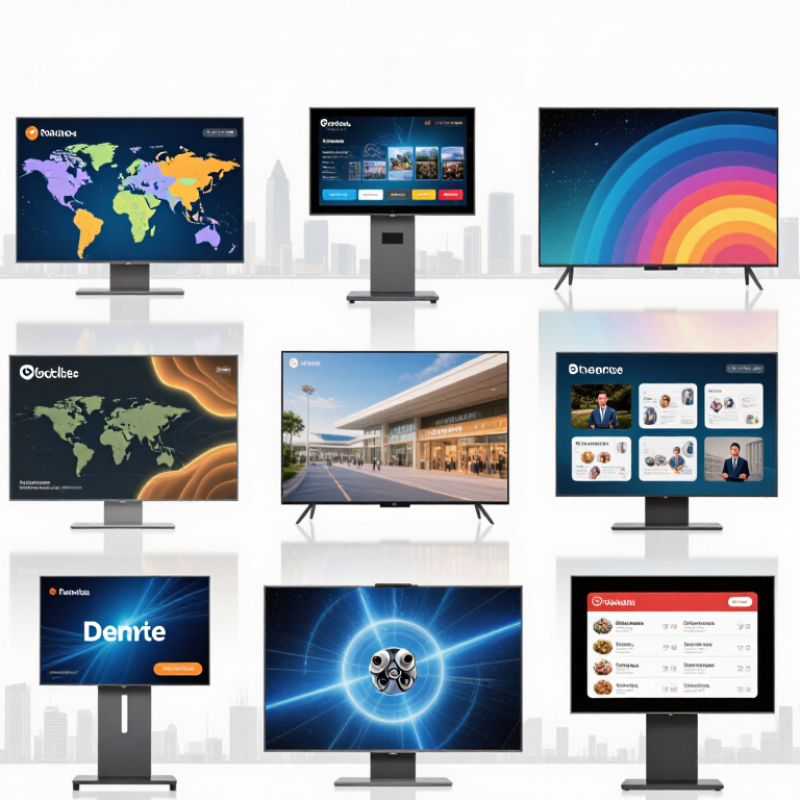
Commercial display TVs in China are professional visual systems, not simply oversized household televisions. They serve retail stores, hotels, schools, hospitals, transport hubs, and corporate sites. Their role is practical: present prices, schedules, lessons, menus, alerts, and live operational data on bright, readable screens.
Compared with consumer models, commercial displays usually support longer operating hours, stronger cooling, scheduled playback, remote device management, and higher brightness. Many also include portrait installation and centralized content control. IDC’s China Commercial Display Quarterly Tracker has reported uneven demand across display categories, with interactive panels gaining importance in education and enterprise settings. Omdia’s professional display research also identifies digital signage and large-format screens as major investment areas in Asia-Pacific.
The market is becoming more measurable. Screen uptime, content accuracy, energy use, and maintenance costs now influence purchasing decisions. China’s National Bureau of Statistics reported an urbanization rate above 66% in 2023, creating more dense retail, transport, and public-service environments for visual communication. Yet a larger screen does not guarantee better communication. Poor contrast, weak installation planning, or irrelevant content can waste money quickly. That remains an uncomfortable industry lesson. Reliable buyers should verify brightness, operating temperature, software security, service response, and total ownership cost before comparing specifications.
Ranking China’s top commercial display TV manufacturers in 2026 requires more than counting shipments. AVIXA’s 2024 Industry Outlook valued the professional audiovisual market at approximately $332 billion worldwide. That figure shows market scale, but it does not measure product reliability. A stronger ranking combines sales data, verified installations, warranty performance, and long-term service capability. Shipment volume alone can mislead.
Panel performance remains a practical test. Independent evaluation should examine brightness stability, color accuracy, viewing angles, and thermal control. For control rooms and retail spaces, 24-hour operation matters. Energy efficiency also affects total ownership cost. ENERGY STAR data indicates certified displays can use substantially less energy than conventional models, although savings depend on settings and operating hours. Manufacturers should provide measured power figures, not vague efficiency claims.
Service evidence deserves equal weight. Ranking teams should review spare-parts availability, repair response times, software update policies, and cybersecurity procedures. Omdia’s public display research highlights continuing demand for larger, networked commercial screens, increasing the importance of remote monitoring and fleet management. In practice, a display that fails during a busy sales period creates more damage than its purchase price suggests. I would score transparent testing highly, yet this remains imperfect: regional data is inconsistent, and some manufacturers report success without publishing failure rates. That gap requires cautious verification.
China’s Top 10 Commercial Display TV Manufacturers in 2026 reflect a market shifting from basic screens toward complete visual solutions. IDC’s China Commercial Display Market Tracker reported more than four million interactive flat-panel shipments in 2023. That volume shows strong demand from schools, meeting rooms, hotels, transport hubs, and retail spaces.
The 2026 top ten should be judged beyond factory scale. Procurement teams usually examine panel consistency, brightness stability, operating temperature, warranty response, and spare-part availability. Omdia’s professional display research identifies LCD as the dominant commercial display technology, while direct-view LED continues gaining attention in large venues. Field experience also reveals a less attractive fact. A low purchase price can hide higher installation and maintenance costs.
These manufacturers typically compete through large-screen production, software integration, remote device management, and customized installation services. Energy consumption deserves closer attention, especially for displays operating sixteen hours daily. Public data remains uneven. Some companies publish detailed shipment figures, while others emphasize project counts without clear definitions. That weakens precise ranking. Still, IDC shipment data, audited financial disclosures, product certifications, and verified commercial references provide a more reliable comparison framework. Buyers should also test motion handling, heat dissipation, and service response before signing long-term contracts. Spec sheets are not enough.
Commercial display manufacturers are competing on more than screen size. Product strength now includes brightness stability, 24/7 operation, remote monitoring, and serviceable design. AVIXA’s 2024 Industry Outlook valued the professional audiovisual market at more than 300 billion US dollars globally. This supports continued demand from retail, education, transport, hospitality, and corporate spaces. Omdia research also tracks strong demand for large-format professional displays, especially in meeting rooms and digital signage. However, market data varies by definition.
The strongest Chinese manufacturers typically offer 4K panels, integrated system-on-chip platforms, wireless casting, and central device management. Fine-pitch LED solutions suit shopping malls and control rooms. High-brightness LCD models work better near windows or outdoor-facing entrances. Target markets differ. Retail buyers need vivid colors and simple content updates. Schools often prioritize durability, classroom sharing, and lower operating costs. Hotels usually require discreet installation and reliable network control. Field deployment experience shows that after-sales response can matter more than peak brightness. The ranking is not perfect. Some technical claims need independent testing.
Tips: Request a 72-hour burn-in test, measure brightness after calibration, and verify spare-part availability. Check software security updates, warranty terms, and local service coverage. A lower purchase price may create higher maintenance costs. Energy use also deserves attention. The International Energy Agency reports that buildings remain a major source of global electricity demand, so efficient displays can reduce operating expenses. Do not judge a commercial TV by the showroom image alone.
How to Select a Suitable Commercial Display TV Manufacturer
Selecting a commercial display TV manufacturer requires more than comparing screen prices. AVIXA’s 2024 Industry Outlook and Trends Analysis valued the professional audiovisual market at about USD 332 billion in 2023. This growth increases supplier choice, but also increases evaluation risk. Ask for factory audit records, production capacity, quality-control procedures, and export experience. A reliable manufacturer should explain panel sourcing, burn-in testing, thermal management, and repair handling clearly.
Check performance in real locations. A bright retail window needs higher brightness and anti-glare treatment. A hotel lobby may need quiet cooling and continuous operation. Request sample units for at least 72 hours. Test remote control, media playback, network stability, and screen uniformity. I would not trust a polished showroom alone. It can hide weak after-sales systems. According to IDC’s 2024 research on digital business infrastructure, reliability and security remain major technology investment priorities, so verify firmware updates, access controls, and device monitoring.
Commercial display ownership also includes hidden costs. Compare warranty length, spare-panel availability, packaging quality, installation guidance, and response times. A slightly cheaper quotation may create higher replacement expenses. Ask for total cost estimates over three to five years. Review independent customer references, not only selected testimonials. TÜV, CE, RoHS, or equivalent documentation can support compliance checks, but certificates never replace practical testing. Leave room for doubt. The best manufacturer is not always the largest; it is the one that documents limits honestly and supports the product after delivery.
This practical procurement benchmark prioritizes commercial reliability, total cost of ownership, and support capability rather than brand visibility. Buyers can use these percentage weights to compare shortlisted manufacturers consistently, then verify warranty terms, operating-hour ratings, service coverage, certifications, and integration compatibility.
„Thanks to the LUVIR technology, the solder resist process could be switched directly from the previously used mask exposure to direct exposure. As an outstanding digital solution on the market, this technology has been able to demonstrate fast process times and superior quality on our certified conventional ink in production. This allowed us to fully digitize the solder mask process at low cost – without process or ink adjustments. An excellent benefit to our production in Rot am See.“
Ralf Göhringer (Head of Production WE Rot am See)
I would definitely recommend the Limata machine and team for a future company purchase
Michael Greenaway
Compunetics Inc.
“The Limata ldi has been amazing!! Best thing we did was buy this machine”
Richard Brady
GM
Circuitlabs
“Since 2019, we have been running the Limata X1000 LDI system (including LUVIR for solder mask imaging) in daily production as an addition to our current process with film. The machine was capable of properly exposing Taiyo PSR-4000 BN (DI) solder mask types on normal to high-copper boards using a new and unique direct imaging process. The machine operating interface is very user friendly which allowed for a quick technical training curve. The pre-registration processing reduced several seconds of production time at every print. Limata support and service staff is incomparable. They supported our team every step of the way at basically any time of the day or night, with literally, an immediate response time, customizing the software interface to best fit our Operations and needs.
We have exposed more than 8,000 prints since end of October, on various solder mask colors and some resist film panels. Limata, has proven to be very capable and innovative. They are a strong contender in the industry.
We have very much enjoyed this project, and working with the team!
Thank you Limata for the continued support and being a part of our growth.”
Bill Sezate
Vice President, GM
Summit Interconnect
As a replacement to our current contact exposure process with film, the LIMATA X2000 system including LUVIR-Technology was capable of properly exposing non-LDI solder mask types using a direct imaging process. The machine offers cutting edge software with a very intuitive operating interface which allowed for quick technician training curve. The dual drawer system combined with pre-registration processing reduced several seconds of production time at every machine cycle. Limata support and service staff is world class. They added software patches to keep production running at shortest possible response times, customized the software interface to best fit our in-house Operations system, and even wrote a step-by-step machine processing manual. As a result of the project, we have exposed more than 16,000 times on various product types and solder mask brands/colors. Limata, in a very short timeframe as a company, has definitely shown they are truly innovative and will be challenging the industry of direct imaging for the top spot.
Kevin Beattie
Process Engineer
TTM Technologies
Forest Grove Division