China is a major source of commercial display technology, from compact retail screens to large LED video walls. Choosing a supplier, however, involves more than comparing a product photo or advertised price. Buyers need to consider image quality, installation conditions, production capacity, and after-sales support.
This guide introduces ten notable Digital Display manufacturers in China and explains what buyers may want to examine when comparing them. A bright showroom screen may perform poorly in direct sunlight, while a fine-pitch LED wall can look impressive up close but exceed a project’s budget. Viewing distance matters. So do pixel pitch, brightness, cabinet design, power use, and control software. These details help connect a product’s specifications to its actual use.
The list should be treated as a starting point, not a universal ranking. Manufacturer capabilities and product lines can change, and the best fit depends on the project. A careful review should check current product datasheets, warranty terms, customization options, delivery arrangements, and available service support. Where possible, request a demonstration or sample and ask how the supplier tests its products. Factory claims also deserve verification. No list is perfect. Even a well-known brand may not suit every installation, budget, or maintenance plan. Comparing evidence—not just marketing language—can help buyers make a more informed shortlist.
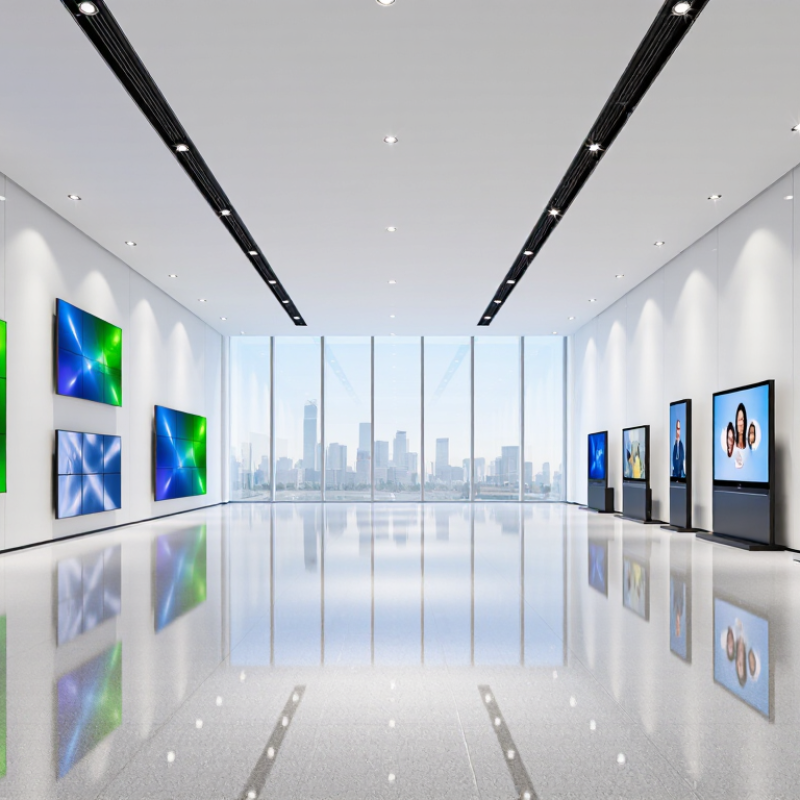
China’s digital-display landscape is not one factory story. It is a connected network of panel plants, component makers, module assemblers, and logistics hubs. In several manufacturing clusters, glass, backlights, circuit boards, and packaging can move between nearby facilities. That proximity can speed coordination, though supplier quality is not uniform.
Omdia’s 2024 Display Long-Term Demand Forecast estimates that China held about 70% of global LCD panel capacity in 2023. This scale supports high-volume production for televisions, monitors, and commercial screens. OLED production requires different materials and process controls, while emerging technologies demand further investment. Capacity alone does not prove high yield or stable color performance. The map is impressive, but not perfectly tidy: national figures cannot reveal how consistently an individual factory performs. Buyers should compare sample uniformity, brightness, pixel pitch, viewing angle, and thermal behavior under realistic operating conditions.
Tips: Request test reports and inspect a powered sample in the intended environment. Check warranty terms, spare-part availability, and stated production lead times. A bright showroom demo is useful, but it is not a reliability test.
Pixel counts of common display resolutions, from HD to 8K UHD.
Pixel counts are calculated from each resolution’s width × height. Higher-resolution panels require more pixels; this chart compares display formats and does not rank manufacturers or represent market share.
Selecting leading digital display manufacturers requires more than comparing headline specifications. Match the display type to its real setting, such as a bright shop window, a control room, or an outdoor wall. Ask for measured brightness, color uniformity, pixel pitch, and viewing-angle data. A showroom demo helps, but inspect it under lighting similar to your installation. Small details matter.
Review how each manufacturer controls quality across production. Request sample inspection records, aging-test procedures, and information about heat management. Check whether the company can explain its component choices and provide consistent technical documentation. Ask for installation guidance, spare-parts availability, and a clear repair process. Paper claims need evidence.
Assess engineering support and delivery reliability, too. Discuss custom dimensions, control-system compatibility, packaging, and realistic lead times before comparing quotations. Where possible, speak with customers who operate similar displays and ask about performance after extended use. No scorecard is perfect. A lower-cost option may suit a simple indoor project, while demanding environments need stronger support and verified durability. Note any unanswered questions; they can reveal more than a polished presentation.
China’s digital display industry spans LED walls, LCD signage, touchscreens, and custom-built systems. These ten profiles describe different manufacturing strengths, not a verified ranking. Check current product specifications and service terms before making a purchasing decision.
One manufacturer focuses on large-format LED walls for public venues, with modular cabinets that crews can replace quickly. Another builds LCD signage for shops and transport hubs, emphasizing slim frames and scheduled content playback. A third produces transparent LED panels for glass façades, balancing visibility with screen brightness. A fourth specializes in rental displays, where fast-locking panels and reinforced corners matter. Small details count.
A fifth maker targets outdoor installations with high-brightness screens and weather-resistant enclosures. A sixth develops fine-pitch LED displays for close viewing in meeting rooms and studios. A seventh combines touchscreens with interactive software for classrooms and visitor centers. An eighth serves retailers with compact displays designed for shelves and product counters. A ninth builds multi-screen systems for control rooms, prioritizing consistent color and continuous operation. A tenth offers OEM production and custom dimensions for project-specific installations. Their strengths differ, and no single specification tells the whole story. Ask about panel uniformity, spare-part availability, and how warranty coverage works in practice. Even detailed brochures can leave gaps.
Comparing China’s leading digital display manufacturers is more useful when the focus stays on product range, technology, and market strengths—not a fixed ranking. The top ten can change depending on whether a buyer needs indoor signage, outdoor advertising screens, video walls, or interactive displays. A supplier with a broad catalogue may suit a multi-site rollout, while a specialist may offer better control over a particular screen format.
Look closely at the details. Pixel pitch affects viewing distance and image clarity; brightness matters near sunlit windows or outdoors. Ask for sample units, operating-temperature data, service-life estimates, and warranty terms. Check how the display handles heat, dust, and long operating hours. Small details matter. A polished demonstration is useful, but it cannot replace testing the screen in the actual installation environment.
Technology and market strength also show up in integration and support. Some manufacturers provide control software, cabinet design, and installation guidance alongside the display. Others concentrate on hardware and depend on local partners for setup or repairs. Neither model is automatically better. Response time, spare-part availability, and communication can matter more than a headline specification. I would treat published performance figures as a starting point, not proof; testing conditions are not always clear, and comparisons can be imperfect. A careful shortlist should weigh verified specifications against the buyer’s real site conditions and support needs.
Choosing a digital display manufacturer starts with the installation environment, not the catalogue. MarketsandMarkets estimates the global digital signage market will grow from USD 27.8 billion in 2024 to USD 40.8 billion by 2029. That expansion makes supplier capacity and quality control worth checking carefully. Ask for production lead times, monthly capacity, and the inspection records for the exact product configuration.
Match technical specifications to real conditions. For a bright shop window, verify measured brightness, viewing angle, and heat performance; for a control room, check pixel pitch, color consistency, and continuous-operation ratings. Request test reports, not just claims in a brochure. Small details matter. Confirm the panel, controller, power supply, and casing are covered by clear warranty terms, and ask how replacement parts will be sourced several years later.
Audit the factory or request a live production walkthrough. Check calibration equipment, burn-in procedures, packaging, and how defects are recorded. Test the sample. A good prototype can still hide batch variation, so inspect several units before placing a large order. Compare compliance documents and service response times, too. I would not treat a low quote as proof of value; freight, installation, and downtime can change the real cost. No checklist catches everything. Keep a written record of agreed specifications and acceptance tests.
„Thanks to the LUVIR technology, the solder resist process could be switched directly from the previously used mask exposure to direct exposure. As an outstanding digital solution on the market, this technology has been able to demonstrate fast process times and superior quality on our certified conventional ink in production. This allowed us to fully digitize the solder mask process at low cost – without process or ink adjustments. An excellent benefit to our production in Rot am See.“
Ralf Göhringer (Head of Production WE Rot am See)
I would definitely recommend the Limata machine and team for a future company purchase
Michael Greenaway
Compunetics Inc.
“The Limata ldi has been amazing!! Best thing we did was buy this machine”
Richard Brady
GM
Circuitlabs
“Since 2019, we have been running the Limata X1000 LDI system (including LUVIR for solder mask imaging) in daily production as an addition to our current process with film. The machine was capable of properly exposing Taiyo PSR-4000 BN (DI) solder mask types on normal to high-copper boards using a new and unique direct imaging process. The machine operating interface is very user friendly which allowed for a quick technical training curve. The pre-registration processing reduced several seconds of production time at every print. Limata support and service staff is incomparable. They supported our team every step of the way at basically any time of the day or night, with literally, an immediate response time, customizing the software interface to best fit our Operations and needs.
We have exposed more than 8,000 prints since end of October, on various solder mask colors and some resist film panels. Limata, has proven to be very capable and innovative. They are a strong contender in the industry.
We have very much enjoyed this project, and working with the team!
Thank you Limata for the continued support and being a part of our growth.”
Bill Sezate
Vice President, GM
Summit Interconnect
As a replacement to our current contact exposure process with film, the LIMATA X2000 system including LUVIR-Technology was capable of properly exposing non-LDI solder mask types using a direct imaging process. The machine offers cutting edge software with a very intuitive operating interface which allowed for quick technician training curve. The dual drawer system combined with pre-registration processing reduced several seconds of production time at every machine cycle. Limata support and service staff is world class. They added software patches to keep production running at shortest possible response times, customized the software interface to best fit our in-house Operations system, and even wrote a step-by-step machine processing manual. As a result of the project, we have exposed more than 16,000 times on various product types and solder mask brands/colors. Limata, in a very short timeframe as a company, has definitely shown they are truly innovative and will be challenging the industry of direct imaging for the top spot.
Kevin Beattie
Process Engineer
TTM Technologies
Forest Grove Division
