Choosing the right heating system can affect comfort, operating costs, maintenance, and workplace safety. A Fuel Oil Heater may suit workshops, warehouses, farms, construction areas, or backup heating applications. However, the best choice depends on the building size, ventilation, fuel availability, climate, and expected operating hours.
This guide examines ten common types of fuel oil heaters, including portable forced-air units, indirect-fired heaters, hydronic systems, pressure-jet models, and waste-oil alternatives. Each design creates heat differently. Some deliver fast, powerful warmth across an open space. Others provide cleaner heat through ducting or water-based circulation. Fuel consumption, heat output, ignition systems, thermostat control, tank capacity, and maintenance access deserve careful comparison. Small details matter. A poorly placed heater can waste fuel or create uneven temperatures near doors and concrete floors.
Safety remains central to any responsible purchase. Buyers should check manufacturer instructions, ventilation requirements, emissions information, electrical specifications, and applicable local standards. Certified installation and regular inspection are not optional extras. They protect people and equipment. Product claims also need scrutiny. A high output rating may not translate into lower running costs. Some assumptions need checking. In real use, fuel quality, filter condition, wind exposure, and operator habits can change performance significantly. This overview aims to provide practical, evidence-informed guidance while recognizing that no single heater fits every application. Compare the specifications carefully, consult qualified professionals when needed, and select a model that matches the actual site rather than an idealized sales description.
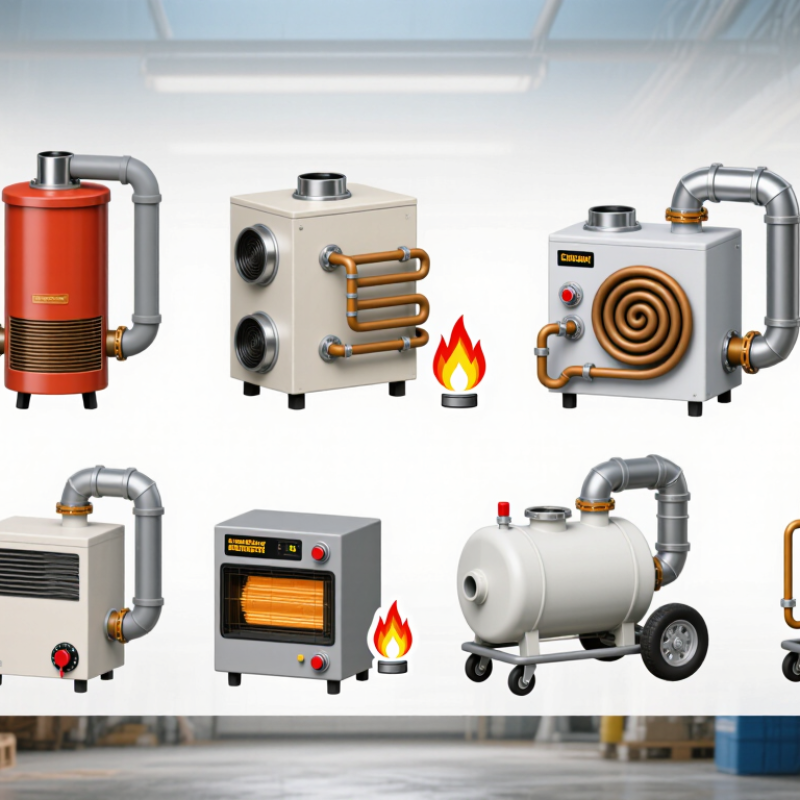
Fuel oil heaters burn liquid fuel in a controlled chamber. A pump delivers oil to a nozzle, where it becomes a fine spray. An igniter starts combustion. The heat then moves through air, water, or another heat-transfer surface. Clean filters and correct nozzle pressure matter. Small errors can cause smoke, odor, or unstable flames.
The ten main types differ by heat delivery and installation. Portable direct-fired heaters warm air quickly but release combustion gases indoors. Indirect-fired models use a heat exchanger and vent outdoors. Radiant heaters warm nearby objects, while convection heaters warm surrounding air slowly.
Ducted forced-air units distribute heat through connected channels. Oil furnaces serve whole buildings through permanent ductwork. Hydronic boilers heat water for radiators or floor loops. Steam boilers produce vapor for older radiator systems. Tankless oil water heaters supply domestic hot water on demand. Waste-oil heaters use approved, filtered used oil under strict local requirements.
Match the heater to the room, fuel quality, ventilation, and heat demand. A warehouse may benefit from indirect forced air. A workshop with open floor space may suit radiant heat. In field checks, blocked flues and neglected filters appear more often than major mechanical failures. That is easy to underestimate. Qualified technicians should verify combustion, carbon monoxide safety, electrical connections, and fuel-line integrity. Local codes and the equipment manual still control the final installation.
Residential fuel oil heaters usually fall into three practical groups: furnaces, boilers, and space heaters. Each one suits a different home layout and heating habit.
Fuel oil furnaces heat air inside a combustion chamber, then push warm air through ducts. They respond quickly, especially in homes with existing ventilation systems.
Buyers should inspect filter access, duct condition, chimney connections, and burner service records. An oversized furnace may cycle too often and waste fuel. It can also create uneven temperatures between rooms.
Fuel oil boilers heat water and send it through radiators, baseboards, or radiant floor loops. Their heat feels steady, like warmth rising from a kitchen floor.
Boilers often operate quietly, but frozen pipes and leaking valves require serious attention. Ask a qualified technician to check pressure, expansion tanks, safety controls, and combustion performance.
A professional sizing calculation matters more than a large capacity rating.
Space heaters are compact and useful for workshops, cabins, or occasional room heating. Some models use a flue, while others require carefully managed ventilation.
They need stable placement, clearances from curtains, and reliable carbon monoxide protection. Never judge safety by flame color alone. A certified inspection is wiser.
Fuel storage also matters. Tanks should be checked for corrosion, moisture, and difficult access. Local installation rules vary, so buyers should verify permits and servicing requirements before purchase. My only hesitation is assuming the cheapest installation is the best value; maintenance access can quietly shape long-term costs.
What Are the Top 10 Types of Fuel Oil Heaters for Buyers?
Commercial and industrial sites need more than simple heat output. They need stable combustion, controlled fuel use, and dependable operation around dust, cold air, and long shifts. The ten common types include pressure-atomizing heaters, air-atomizing heaters, rotary-cup burners, vaporizing heaters, direct-fired heaters, indirect-fired heaters, forced-air oil heaters, hydronic oil boilers, portable oil heaters, and low-emission industrial heaters. Each design serves a different workload.
Direct-fired units heat large workshops quickly, but they require suitable ventilation. Indirect-fired models protect indoor air quality by sending combustion gases outside through a flue. Hydronic boilers work well with radiant floors, coils, and process loops. Rotary-cup and air-atomizing systems can handle demanding industrial duty when fuel preparation and maintenance are carefully managed. Portable units help during temporary construction, emergency repairs, or seasonal demand. Tank-top heaters suit small zones, not every factory.
In real installations, sizing errors cause expensive problems. A heater that is too large may cycle often and waste fuel. An undersized unit may run continuously beside open loading doors. Buyers should check fuel viscosity, storage conditions, electrical supply, exhaust routing, noise levels, and local safety requirements. Combustion testing should follow installation and during routine service. I have found that filters and nozzles are often overlooked. Small parts matter. No configuration is perfect. A site assessment, airflow calculation, and maintenance plan usually provide more value than choosing the highest rated output.
Commercial and industrial fuel oil heaters for heavy-duty applications, grouped by typical rated heat-output range.
The ranges shown are indicative engineering capacity bands commonly used for commercial and industrial equipment. Actual output depends on burner design, fuel grade, combustion controls, heat-transfer method, and installation requirements.
Choosing among the top 10 fuel oil heater types requires more than comparing advertised heat output. Common options include portable radiant heaters, convection heaters, forced-air furnaces, direct-vent heaters, indirect-fired heaters, hydronic boilers, steam boilers, warm-air furnaces, condensing furnaces, and commercial unit heaters. Each design moves heat differently. A radiant model warms people and nearby tools quickly, while a hydronic boiler provides steadier room temperatures through radiators or floor loops.
Efficiency depends on measured performance, installation, and operating habits. The U.S. Energy Information Administration’s 2020 Residential Energy Consumption Survey reports that space heating uses about 42% of household energy. That makes seasonal efficiency important. The U.S. Department of Energy uses AFUE to measure annual fuel conversion, including cycling losses. Higher AFUE is useful, but only when sizing and venting are correct. The ENERGY STAR specification for qualifying oil furnaces requires at least 85% AFUE. Check the label, not the sales promise.
Fuel quality matters. So does maintenance. A dirty nozzle, blocked filter, or weak chimney draft can reduce performance and create unpleasant odors. In a 500-square-foot workshop, a compact direct-vent heater may respond faster than a boiler system. Yet the boiler could feel more comfortable over long working hours. I would not rank one type as universally best. Buyers should compare AFUE, heat distribution, noise, startup time, tank capacity, servicing access, and local installation requirements. My own comparison would also include a less exciting detail: how easily a technician can reach the burner.
What Are the Top 10 Types of Fuel Oil Heaters for Buyers?
The ten common designs include portable forced-air, radiant, convection, indirect-fired, direct-fired, hydronic boiler, furnace, gravity-feed, siphon-feed, and pressure-atomizing heaters. Each requires a fuel suitable for its burner and operating temperature. A heater designed for kerosene may not safely accept diesel or another fuel. Always follow the equipment manual and local installation rules.
Safety starts with ventilation, clearance, and combustion control. Keep curtains, cardboard, and stored fuel well away from hot surfaces. Direct-fired units need extra airflow because combustion gases enter the heated space. Indirect-fired models discharge fumes outdoors through a properly sized flue. Carbon monoxide alarms should be installed near occupied areas. Never operate a heater with a damaged hose, leaking fitting, or blocked air intake.
Installation should be completed by a qualified technician when electrical, fuel, or flue connections are involved. The technician should verify grounding, nozzle condition, pressure, and exhaust direction. Maintenance includes cleaning filters, checking electrodes, inspecting seals, and removing soot before it hardens. Use clean fuel from a reliable source. Old fuel can clog screens and create unstable flames. During operation, watch for smoke, unusual odor, vibration, or repeated shutdowns. Stop the unit if these signs appear. A checklist helps, but it can still miss a loose fitting. Hands-on inspection matters. Never leave a portable heater running unattended or refuel it while hot.
„Thanks to the LUVIR technology, the solder resist process could be switched directly from the previously used mask exposure to direct exposure. As an outstanding digital solution on the market, this technology has been able to demonstrate fast process times and superior quality on our certified conventional ink in production. This allowed us to fully digitize the solder mask process at low cost – without process or ink adjustments. An excellent benefit to our production in Rot am See.“
Ralf Göhringer (Head of Production WE Rot am See)
I would definitely recommend the Limata machine and team for a future company purchase
Michael Greenaway
Compunetics Inc.
“The Limata ldi has been amazing!! Best thing we did was buy this machine”
Richard Brady
GM
Circuitlabs
“Since 2019, we have been running the Limata X1000 LDI system (including LUVIR for solder mask imaging) in daily production as an addition to our current process with film. The machine was capable of properly exposing Taiyo PSR-4000 BN (DI) solder mask types on normal to high-copper boards using a new and unique direct imaging process. The machine operating interface is very user friendly which allowed for a quick technical training curve. The pre-registration processing reduced several seconds of production time at every print. Limata support and service staff is incomparable. They supported our team every step of the way at basically any time of the day or night, with literally, an immediate response time, customizing the software interface to best fit our Operations and needs.
We have exposed more than 8,000 prints since end of October, on various solder mask colors and some resist film panels. Limata, has proven to be very capable and innovative. They are a strong contender in the industry.
We have very much enjoyed this project, and working with the team!
Thank you Limata for the continued support and being a part of our growth.”
Bill Sezate
Vice President, GM
Summit Interconnect
As a replacement to our current contact exposure process with film, the LIMATA X2000 system including LUVIR-Technology was capable of properly exposing non-LDI solder mask types using a direct imaging process. The machine offers cutting edge software with a very intuitive operating interface which allowed for quick technician training curve. The dual drawer system combined with pre-registration processing reduced several seconds of production time at every machine cycle. Limata support and service staff is world class. They added software patches to keep production running at shortest possible response times, customized the software interface to best fit our in-house Operations system, and even wrote a step-by-step machine processing manual. As a result of the project, we have exposed more than 16,000 times on various product types and solder mask brands/colors. Limata, in a very short timeframe as a company, has definitely shown they are truly innovative and will be challenging the industry of direct imaging for the top spot.
Kevin Beattie
Process Engineer
TTM Technologies
Forest Grove Division
