Injection Molding Automation is changing how manufacturers handle repetitive tasks around the press. Robots remove molded parts, conveyors move them downstream, and vision systems can check features before packaging. Together, these tools may reduce manual handling and support more consistent production. The details matter.
This guide introduces 10 companies associated with injection molding automation for 2026. It considers their automation offerings, integration capabilities, and relevance to different production environments. A small shop making short runs may need a different solution from a plant operating multiple presses around the clock. Robot reach, payload, cycle time, safety features, and compatibility with existing equipment all deserve careful review. So do service coverage and operator training.
A polished demonstration can hide the work required to integrate a system. Not always. Buyers should ask how equipment performs with their molds, materials, and actual cycle conditions. They should also clarify what is included in a quoted project, from end-of-arm tooling to commissioning and ongoing support. Product specifications and availability can change, so details should be confirmed directly with each supplier.
No list is perfect. The companies below are presented as options to investigate, not as a guarantee that one provider fits every factory. Use the comparison as a starting point, then assess each solution against real production needs, budget, and maintenance capacity.
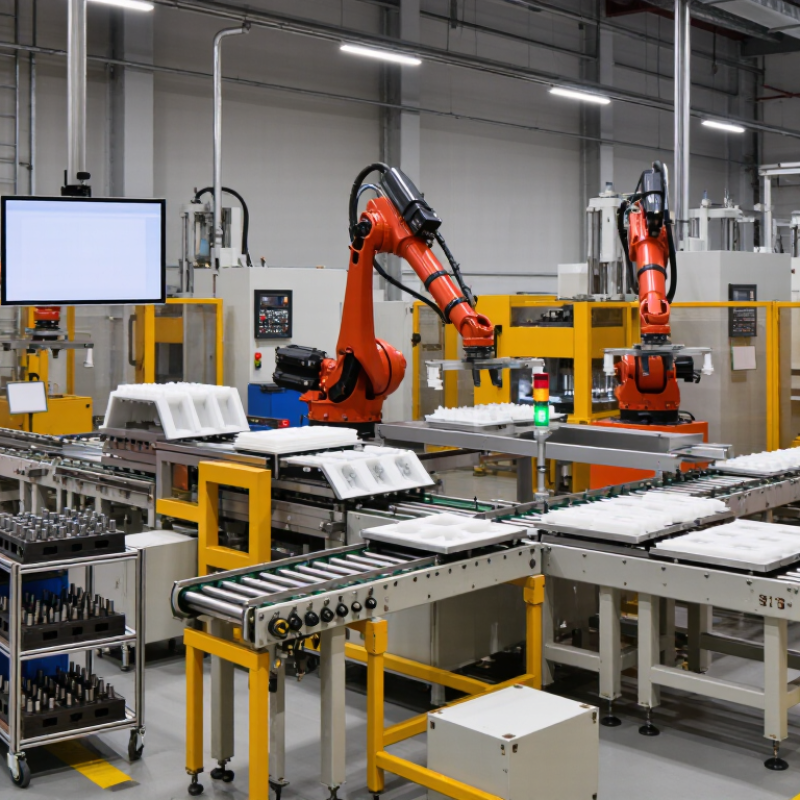
Injection molding automation covers more than placing a robot beside a press. It connects material preparation, molding, part handling, inspection, and downstream packing. Dryers and loaders help keep resin conditions consistent, while sensors can flag interrupted material flow. Small details matter.
At the machine, a robot may remove a hot part or separate runners. Conveyors then move components to trimming, cooling, or inspection stations. Vision systems can check features such as flash, missing inserts, or surface marks. Not just robots. Safety guarding, interlocks, and coordinated controls help people work around equipment with fewer interruptions.
A well-designed cell also tracks cycle times, alarms, and production counts. These records help teams identify recurring stoppages, though data alone will not explain every defect. Automation must match the part, mold, and production volume. A delicate component may need gentle gripping; a high-output line may need faster handling and reliable buffering.
Changeovers deserve attention, too. A setup that works for one mold can become awkward with another. In practice, integration is rarely perfect on the first try. Teams may need to adjust grippers, sensor positions, or conveyor timing after observing real production. That effort is easy to underestimate.
When evaluating injection molding automation companies in 2026, start with the part and the production process, not a catalogue. Share the resin, part weight, target cycle time, and required handling steps. Ask how the proposed robot reach and payload fit your machine layout. A system that works in a presentation may struggle beside a crowded press. Numbers matter.
Tips: Request a trial using a representative part. Review cycle-time data, changeover steps, and safety documentation. Ask who handles installation, operator training, and service when production is down.
Compare more than purchase price. Check how the automation connects with the molding machine and downstream equipment, and whether operators can adjust recipes without specialist support. Request references from facilities with similar parts and production volumes. Ask what the quote excludes, such as guarding, fixtures, or integration work. Small omissions can become costly. Also assess spare-part availability and response times. A supplier’s projected uptime is useful, but ask how it was measured. One weak point in my own evaluations has been assuming the factory layout will stay fixed; confirm clearance and future expansion plans before approving a design.
Evaluation framework for comparing injection molding automation providers. Company and brand names are intentionally omitted; the rows are evaluation criteria, not a ranked list of suppliers.
| No. | Evaluation Dimension | What to Evaluate | Practical Evidence to Request |
|---|---|---|---|
| 1 | Injection Molding Experience | Assess experience with the relevant molding process, machine configuration, part geometry, materials, and production environment. | Ask for comparable project references, process descriptions, and examples of systems installed for similar part and production requirements. |
| 2 | Machine and Robot Integration | Check compatibility with the molding machine, robot, controller, safety circuits, and any existing production equipment. | Request an integration plan showing interfaces, signal exchange, responsibilities, and how the system will be tested with the specified machine. |
| 3 | Part Take-Out and Handling | Review how parts, runners, inserts, and other items will be removed or handled without damage, contamination, or unnecessary cycle-time delays. | Request a handling concept, end-of-arm tooling details, sample cycle sequence, and a demonstration or trial using representative parts where feasible. |
| 4 | End-of-Arm Tooling | Evaluate whether the tooling suits the part’s shape, weight, surface, temperature, and required grip or release method. | Review tooling drawings, changeover method, wear items, maintenance access, and provisions for detecting a failed pickup or dropped part. |
| 5 | Cell Layout and Safety | Assess access for operators and maintenance, guarding, interlocks, emergency stops, material flow, and risks associated with robot motion and machine operation. | Request a proposed layout, documented risk assessment, safety-device list, and evidence that applicable local regulations and current standards will be addressed. |
| 6 | Quality Inspection and Vision | Determine whether inspection is needed for part presence, orientation, visible defects, assembly features, or other defined quality characteristics. | Ask for inspection specifications, sample images or test results, acceptance criteria, and an explanation of how rejected parts are identified and segregated. |
| 7 | Controls and Data Connectivity | Review the controls architecture, alarm handling, recipe or job selection, production data needs, and connection requirements for plant systems. | Request an I/O and communications list, data-flow description, user-access approach, and confirmation of which interfaces are included in the proposed scope. |
| 8 | Changeover and Flexibility | Evaluate how the cell will accommodate different molds, parts, tooling, or production recipes, and how changeover tasks are controlled. | Request a documented changeover procedure, estimated changeover steps, tooling storage concept, and details of recipe validation or error-proofing features. |
| 9 | Commissioning and Support | Compare installation planning, operator and maintenance training, troubleshooting support, spare-parts availability, and service coverage for the intended operating location. | Request a commissioning schedule, training plan, support response terms, recommended spare-parts list, and warranty and service conditions in writing. |
| 10 | Total Cost and Business Case | Consider equipment, integration, installation, training, maintenance, tooling, and expected operating costs alongside the production benefits. | Ask for an itemized quotation and a business-case calculation that clearly states its assumptions, including cycle time, staffing, uptime, production volume, and payback method. |
The top 10 injection molding automation companies for 2026 should be judged by how well their systems fit a real production floor, not by impressive demonstrations alone. A cell may combine a takeout robot, custom gripper, vision inspection, conveyor, and part stacking. The details matter. A gripper that marks a glossy housing or misses a warm part can create costly interruptions.
A reliable comparison looks at integration experience, cycle-time performance, changeover steps, and access to service support. Ask how the supplier tests a complete cell, including mold changes and restart procedures. Request measurable acceptance criteria, such as repeatable part placement and documented cycle times. Safety interlocks and clear operator controls also deserve attention. A polished dashboard is useful, but it cannot replace a practical maintenance plan.
The strongest providers explain what their equipment can and cannot handle. They should discuss resin behavior, part geometry, machine interfaces, and expected production volume before recommending a configuration. Not every company publishes comparable performance data, which makes a strict ranking imperfect. That is worth acknowledging. For a 2026 shortlist, compare verified installations, training, spare-parts access, and support response times alongside price. Ask for a sample changeover demonstration, then watch how many tools and adjustments it actually takes.
Leading injection molding automation companies combine robotic part removal, in-mold handling, and downstream packaging. Six-axis robots can move parts from a mold to a cooling station, while sprue pickers handle simpler removal tasks. Vision systems inspect each part for color shifts, flash, or missing features. These tools work best when matched to cycle time, part geometry, and available floor space.
Integration matters as much as equipment. Providers may connect robots, conveyors, dryers, and inspection stations to a central control system. Production dashboards can track cycle times, machine stops, and reject rates. Mold-protection sensors help detect an obstruction before a closing mold causes damage. Installation, safety assessments, operator training, and preventive maintenance are also important services. Still, software data can be misleading if sensors are poorly configured.
Tips: Ask for a sample cell layout using your actual part dimensions. Check how the system handles color changes, short runs, and planned maintenance. Request clear training and service-response details. Small trials help. Automation can reduce repetitive handling, but it will not fix unstable molding settings; those may need careful adjustment first.
Automation cells may use Cartesian, articulated, or collaborative robots for part removal, handling, and downstream operations. The chart shows representative axis counts by robot type, not company-specific data; configurations vary by application and model.
Choosing an injection molding automation provider starts with the parts, not the sales presentation. Share real cycle times, resin changes, part weights, and daily production targets. Ask how the proposed system handles a warm machine, a stuck part, or a short production run. Those details reveal whether the design fits your floor or only looks convincing in a demo.
Check the provider’s experience with your machine interfaces, end-of-arm tooling, vision inspection, and downstream packaging. Request a sample cycle plan and clear estimates for installation, operator training, and spare parts. Ask who responds when a robot stops at 2 a.m., and how quickly support is available. Ask for evidence. A polished reference list helps, but a conversation with a similar-sized plant may reveal more. Watch an actual cell run, and note part handling, guarding, and recovery after a fault. Small delays add up.
Compare performance claims using the same cycle definition and product conditions. Get acceptance measures in writing, including changeover time and acceptable reject rates. Even a careful checklist misses something; leave room for a production trial before committing. The best-fit provider should explain trade-offs plainly, including what the system cannot automate reliably.
„Thanks to the LUVIR technology, the solder resist process could be switched directly from the previously used mask exposure to direct exposure. As an outstanding digital solution on the market, this technology has been able to demonstrate fast process times and superior quality on our certified conventional ink in production. This allowed us to fully digitize the solder mask process at low cost – without process or ink adjustments. An excellent benefit to our production in Rot am See.“
Ralf Göhringer (Head of Production WE Rot am See)
I would definitely recommend the Limata machine and team for a future company purchase
Michael Greenaway
Compunetics Inc.
“The Limata ldi has been amazing!! Best thing we did was buy this machine”
Richard Brady
GM
Circuitlabs
“Since 2019, we have been running the Limata X1000 LDI system (including LUVIR for solder mask imaging) in daily production as an addition to our current process with film. The machine was capable of properly exposing Taiyo PSR-4000 BN (DI) solder mask types on normal to high-copper boards using a new and unique direct imaging process. The machine operating interface is very user friendly which allowed for a quick technical training curve. The pre-registration processing reduced several seconds of production time at every print. Limata support and service staff is incomparable. They supported our team every step of the way at basically any time of the day or night, with literally, an immediate response time, customizing the software interface to best fit our Operations and needs.
We have exposed more than 8,000 prints since end of October, on various solder mask colors and some resist film panels. Limata, has proven to be very capable and innovative. They are a strong contender in the industry.
We have very much enjoyed this project, and working with the team!
Thank you Limata for the continued support and being a part of our growth.”
Bill Sezate
Vice President, GM
Summit Interconnect
As a replacement to our current contact exposure process with film, the LIMATA X2000 system including LUVIR-Technology was capable of properly exposing non-LDI solder mask types using a direct imaging process. The machine offers cutting edge software with a very intuitive operating interface which allowed for quick technician training curve. The dual drawer system combined with pre-registration processing reduced several seconds of production time at every machine cycle. Limata support and service staff is world class. They added software patches to keep production running at shortest possible response times, customized the software interface to best fit our in-house Operations system, and even wrote a step-by-step machine processing manual. As a result of the project, we have exposed more than 16,000 times on various product types and solder mask brands/colors. Limata, in a very short timeframe as a company, has definitely shown they are truly innovative and will be challenging the industry of direct imaging for the top spot.
Kevin Beattie
Process Engineer
TTM Technologies
Forest Grove Division
