Silica Tubing supports demanding work in semiconductor processing, analytical laboratories, lighting, and high-temperature equipment. Buyers often focus on purity, dimensional consistency, thermal performance, and delivery reliability. Those details matter at the bench: a small bore variation can affect flow, while surface defects may complicate cleaning or assembly.
The U.S. Geological Survey’s Mineral Commodity Summaries 2024 estimated U.S. industrial sand and gravel output at about 120 million tons in 2023. This figure provides useful upstream context, but it does not measure silica tubing production or sales. That distinction matters. Public industry reports often group tubing with wider silica or quartz product categories, so precise supplier comparisons can be difficult.
This guide introduces ten manufacturers and considers their product range, stated material specifications, customization options, and quality information. Where available, buyers should verify composition, tolerances, inspection methods, and application suitability directly with each supplier. A polished catalog is helpful, but it cannot replace a technical datasheet or a sample evaluation. There is no single best tube for every process. The list is a starting point, not a certified ranking or endorsement, and supplier capabilities can change. One limitation remains: publicly available data may not reveal production capacity or independent defect rates.
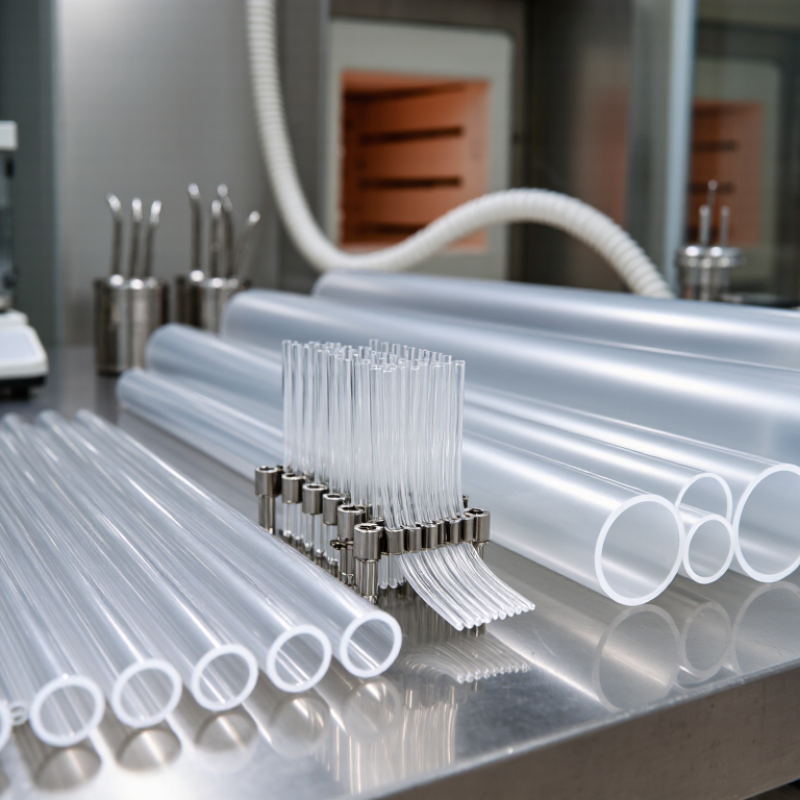
Silica tubing is a hollow tube made from high-purity silicon dioxide, often in fused form. Unlike common glass, it can tolerate higher temperatures and expands very little when heated. Depending on its grade and wall thickness, it can also transmit ultraviolet light. It behaves differently. These properties matter when equipment needs heat resistance, optical access, or low contamination.
In laboratories, narrow silica tubes carry gases or liquids through analytical instruments and may serve as sample cells or furnace liners. Industrial systems use them to guide hot gases, protect sensors, or provide a clear path for light near a process. A technician may check a tube under a bench lamp for chips, cloudy patches, or rough ends before installation. Small details matter. Silica is hard but brittle, so a sharp bend or side load can cause a sudden break.
Selecting tubing involves checking its inner and outer diameters, wall thickness, operating temperature, chemical exposure, and bend radius. The right dimensions depend on flow and pressure, not appearance alone. A thinner wall may improve heat transfer but leave less room for handling errors. In practice, a specification sheet rarely tells the whole story: connectors, thermal cycling, and installation stress can affect service life. Testing the assembly under realistic conditions can reveal problems early.
Evaluating a silica tubing manufacturer starts with the material, not the catalog. Buyers should ask about silica purity, production methods, and how each batch is checked. Request dimensional data, including inner diameter, outer diameter, and wall thickness. Small variations can affect flow, fitting, and performance in heated equipment.
Performance claims need context. Ask for test conditions, such as temperature range, thermal cycling, and chemical exposure. A tube tested under one condition may behave differently in another application. Look for batch records and inspection reports that connect measurements to actual production lots. A neat brochure is not proof. Samples can help, but they should represent routine output, not specially prepared pieces.
Production capacity, packaging, and technical communication also matter. Check whether the supplier can maintain consistent tolerances across repeat orders and protect tubing from dust, impact, and moisture during shipping. Clear answers about lead times and defect handling are useful evidence of operational discipline. No scorecard is perfect. Buyers may still overlook a detail, so document application requirements before comparing suppliers. A careful evaluation balances verified test data with practical questions from the people who will install and use the tubing.
Ten Chinese silica tubing manufacturers to know should be compared by process control, not catalogue breadth alone. Silica tubing serves demanding applications where wall thickness, bore diameter, purity, and thermal stability matter. Ask for tolerances and batch inspection records. Small variations can complicate assembly.
The U.S. Geological Survey’s Mineral Commodity Summaries 2024 estimated U.S. industrial sand and gravel production at about 120 million metric tons in 2023. This is a useful raw-material indicator, not a measure of tubing output. That distinction matters. Supplier checks should include material traceability, dimensional reports, and sample testing under the intended temperature cycle. Request clear data on breakage rates and packaging, too. A polished sample tells only part of the story. Comparisons remain imperfect when manufacturers use different test methods; buyers should align specifications before reviewing quotes. A careful shortlist can reveal meaningful differences in consistency, lead times, and technical support.
Comparing ten silica-tubing manufacturers means looking beyond headline purity claims. Check outside diameter, wall thickness, concentricity, and length tolerances against your process drawings. For high-temperature furnaces, thermal-shock resistance and consistent wall geometry matter at the hot zone, where uneven heating can cause premature failure. For fluid handling, inspect surface finish, bore cleanliness, and whether custom bends introduce stress. Ask how each supplier tests and documents these properties. That matters.
Capacity is another dividing line. Some producers focus on standard tubing and repeatable volume; others offer small-batch dimensions, drawn-to-order sections, or tighter inspection records. SEMI reported that global semiconductor-materials sales reached 67.5 billion dollars in 2024, reflecting strong demand across a sector that uses high-purity materials. This figure is not silica-tubing sales, so it should not be treated as a direct market ranking. Rankings can mislead. Catalogs rarely show real-world yield, lead-time variation, or how promptly a supplier resolves out-of-tolerance parts. Compare sample inspection reports, lot traceability, and delivery records alongside specifications. A slightly awkward point: the lowest stated impurity level may not improve performance if the tubing’s dimensions drift between batches. Request comparable test data before deciding.
A material-level comparison of typical thermal expansion coefficients—not a manufacturer ranking. Lower expansion generally means less dimensional change during temperature shifts.
Typical approximate coefficients of thermal expansion (20–300°C): fused silica, 0.55; borosilicate glass, 3.3; soda-lime glass, 9.0 × 10⁻⁶/K. Actual values vary with glass composition and product specifications.
Choosing a silica tubing manufacturer requires more than comparing prices and lead times. Check the tube’s outer diameter, wall thickness, concentricity, and straightness against your application’s tolerances. Ask for batch-level inspection records, not just a sample certificate. Small differences matter. The USGS Mineral Commodity Summaries 2024 estimated U.S. industrial sand and gravel production at 120 million metric tons in 2023. That figure describes a broad feedstock market, not tubing quality; it is a reminder to verify the manufacturer’s silica grade and traceability directly.
Request material composition, operating-temperature limits, and test methods in writing. For thermal processes, NIST reference data place fused silica’s thermal expansion near 0.5 parts per million per kelvin at room temperature, but actual performance depends on material and conditions. Ask how each batch is measured, and whether the supplier can provide dimensional results and representative test data. Inspect packaging details too: capped ends and clean, separated tubes reduce the chance of chips or contamination during shipment. Ask for proof. A polished audit file can still miss variation between batches, so compare documents with trial samples and your own measurements before committing to volume orders.
„Thanks to the LUVIR technology, the solder resist process could be switched directly from the previously used mask exposure to direct exposure. As an outstanding digital solution on the market, this technology has been able to demonstrate fast process times and superior quality on our certified conventional ink in production. This allowed us to fully digitize the solder mask process at low cost – without process or ink adjustments. An excellent benefit to our production in Rot am See.“
Ralf Göhringer (Head of Production WE Rot am See)
I would definitely recommend the Limata machine and team for a future company purchase
Michael Greenaway
Compunetics Inc.
“The Limata ldi has been amazing!! Best thing we did was buy this machine”
Richard Brady
GM
Circuitlabs
“Since 2019, we have been running the Limata X1000 LDI system (including LUVIR for solder mask imaging) in daily production as an addition to our current process with film. The machine was capable of properly exposing Taiyo PSR-4000 BN (DI) solder mask types on normal to high-copper boards using a new and unique direct imaging process. The machine operating interface is very user friendly which allowed for a quick technical training curve. The pre-registration processing reduced several seconds of production time at every print. Limata support and service staff is incomparable. They supported our team every step of the way at basically any time of the day or night, with literally, an immediate response time, customizing the software interface to best fit our Operations and needs.
We have exposed more than 8,000 prints since end of October, on various solder mask colors and some resist film panels. Limata, has proven to be very capable and innovative. They are a strong contender in the industry.
We have very much enjoyed this project, and working with the team!
Thank you Limata for the continued support and being a part of our growth.”
Bill Sezate
Vice President, GM
Summit Interconnect
As a replacement to our current contact exposure process with film, the LIMATA X2000 system including LUVIR-Technology was capable of properly exposing non-LDI solder mask types using a direct imaging process. The machine offers cutting edge software with a very intuitive operating interface which allowed for quick technician training curve. The dual drawer system combined with pre-registration processing reduced several seconds of production time at every machine cycle. Limata support and service staff is world class. They added software patches to keep production running at shortest possible response times, customized the software interface to best fit our in-house Operations system, and even wrote a step-by-step machine processing manual. As a result of the project, we have exposed more than 16,000 times on various product types and solder mask brands/colors. Limata, in a very short timeframe as a company, has definitely shown they are truly innovative and will be challenging the industry of direct imaging for the top spot.
Kevin Beattie
Process Engineer
TTM Technologies
Forest Grove Division
