As the agricultural sector evolves, Agricultural Drones emerge as game-changers. These high-tech devices revolutionize farming practices through enhanced precision and efficiency. Modern drones allow farmers to monitor crops, assess health, and optimize yields, making them indispensable tools in today’s competitive landscape.
Chinese manufacturers lead the way in innovation, producing advanced drones equipped with unique features. For global buyers, understanding the variety and capabilities of these drones is crucial. Some models excel in pesticide spraying, while others focus on aerial imaging. This diversity offers tailored solutions for different farming needs.
However, selecting the right Agricultural Drone can be challenging. Factors such as pricing, technology, and support services matter significantly. Buyers must weigh their options carefully and consider after-sales support. With rapid advancements, staying informed about new developments is necessary for making smart purchases. Insightful choices can enhance agricultural productivity and sustainability, but misconceptions about drone capabilities can lead to missed opportunities.
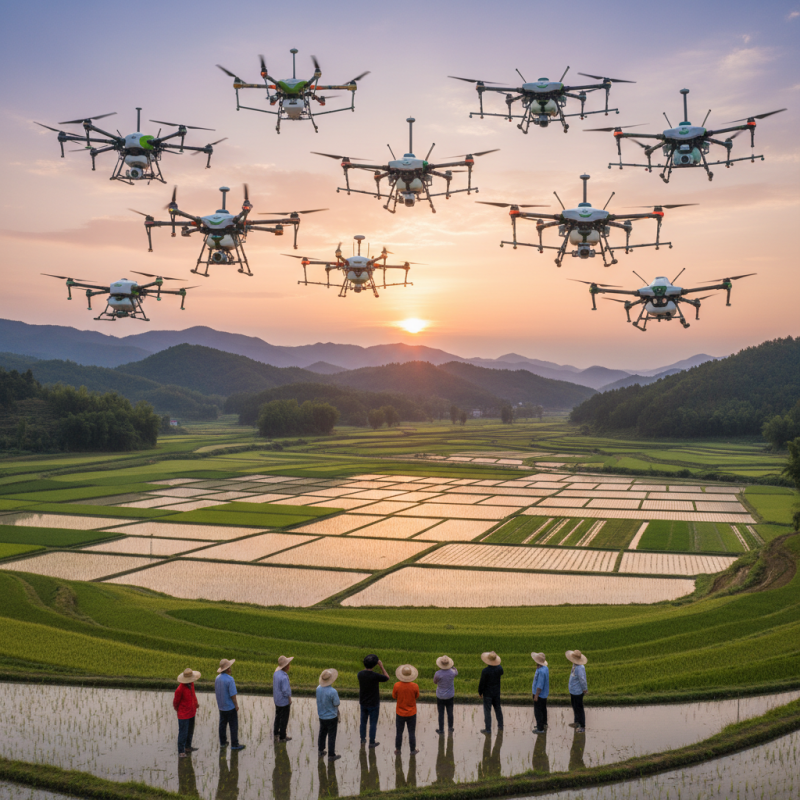
Agricultural drones in China have transformed the farming landscape. They are increasingly utilized for crop health monitoring, pest control, and precision farming. A recent report by ResearchAndMarkets indicated that the Chinese agricultural drone market is expected to grow at a compound annual growth rate (CAGR) of over 15% from 2023 to 2028. This momentum reflects the increasing reliance on technology to enhance agricultural efficiency.
Each year, more farmers embrace these drones for their ability to collect data rapidly. Drones can cover large areas, sometimes up to 100 acres in a single flight. They offer real-time insights, allowing farmers to respond quickly to issues like irrigation needs or disease outbreaks. However, challenges remain.
Data accuracy can vary based on environmental conditions, and not all regions are equally receptive to drone technology. Successful implementation requires training and understanding of drone capabilities. Many farmers still lack these skills or access to education, hindering full benefits of the technology. Additionally, while drones provide valuable data, interpreting this information remains a hurdle.
As the industry evolves, addressing these gaps will be crucial for maximizing the potential of agricultural drones in China.
Selecting the best agricultural drones requires careful consideration of several key criteria. First, assess the drone's payload capacity. This affects how much equipment or materials it can carry. Drones with higher capacities often perform better in larger fields. Battery life is also critical. A drone that can operate for extended periods reduces downtime. Different crops may require different handling, making versatility an asset. Drones that can adapt to various field conditions are highly desirable.
Next, consider the drone’s sensors and imaging capabilities. High-resolution cameras and multi-spectral sensors provide vital data. This data helps in mapping crop health and identifying pests. An intuitive user interface is important for ease of operation. New users may find complex systems overwhelming. Usability can directly impact efficiency in the field. Lastly, think about service and support. Reliable customer service adds value. If issues arise, a supportive provider can make a difference. Reflecting on these aspects enhances decision-making when seeking agricultural drones.
China has emerged as a leader in agricultural drone technology. Several manufacturers are paving the way with innovative designs. They focus on precision agriculture. These drones are equipped with advanced sensors and cameras. This allows farmers to monitor crops effectively. Reliability in these tools is crucial. Farmers need functional and efficient machines.
Many manufacturers incorporate user feedback. This is necessary for improvement. However, some companies still face challenges. Quality control can be inconsistent. These issues may lead to skepticism among users. It's essential to have transparent communication between producers and buyers.
Emerging technologies are introduced constantly. This evolution can be overwhelming for farmers. Education plays a vital role in ensuring effective usage. Some companies offer training alongside their products. Although beneficial, not all farmers take advantage. This gap in knowledge can hinder the full potential of these drones.
The agricultural drone market in China has seen impressive advancements. These drones are designed with cutting-edge technologies that enhance efficiency in farming. They often feature high-resolution cameras and sensors for precise crop monitoring. Many models use advanced data analytics to assist in decision-making.
Battery life is a critical factor. Some drones can operate for up to 30 minutes on a single charge. This may seem short, but it is enough for targeted applications. GPS technology allows drones to fly over large areas autonomously, reducing the time needed for manual inspection. However, lift capabilities vary. Some models may struggle with heavier payloads.
Farmers increasingly rely on data collection. This aids in effective pest management and irrigation planning. The integration of AI in these drones is innovative, yet still developing. Users may encounter challenges with software updates and compatibility issues. Such flaws highlight the growing pains of this technology. Understanding these nuances is essential for global buyers seeking reliable tools.
The agricultural drone market in China is rapidly evolving. As global demand for efficient farming solutions increases, Chinese manufacturers are stepping up. These drones are designed to improve crop monitoring, precision agriculture, and pest control. Recent trends show a significant rise in the adoption of UAVs in farming practices. This shift aligns with the global push for sustainable and high-yield farming.
Many farmers are now looking for ways to integrate drones into their operations. However, knowledge gaps remain. Some agricultural workers may not fully understand drone technology. This may hinder optimal usage. Training and support are essential to bridge these gaps. It ensures that farmers can maximize the potential of these tools.
In addition, data analytics is playing a crucial role in this sector. Drones collect invaluable information, enhancing decision-making processes. However, some producers face challenges in data interpretation. Recognizing and addressing this issue is important for future growth. Chinese agricultural drones hold promise for the global market but must evolve alongside user needs.
„Thanks to the LUVIR technology, the solder resist process could be switched directly from the previously used mask exposure to direct exposure. As an outstanding digital solution on the market, this technology has been able to demonstrate fast process times and superior quality on our certified conventional ink in production. This allowed us to fully digitize the solder mask process at low cost – without process or ink adjustments. An excellent benefit to our production in Rot am See.“
Ralf Göhringer (Head of Production WE Rot am See)
I would definitely recommend the Limata machine and team for a future company purchase
Michael Greenaway
Compunetics Inc.
“The Limata ldi has been amazing!! Best thing we did was buy this machine”
Richard Brady
GM
Circuitlabs
“Since 2019, we have been running the Limata X1000 LDI system (including LUVIR for solder mask imaging) in daily production as an addition to our current process with film. The machine was capable of properly exposing Taiyo PSR-4000 BN (DI) solder mask types on normal to high-copper boards using a new and unique direct imaging process. The machine operating interface is very user friendly which allowed for a quick technical training curve. The pre-registration processing reduced several seconds of production time at every print. Limata support and service staff is incomparable. They supported our team every step of the way at basically any time of the day or night, with literally, an immediate response time, customizing the software interface to best fit our Operations and needs.
We have exposed more than 8,000 prints since end of October, on various solder mask colors and some resist film panels. Limata, has proven to be very capable and innovative. They are a strong contender in the industry.
We have very much enjoyed this project, and working with the team!
Thank you Limata for the continued support and being a part of our growth.”
Bill Sezate
Vice President, GM
Summit Interconnect
As a replacement to our current contact exposure process with film, the LIMATA X2000 system including LUVIR-Technology was capable of properly exposing non-LDI solder mask types using a direct imaging process. The machine offers cutting edge software with a very intuitive operating interface which allowed for quick technician training curve. The dual drawer system combined with pre-registration processing reduced several seconds of production time at every machine cycle. Limata support and service staff is world class. They added software patches to keep production running at shortest possible response times, customized the software interface to best fit our in-house Operations system, and even wrote a step-by-step machine processing manual. As a result of the project, we have exposed more than 16,000 times on various product types and solder mask brands/colors. Limata, in a very short timeframe as a company, has definitely shown they are truly innovative and will be challenging the industry of direct imaging for the top spot.
Kevin Beattie
Process Engineer
TTM Technologies
Forest Grove Division
