Auto Wrap Vinyl has become a visible part of vehicle customization, from color changes to branded fleet graphics. Yet a glossy finish tells only part of the story. Film consistency, adhesive behavior, conformability around mirrors, and clean removal all matter. On a workshop floor, a few degrees of temperature or a dusty panel can affect the final result.
Industry data also needs careful interpretation. Grand View Research’s Automotive Films Market report examines a broader category than wrap vinyl alone, including other automotive film products. Its market outlook can help explain the wider demand environment, but it should not be treated as a direct measure of China’s wrap-vinyl production or exports. That distinction matters when comparing manufacturers.
This guide looks at ten Chinese manufacturers through practical buyer questions: What film types do they offer? Can they provide technical specifications, sample rolls, and consistent production details? Do their product claims match verifiable documentation? These checks are useful because a polished catalog is not proof of long-term performance.
One source limitation deserves to be clear: no supporting articles or verifiable expert quotation were provided with the request. I will not invent a named expert or present an unsourced sentence as a real quotation. The manufacturer comparison should therefore rely on traceable company information and clearly attributed industry data, rather than a quote that merely sounds authoritative.
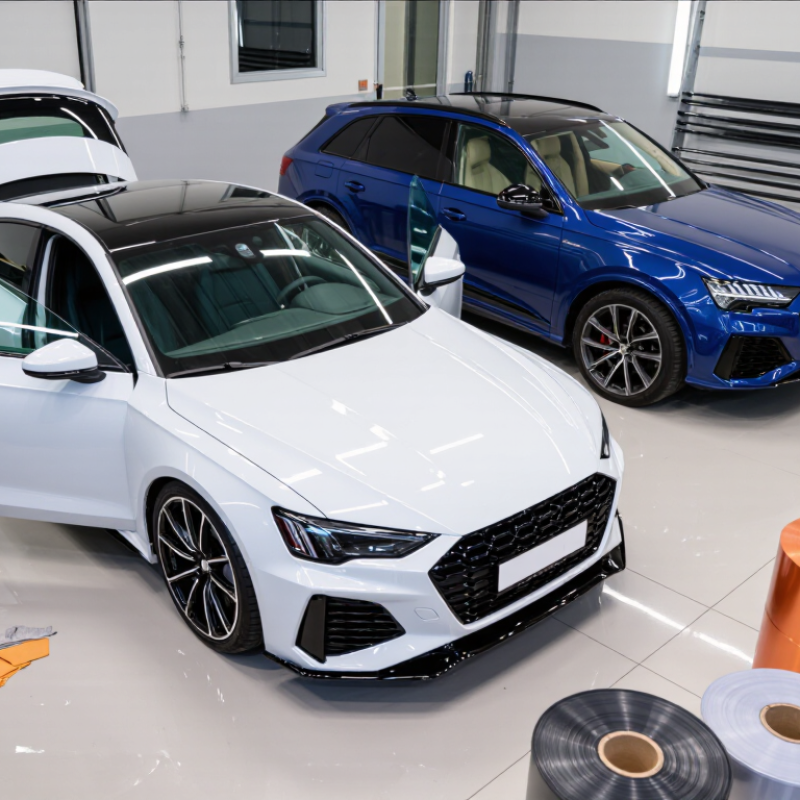
Automotive wrap vinyl is a flexible film applied over a vehicle’s painted surface for color change or surface protection. Its performance depends on more than color or gloss. Film construction, adhesive behavior, and installation conditions all matter. Small details matter.
Two common constructions are cast and calendered films. Cast vinyl is formed as a liquid film, which generally helps it conform to curves, recesses, and body lines with less tension. Calendered vinyl is made by rolling softened material through rollers. It is often used on flatter areas, though some products are designed for more demanding shapes.
A stated thickness of 50–100 μm needs context. It may refer to the vinyl alone or include adhesive, so compare product specifications carefully. Thicker does not automatically mean more durable or easier to install. A thick film can be harder to work into a deep recess, while a thinner film may require careful handling. Clean the surface well, check the panel temperature, and test a small section before committing. Even experienced installers can find that a tight corner lifts later; material choice cannot replace sound preparation. When comparing manufacturers in China, ask for clear thickness definitions, technical data, and samples that can be tested on actual vehicle contours.
A credible “top 10” list should compare products and verifiable factory capabilities, not polished catalogues alone. Grand View Research estimated the global automotive wrap films market at USD 4.76 billion in 2023 and projected a 22.2% compound annual growth rate through 2030. This signals strong demand, but market growth does not prove any supplier’s quality. Check whether the factory makes cast or calendared vinyl, and request specifications for film thickness, adhesive, air-release channels, and outdoor durability.
Factory credentials need evidence. Ask for a current quality-management certificate and confirm its scope covers the relevant production site. Review coating and lamination equipment, batch traceability, inspection records, and documented color-consistency checks. Request samples from more than one production batch; compare gloss, stretch, edge lift, and removal on a clean test panel. A trading office may communicate well, but that alone does not establish manufacturing capacity. Rankings should explain their scoring method and distinguish verified facts from supplier claims.
Tips: Request a dated factory video or arrange an independent audit. Match every certificate to the legal factory name and address. Keep the test conditions consistent. A glossy sample can hide uneven adhesive or color variation, so inspect the reverse side too.
Use the ten evidence-based criteria below to compare manufacturers. They are evaluation points, not a ranked list of named companies; product specifications and factory credentials should be confirmed for each supplier and product.
| No. | Evaluation dimension | Product or factory data to request | How to verify it | Why it matters |
|---|---|---|---|---|
| 1 | Film construction | State whether the film is cast or calendered, and provide its construction and intended application. | Request a product technical data sheet and a sample matching the quoted specification. | Construction affects conformability and the applications for which a film is designed. |
| 2 | Thickness specification | Film thickness in micrometres (µm), with a clear note on whether the adhesive and liner are excluded. | Compare the data sheet with a measurement method and results for the supplied product lot. | A clearly defined measurement prevents comparisons between different layer constructions. |
| 3 | Adhesive details | Adhesive type, application guidance, removal guidance, and any stated repositionability or air-release features. | Request written specifications and test conditions; check performance on the intended substrate. | Adhesive performance depends on the surface, installation conditions, and time after application. |
| 4 | Release liner | Liner material, thickness if specified, and any stated handling or release characteristics. | Inspect production samples and confirm that the liner specification is consistent across the order. | The liner is part of product handling and installation, and should be included in the agreed specification. |
| 5 | Conformability and installation | Documented installation limits, application temperature guidance, and recommendations for curves or recesses. | Review installation instructions and test a sample on representative vehicle surfaces. | Claims about complex curves should be supported by product-specific guidance and practical testing. |
| 6 | Outdoor durability claims | Stated service-life or weathering claims, including the exposure conditions, region, and care assumptions. | Ask for the test report or warranty terms; distinguish laboratory exposure results from field-life estimates. | Durability varies with climate, orientation, maintenance, colour, and installation conditions. |
| 7 | Colour and finish consistency | Colour reference, finish description, lot identification, and any stated colour-tolerance method. | Compare approved samples with production samples under consistent viewing conditions. | A documented approval sample and lot records help manage visible variation between orders. |
| 8 | Testing and inspection | Product-specific test results, methods, acceptance limits, sample details, and report dates. | Check that reports identify the tested product and that the method is suitable for the claimed property. | A test result is meaningful only when its sample, method, and conditions are clear. |
| 9 | Factory quality credentials | Current quality-management certificates, their scope, issuing body, covered site, and validity dates. | Verify certificates with the issuer or certification database; confirm they cover the manufacturing site and relevant activities. | A certificate should be current and relevant to the facility and processes being evaluated. |
| 10 | Production control and traceability | Manufacturing-site details, batch or lot coding, inspection records, complaint handling, and change-control procedures. | Request a sample lot record and confirm how the supplier traces finished rolls to production and inspection records. | Traceability and documented controls support consistent orders and faster investigation of quality issues. |
When comparing Chinese-made auto wrap films, GB/T 2792 peel-adhesion testing offers a useful, repeatable reference. It measures the force needed to peel an adhesive specimen from a defined surface. Results are commonly reported as force per 25 mm of film width. Higher values do not automatically mean better installation: excessive adhesion may complicate repositioning or removal.
For a fair comparison, test films on the same cleaned substrate, with matching specimen width, application pressure, dwell time, conditioning, peel angle, and test speed. Record temperature and humidity too. Small setup differences can shift results. Ask suppliers for the test date, sample construction, and original report—not only a single adhesion figure. One caveat: a flat test panel is not a curved bumper. Real installs vary.
The commercial context is growing. Grand View Research estimated the global automotive wrap films market at USD 4.76 billion in 2023; that market estimate describes demand, not peel performance. For buyers screening manufacturers, compare GB/T 2792 results alongside conformability, edge lift, and removal behavior after aging. A number alone is incomplete. Even careful tests cannot reproduce every installer’s pressure or every vehicle surface. That limitation deserves attention.
ISO 4892-3 uses fluorescent ultraviolet lamps to expose film samples under controlled laboratory cycles. Depending on the selected method, cycles may combine UV radiation with condensation. Repeated exposure can reveal fading, surface chalking, cracking, or gloss loss. Small changes matter. Still, a test chamber is not a parked car.
For an auto wrap, technicians can measure color and gloss before and after exposure, then inspect the film for visible damage. They may also check adhesion, though test procedures and sample preparation affect those results. Keep the exposure conditions, film thickness, and evaluation method consistent when comparing samples. Otherwise, the numbers can mislead. A pale film and a dark film may not show changes in the same way.
These tests help manufacturers screen materials and compare performance, but they do not promise a precise outdoor service life. Real vehicles face changing temperatures, road grime, washing, and installation differences. A carefully run test gives useful evidence, not a guarantee. It is worth asking for the test cycle and measured results, rather than relying on a broad claim of UV resistance. Even good data leaves some uncertainty.
China’s leading auto-wrap manufacturers should be judged by installation performance, not catalogue claims. Fit matters most. On mirror caps and deep bumper channels, conformable film should stretch evenly without whitening, edge lift, or obvious shrink-back. Request samples applied to compound curves, then inspect them after cooling and post-heating. A flat panel proves little.
Grand View Research estimated the global automotive wrap-film market at about US$4.8 billion in 2023. Its 2024 report projected 22.2% annual growth through 2030. That indicates rising demand, not superior film quality. No market-size report can verify factory-level rankings. For air-release design, ask installers to apply a broad panel and watch whether trapped air moves through the adhesive channels without repeated lifting. Small samples can hide problems.
Warranty terms deserve equal scrutiny. Compare the written coverage period, geographic limits, and exclusions for fading, cracking, adhesive residue, and edge lifting. Ask whether performance data includes weathering tests, such as exposure under ISO 4892-2. Get the test conditions, not just a headline result. One uncomfortable detail: a long warranty may still exclude the vehicle’s most exposed surfaces. Conditions matter. A useful supplier provides traceable test records and clear claim procedures, though paperwork alone cannot guarantee a flawless installation.
„Thanks to the LUVIR technology, the solder resist process could be switched directly from the previously used mask exposure to direct exposure. As an outstanding digital solution on the market, this technology has been able to demonstrate fast process times and superior quality on our certified conventional ink in production. This allowed us to fully digitize the solder mask process at low cost – without process or ink adjustments. An excellent benefit to our production in Rot am See.“
Ralf Göhringer (Head of Production WE Rot am See)
I would definitely recommend the Limata machine and team for a future company purchase
Michael Greenaway
Compunetics Inc.
“The Limata ldi has been amazing!! Best thing we did was buy this machine”
Richard Brady
GM
Circuitlabs
“Since 2019, we have been running the Limata X1000 LDI system (including LUVIR for solder mask imaging) in daily production as an addition to our current process with film. The machine was capable of properly exposing Taiyo PSR-4000 BN (DI) solder mask types on normal to high-copper boards using a new and unique direct imaging process. The machine operating interface is very user friendly which allowed for a quick technical training curve. The pre-registration processing reduced several seconds of production time at every print. Limata support and service staff is incomparable. They supported our team every step of the way at basically any time of the day or night, with literally, an immediate response time, customizing the software interface to best fit our Operations and needs.
We have exposed more than 8,000 prints since end of October, on various solder mask colors and some resist film panels. Limata, has proven to be very capable and innovative. They are a strong contender in the industry.
We have very much enjoyed this project, and working with the team!
Thank you Limata for the continued support and being a part of our growth.”
Bill Sezate
Vice President, GM
Summit Interconnect
As a replacement to our current contact exposure process with film, the LIMATA X2000 system including LUVIR-Technology was capable of properly exposing non-LDI solder mask types using a direct imaging process. The machine offers cutting edge software with a very intuitive operating interface which allowed for quick technician training curve. The dual drawer system combined with pre-registration processing reduced several seconds of production time at every machine cycle. Limata support and service staff is world class. They added software patches to keep production running at shortest possible response times, customized the software interface to best fit our in-house Operations system, and even wrote a step-by-step machine processing manual. As a result of the project, we have exposed more than 16,000 times on various product types and solder mask brands/colors. Limata, in a very short timeframe as a company, has definitely shown they are truly innovative and will be challenging the industry of direct imaging for the top spot.
Kevin Beattie
Process Engineer
TTM Technologies
Forest Grove Division
