China’s absorbent hygiene industry serves buyers across diapers, adult care, feminine care, and medical applications. This guide examines China’s leading Absorbent Core manufacturers for global buyers. It focuses on production capability, material control, technical support, and supply reliability.
An absorbent core usually combines fluff pulp, superabsorbent polymer, tissue, and nonwoven layers. Each material affects fluid intake, retention, rewet, thickness, and comfort. Experienced manufacturers should explain these relationships clearly. They should also provide test data, sample records, and traceable quality procedures. Look for evidence from factory audits, laboratory reports, customer references, and consistent batch performance. Certifications matter, but documents alone cannot prove manufacturing discipline. Ask how suppliers control SAP distribution, pulp formation, core compression, dust, and edge leakage. Small production details often decide whether a product performs well on the shelf.
Details matter most.
This overview considers factories that support OEM development, stable volume production, export packaging, and responsive communication. It also recognizes practical limitations. Public information may be incomplete, and supplier claims require independent verification. Product performance can change with machine settings, material substitutions, humidity, and storage time. Global buyers should test finished samples under realistic pressure, temperature, and liquid conditions. They should review lead times, minimum order quantities, payment terms, and corrective-action records. A lower quotation may hide higher inspection costs or inconsistent absorbency. A strong supplier is not simply the cheapest option. It is a manufacturer that communicates risks honestly and improves when problems appear. That standard supports safer purchasing decisions, stronger long-term partnerships, and more dependable hygiene products.
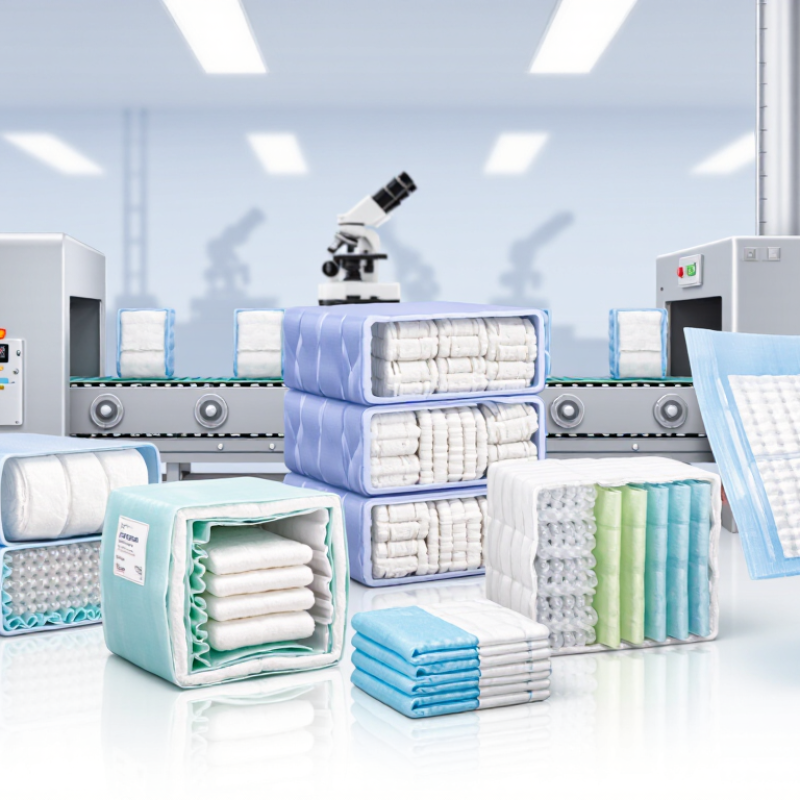
China Top Absorbent Core Manufacturers for Global Buyers
What Absorbent Cores Are and Why They Matter in Hygiene Products
An absorbent core is the working center inside a diaper, sanitary pad, or adult incontinence product. It usually combines fluff pulp with superabsorbent polymer, or SAP. The pulp draws liquid across the structure. SAP locks much of that liquid into gel. This balance affects dryness, leakage control, comfort, and product thickness. In practical testing, liquid must move quickly from the surface, then remain stable during pressure and movement. A core that absorbs well in a laboratory can still perform poorly during sleep or long sitting.
The need is substantial. UNICEF and WHO reported in their 2023 menstrual health analysis that about 1.8 billion women and girls menstruate worldwide, while many still lack suitable materials, privacy, or water facilities. Smithers’ The Future of Global Nonwovens to 2029 also identifies hygiene as a major nonwoven end-use sector. These findings show why core design matters beyond factory efficiency. Fiber choice, SAP distribution, acquisition layers, and core shaping must match local use conditions. A thinner core is not automatically better. That assumption deserves more testing.
Tips: Ask manufacturers for acquisition speed, rewet, retention, and pressure-leakage data. Check results under realistic loads, not only dry laboratory conditions. Confirm SAP uniformity across the full core. Small gaps can create large failures.
Absorbent cores typically combine fluff pulp for liquid distribution and structural support with superabsorbent polymer (SAP) for liquid retention. The representative values below show approximate liquid-holding capacity by material under different test conditions. Actual performance varies with formulation, pressure, liquid composition, and core design.
China Top Absorbent Core Manufacturers for Global Buyers
China’s absorbent core industry has changed from basic cotton and fluff structures to engineered systems using SAP, airlaid materials, and nonwoven layers. Early production focused on volume and simple assembly. Today, many factories use automated forming lines, online weight control, and laboratory testing. These improvements support thinner cores, faster liquid acquisition, and better retention under pressure. Production is also more flexible. Buyers can request different core weights, dimensions, acquisition speeds, and packaging formats for regional markets.
This development has not been perfectly smooth. Some suppliers still depend heavily on manual inspection, which can create uneven density between batches. Material traceability also varies. Reliable manufacturers should provide test records for absorbency, rewet, tensile strength, and dimensional stability. They should explain SAP ratios clearly, not hide performance behind vague claims. Factory audits, sample comparisons, and small trial orders remain practical safeguards for international buyers. Lower pricing can be useful, but inconsistent raw materials may increase total costs later.
Tips: Compare samples under the same test method. Check core density at several points, not only the center. Ask how suppliers control pulp moisture and SAP distribution. Review production capacity, inspection procedures, and export documentation before signing a long-term agreement. Sustainability deserves attention too. Thinner cores may reduce material use, yet recycling and disposal challenges remain. This part still needs more honest industry discussion.
Chinese absorbent core manufacturers increasingly combine fluff pulp, superabsorbent polymer (SAP), tissue, and nonwoven layers. Grand View Research valued the global SAP market at about USD 9.15 billion in 2023, with continued growth expected through 2030. This demand encourages Chinese producers to improve material control, rather than simply increase output.
Fluff pulp creates the initial liquid pathway. SAP then locks fluid inside the core. Many factories use airlaid forming, controlled SAP dosing, and hot-melt bonding to reduce shifting. Acquisition layers help spread liquid across the surface. Channel designs can improve dryness and reduce core thickness. However, a thinner core is not automatically better. Poor distribution may create gel blocking, especially under pressure.
Independent supplier audits should check SAP absorption under load, pulp moisture, basis weight, and core integrity. EDANA guidance emphasizes standardized hygiene-product testing, including liquid acquisition and retention performance. Chinese producers also use online cameras, weight sensors, and sampling laboratories to control variation. The equipment looks advanced. Results can still differ between production lines. That weakness deserves attention.
For global buyers, technical documents should identify SAP dosage, pulp origin, adhesive type, testing temperature, and sample conditioning. Trial orders should include repeated absorption tests, not one successful sample. Bio-based materials are gaining interest, but their environmental claims require verified life-cycle evidence. The real advantage lies in stable formulation and disciplined process control. Not attractive wording.
Global buyers should assess China’s absorbent core manufacturers through evidence, not factory photographs. Grand View Research estimated the global superabsorbent polymers market at USD 9.42 billion in 2023. Its report also projects a 6.3% CAGR from 2024 to 2030. This growth increases supplier choices, but it also increases evaluation risks. Ask for recent test results covering absorption capacity, retention under pressure, acquisition speed, dust, and core integrity.
Request samples from the same production line proposed for mass orders. A reliable manufacturer should explain pulp sourcing, SAP grades, forming equipment, and quality-control frequency. Check whether operators record basis weight and moisture at defined intervals. Independent laboratory testing is valuable. Compare results against agreed specifications, not vague claims such as “ultra absorbent.” Smithers’ hygiene products market analysis highlights continuing demand for thinner products with stronger performance. Therefore, test leakage protection after compression, bending, and repeated loading.
Factory audits should examine traceability, calibration records, complaint handling, and corrective actions. Production capacity deserves careful questioning. Monthly output may look impressive, yet available capacity can shrink during seasonal demand. I have seen evaluations focus too heavily on price. That is a mistake. A lower quotation may hide higher rejection rates, unstable materials, or expensive port delays. Still, no audit is perfect. Recheck performance after pilot production, because laboratory samples can flatter real manufacturing. Ask for batch records and retain sealed samples for comparison.
China’s absorbent core manufacturers serve a growing hygiene market, but export readiness requires more than competitive pricing. The United Nations World Population Prospects 2024 projects that people aged 65 and above will exceed children under 18 globally by 2080. This demographic shift supports continued demand for reliable incontinence products. Buyers should verify whether suppliers can produce stable fluff pulp and superabsorbent polymer structures at commercial scale.
Quality control should follow documented procedures, not verbal promises. Request batch records for basis weight, absorption capacity, retention, rewet, core dimensions, and material cleanliness. ISO 9073 test methods can support nonwoven evaluation, while ISO 10993 may help assess biological safety for relevant product components. Export files should include technical specifications, safety data sheets, origin documents, and consistent packaging records. A third-party laboratory report is useful. It is not enough.
Inspect production floors for calibrated weighing scales, controlled storage, dust management, and sealed raw-material packaging. Moisture exposure can reduce performance before the core reaches the converter. Ask for samples from three separate batches, then test them on the intended production line. A supplier may pass a laboratory test yet fail during high-speed assembly. I would also check lead-time history, complaint response, and corrective-action records. One weakness remains common: audits often measure readiness, not long-term consistency. That difference deserves attention.
„Thanks to the LUVIR technology, the solder resist process could be switched directly from the previously used mask exposure to direct exposure. As an outstanding digital solution on the market, this technology has been able to demonstrate fast process times and superior quality on our certified conventional ink in production. This allowed us to fully digitize the solder mask process at low cost – without process or ink adjustments. An excellent benefit to our production in Rot am See.“
Ralf Göhringer (Head of Production WE Rot am See)
I would definitely recommend the Limata machine and team for a future company purchase
Michael Greenaway
Compunetics Inc.
“The Limata ldi has been amazing!! Best thing we did was buy this machine”
Richard Brady
GM
Circuitlabs
“Since 2019, we have been running the Limata X1000 LDI system (including LUVIR for solder mask imaging) in daily production as an addition to our current process with film. The machine was capable of properly exposing Taiyo PSR-4000 BN (DI) solder mask types on normal to high-copper boards using a new and unique direct imaging process. The machine operating interface is very user friendly which allowed for a quick technical training curve. The pre-registration processing reduced several seconds of production time at every print. Limata support and service staff is incomparable. They supported our team every step of the way at basically any time of the day or night, with literally, an immediate response time, customizing the software interface to best fit our Operations and needs.
We have exposed more than 8,000 prints since end of October, on various solder mask colors and some resist film panels. Limata, has proven to be very capable and innovative. They are a strong contender in the industry.
We have very much enjoyed this project, and working with the team!
Thank you Limata for the continued support and being a part of our growth.”
Bill Sezate
Vice President, GM
Summit Interconnect
As a replacement to our current contact exposure process with film, the LIMATA X2000 system including LUVIR-Technology was capable of properly exposing non-LDI solder mask types using a direct imaging process. The machine offers cutting edge software with a very intuitive operating interface which allowed for quick technician training curve. The dual drawer system combined with pre-registration processing reduced several seconds of production time at every machine cycle. Limata support and service staff is world class. They added software patches to keep production running at shortest possible response times, customized the software interface to best fit our in-house Operations system, and even wrote a step-by-step machine processing manual. As a result of the project, we have exposed more than 16,000 times on various product types and solder mask brands/colors. Limata, in a very short timeframe as a company, has definitely shown they are truly innovative and will be challenging the industry of direct imaging for the top spot.
Kevin Beattie
Process Engineer
TTM Technologies
Forest Grove Division
