Selecting an Aeration Diffuser manufacturer is not simply a price comparison. Global buyers must examine oxygen transfer, membrane quality, energy use, service support, and field performance. A diffuser may look efficient in a catalog, yet perform differently inside a deep tank with uneven airflow, cold water, or heavy biological loading.
Dr. Bruce Rittmann, a leading wastewater treatment researcher, has stated, “Energy efficiency must be built into water treatment, not added later.” This principle matters when evaluating Aeration Diffuser suppliers. Fine-bubble systems can reduce blower demand, but only when pore structure, operating pressure, and maintenance practices work together. Factory testing helps. Independent performance data helps more.
The leading manufacturers usually show practical evidence. Look for oxygen transfer test results, membrane materials, airflow ranges, replacement schedules, and projects with similar wastewater conditions. Ask how the diffuser behaves after months of exposure to grease, scaling, or suspended solids. A low purchase price can become expensive when cleaning is difficult or membranes fail early.
Some rankings remain imperfect.
Supplier claims may not use identical test methods. That makes direct comparison harder. Buyers should review technical drawings, certifications, warranties, and local installation experience before choosing. This guide examines China’s top Aeration Diffuser manufacturers for global buyers, focusing on measurable performance, production capability, customization, and dependable after-sales support. The best choice is rarely the cheapest one. It is the diffuser that delivers stable oxygen transfer, manageable maintenance, and credible results in real operating conditions.
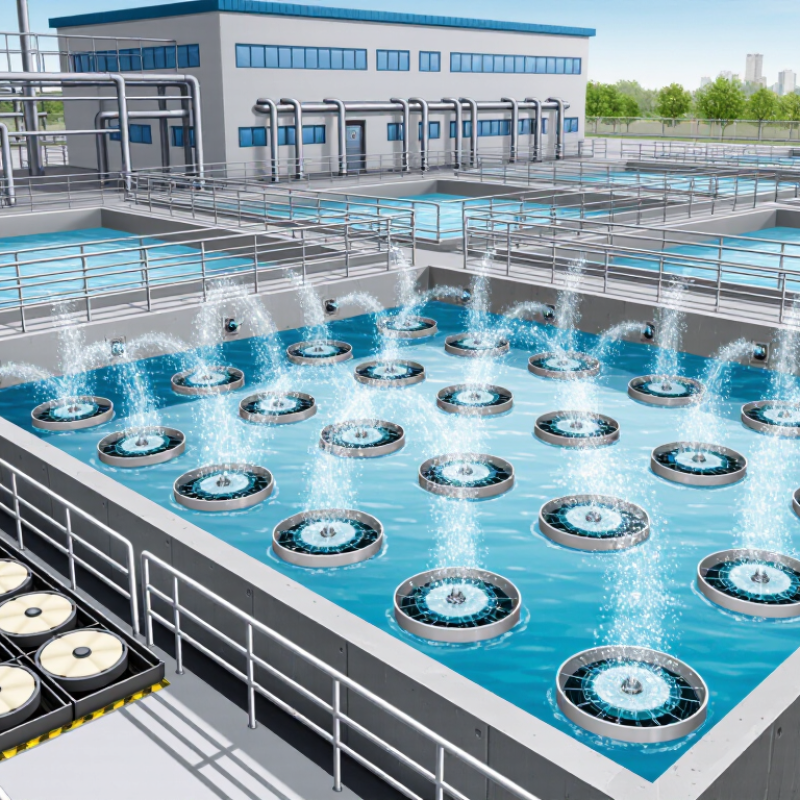
China’s aquaculture farms commonly use fine-bubble disc and tube diffusers. They release small bubbles across tanks, ponds, and raceways. Smaller bubbles usually provide better oxygen transfer. However, clogging can reduce performance in muddy or algae-rich water. Membrane materials often include EPDM or silicone. Selection should match salinity, temperature, ozone exposure, and cleaning methods.
Wastewater plants use disc, tube, and coarse-bubble diffusers for biological treatment and mixing. Fine-bubble systems suit activated sludge tanks because they improve oxygen efficiency. Coarse bubbles are useful where solids may settle or where stronger circulation is needed. Ceramic diffusers can handle certain high-temperature applications, but they may require careful handling. Actual performance depends on airflow, water depth, fouling, and tank geometry, not diffuser type alone.
Tips: Ask manufacturers for clean-water and process-water test data. Check oxygen transfer results at your operating depth. Request membrane aging information and replacement guidance. Inspect pore uniformity, connection size, and air distribution before ordering. A lower purchase price can become expensive after frequent cleaning. We have found that pilot testing is often wiser than relying on catalog figures. Some specifications still look convincing, yet field results can disappoint.
Reliable Chinese aeration diffuser manufacturers combine practical engineering with disciplined production control. They understand how pore size, membrane material, and air distribution affect oxygen transfer. A dependable factory should explain these choices clearly, not hide behind technical language. Experienced teams often recommend EPDM for standard wastewater applications and PTFE-coated materials for harsher conditions.
Quality evidence matters. Look for batch records, membrane inspection reports, and airflow testing data. A serious manufacturer checks bubble patterns, connection strength, and operating pressure before shipment. Samples should be tested in water, not only inspected on a workbench. Export experience also helps with packaging, documentation, and installation guidance. Small details prevent costly damage during transport.
No factory is perfect. Even reliable suppliers may face occasional production variation. The important issue is how they respond. They should identify the cause, replace questionable parts, and improve process controls. Ask about traceability from raw material to finished diffuser. A clear answer shows professional responsibility. Site operators should also confirm tank depth, blower capacity, and cleaning conditions before ordering. A diffuser can perform well in testing but disappoint when the airflow is poorly matched. That risk deserves honest discussion.
Typical clean-water oxygen transfer efficiency ranges by diffuser design. Fine-bubble systems generally provide higher oxygen transfer, while coarse-bubble systems are commonly selected for mixing and clogging resistance.
Manufacturing standards determine whether an aeration diffuser performs reliably beyond laboratory conditions.
ISO 9001:2015 supports documented processes, traceability, and corrective actions throughout production. For wastewater applications, ASCE/EWRI 18-18 recommends controlled oxygen-transfer testing under defined water temperature, depth, and airflow conditions.
These details matter because aeration may consume 45–75% of a treatment plant’s electricity, according to the U.S. EPA’s Energy Efficiency in Water and Wastewater Facilities report.
Quality control should begin with incoming membrane materials, not final inspection.
Manufacturers can verify polymer hardness, thickness, tensile strength, and resistance to chemicals used in biological treatment.
During assembly, calibrated gauges should check perforation size and spacing.
A practical batch test measures airflow distribution across several diffusers, while underwater inspection can reveal uneven bubbles, blocked holes, or weak seals. Keep records.
The process is never perfectly uniform. That deserves attention.
Small variations in membrane elasticity can change oxygen transfer and pressure loss.
Independent testing is therefore valuable, especially when buyers compare suppliers using the same airflow and water depth.
Factory acceptance documents should include batch numbers, test conditions, measured pressure loss, and cleaning guidance. A stronger system also samples products after storage and transport, because vibration, heat, and compression may expose weaknesses missed during production.
Global buyers should evaluate diffuser suppliers beyond catalog images and quoted prices. Ask for evidence. A reliable manufacturer can explain membrane material, pore structure, oxygen transfer testing, and pressure loss. Request recent batch records, material certificates, and inspection procedures. These documents reveal whether quality depends on one skilled operator or a repeatable system.
Product samples deserve practical testing. Install several diffusers in a pilot tank with similar water depth and operating pressure. Observe bubble distribution, airflow stability, and fouling after continuous operation. Compare energy use, not only initial bubble size. EPDM may suit many municipal applications, while PTFE-coated options can better handle certain industrial conditions. The correct choice depends on chemicals, temperature, cleaning routines, and expected service life.
Factory evaluation also matters. Check production equipment, warehouse conditions, sealing methods, and traceability labels. Speak with technical staff, not only sales representatives. Ask how they investigate membrane cracking, uneven perforation, or connector leakage. A clear corrective-action process is a strong reliability signal. Warranty terms should define testing conditions, replacement procedures, and response times.
Cheap samples can look excellent for one week. That gap matters. In my experience, buyers sometimes overvalue attractive quotations and underestimate installation support. A supplier may pass a sample test yet struggle with consistent production. Independent inspection and a written pilot protocol can expose that weakness before a large order.
Export support should begin before production, not after packing. Experienced manufacturers confirm tank dimensions, air flow, water quality, connector types, and local electrical requirements. They can provide product drawings, test records, packing lists, certificates, and customs documents. Strong export teams also inspect each batch before shipment. Photos of cartons and loading details reduce confusion at the destination.
Customization matters when standard diffusers do not fit existing equipment. Buyers may request different membrane materials, pore sizes, tube lengths, or mounting connections. Engineers should review air distribution and expected oxygen transfer, rather than simply changing dimensions. In practice, drawings are sometimes revised after the first site check. That is not unusual. It shows why direct technical communication remains important.
Tips: Request a sample, installation guide, spare membranes, and a clear warranty process before ordering. Confirm response times for technical questions and replacement parts. After-sales support should include troubleshooting for uneven bubbles, blocked pores, damaged seals, and unstable airflow. Batch numbers and inspection records make future claims easier. No supplier can predict every operating condition. Buyers should still verify performance during commissioning and record actual airflow, pressure, and cleaning intervals.
„Thanks to the LUVIR technology, the solder resist process could be switched directly from the previously used mask exposure to direct exposure. As an outstanding digital solution on the market, this technology has been able to demonstrate fast process times and superior quality on our certified conventional ink in production. This allowed us to fully digitize the solder mask process at low cost – without process or ink adjustments. An excellent benefit to our production in Rot am See.“
Ralf Göhringer (Head of Production WE Rot am See)
I would definitely recommend the Limata machine and team for a future company purchase
Michael Greenaway
Compunetics Inc.
“The Limata ldi has been amazing!! Best thing we did was buy this machine”
Richard Brady
GM
Circuitlabs
“Since 2019, we have been running the Limata X1000 LDI system (including LUVIR for solder mask imaging) in daily production as an addition to our current process with film. The machine was capable of properly exposing Taiyo PSR-4000 BN (DI) solder mask types on normal to high-copper boards using a new and unique direct imaging process. The machine operating interface is very user friendly which allowed for a quick technical training curve. The pre-registration processing reduced several seconds of production time at every print. Limata support and service staff is incomparable. They supported our team every step of the way at basically any time of the day or night, with literally, an immediate response time, customizing the software interface to best fit our Operations and needs.
We have exposed more than 8,000 prints since end of October, on various solder mask colors and some resist film panels. Limata, has proven to be very capable and innovative. They are a strong contender in the industry.
We have very much enjoyed this project, and working with the team!
Thank you Limata for the continued support and being a part of our growth.”
Bill Sezate
Vice President, GM
Summit Interconnect
As a replacement to our current contact exposure process with film, the LIMATA X2000 system including LUVIR-Technology was capable of properly exposing non-LDI solder mask types using a direct imaging process. The machine offers cutting edge software with a very intuitive operating interface which allowed for quick technician training curve. The dual drawer system combined with pre-registration processing reduced several seconds of production time at every machine cycle. Limata support and service staff is world class. They added software patches to keep production running at shortest possible response times, customized the software interface to best fit our in-house Operations system, and even wrote a step-by-step machine processing manual. As a result of the project, we have exposed more than 16,000 times on various product types and solder mask brands/colors. Limata, in a very short timeframe as a company, has definitely shown they are truly innovative and will be challenging the industry of direct imaging for the top spot.
Kevin Beattie
Process Engineer
TTM Technologies
Forest Grove Division
