Choosing a Metal Filter Disc supplier in China is not just a price comparison. Disc performance depends on the filtration rating, material, operating temperature, and pressure. A disc that looks uniform under bright factory lighting may still have uneven pores or weak welds. Small details matter.
Grand View Research’s Industrial Filtration Market report estimated the global market at about USD 35.1 billion in 2023 and projected continued growth through 2030. This wider market trend reflects rising demand for dependable filtration in manufacturing, water treatment, and process industries. It does not prove that every supplier can meet a buyer’s requirements. That distinction matters.
This guide examines Chinese manufacturers and suppliers through practical purchasing criteria: material traceability, production capability, inspection records, sample testing, and communication during customization. Ask for clear data on pore size, disc thickness, flow rate, and maximum operating conditions. Where appropriate, review relevant test methods, such as ISO 2942 for hydraulic filter-element fabrication integrity; it is not a universal test for every disc. A datasheet is useful. A tested sample is better.
Price still matters, of course. But an attractive quotation can hide differences in tolerances, finishing, or batch consistency. No supplier should be treated as “top” on a name alone. The right choice depends on the application, and even a careful checklist cannot replace testing under real operating conditions.
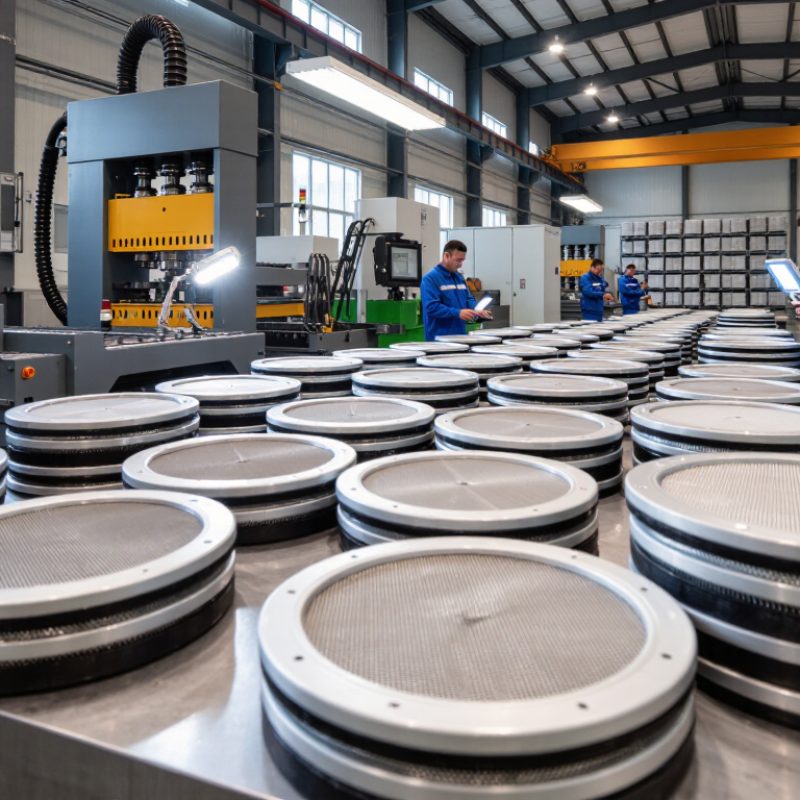
Metal filter discs use three distinct structures, and the right choice depends on particle size, pressure, and cleaning needs. Sintered discs bond metal powder into a rigid porous body. Their tortuous passages support fine filtration, but trapped particles can make cleaning difficult. ISO 4003:1977 specifies bubble-point testing to determine pore size in permeable sintered metal materials. Ask suppliers for test results, not just a nominal micron rating.
Woven discs use interlaced wires, creating regular openings and relatively low flow resistance. ISO 9044:2016 covers industrial woven wire cloth with nominal apertures from 16 μm to 16 mm. That is a broad range. Still, aperture size alone does not guarantee retention; wire diameter and weave also matter. Perforated discs, by contrast, have punched or drilled holes in a solid sheet. They suit coarse screening and mechanical support, but usually cannot match fine sintered media.
When comparing Chinese suppliers, specify alloy, disc thickness, diameter tolerance, operating temperature, and filtration test method. Request a sample and inspect its edges and surface under magnification. Small burrs can complicate assembly. A perfect drawing may still miss real process conditions, so validate the disc with the actual fluid and pressure.
For metal filter discs, 316L stainless steel is a common choice where moisture and cleaning chemicals may challenge the filter. ASTM A240/A240M specifies 316L with a maximum carbon content of 0.03%; its listed composition also includes 2–3% molybdenum. These figures help buyers compare material certificates, not predict service life by themselves. Temperature, chloride exposure, weld quality, and cleaning cycles still matter. A disc can look robust and fail early at a poorly finished edge.
Micron grades commonly span 1–100 μm, but the number alone can mislead. Ask whether the rating is nominal or absolute, and request the test method and particle-capture efficiency. ISO 16889 describes a multipass method for evaluating filter performance using upstream and downstream particle counts. Its beta ratio offers a useful comparison: a beta value of 200 corresponds to 99.5% calculated efficiency at the stated particle size. That is an illustration, not a performance claim for every disc. At 1 μm, pore structure and test conditions become especially important; at 100 μm, open flow and particle retention may be easier to balance. Still, supplier data can vary. Check the actual test report, not just the grade printed on a specification sheet.
A metal filter disc can look flawless and still contain an oversized pore. ISO 4003 describes the bubble-point method for estimating the largest pore in a wetted, permeable metal material. During testing, gas pressure rises until the first steady bubbles appear. That pressure depends on the wetting liquid, surface tension, and temperature, so reports should identify each condition. A single pressure value without test details is hard to compare.
Pressure-drop data add a different view of performance. ISO 4022 covers fluid-permeability testing for permeable sintered metal materials. A useful supplier report pairs differential pressure with flow rate, test fluid, temperature, and exposed disc area. For instance, compare readings at the same flow rather than judging two discs by pressure drop alone. Small setup differences matter. A low pressure drop may indicate easy flow, but it does not prove fine-particle retention. I would want both tests, plus repeat measurements; this is often where a neat datasheet feels incomplete.
Tips: Ask for the ISO 4003 bubble-point result and an ISO 4022 permeability record. Check that the wetting liquid and flow conditions are stated. If values cannot be reproduced, treat the comparison cautiously.
When evaluating China-based metal filter disc manufacturers and suppliers, treat ISO 9001 as a working system, not a wall certificate. ISO’s 2022 Survey reported 1,265,216 valid ISO 9001 certificates worldwide. That figure shows how widely the standard is used; it does not verify a factory’s current controls. Ask for the certificate scope, issuing body, expiry date, and records for nonconforming products and corrective actions. Paperwork matters. So does a clear link between the documented process and the discs being quoted.
For stainless steel discs, request material records traceable to each production lot. ASTM A240 covers chromium and chromium-nickel stainless steel plate, sheet, and strip, including material used in pressure vessels and general applications. Check that the mill test report states the grade, heat number, chemical composition, mechanical properties, and thickness. Then match its heat number to markings or packaging on the supplied material. Ask how cutting, forming, and inspection records preserve that link. A mismatch may be a clerical error, but it still needs resolution before approval. ISO 9001 certification and an ASTM A240 material record answer different questions; neither alone proves a finished disc meets its required pore size or filtration performance. Verify those against the agreed inspection and test criteria.
Specified chromium content ranges for selected stainless steel grades commonly used in metal filter components. Values are weight percent (wt%).
When evaluating suppliers, check material test certificates against the applicable ASTM A240/A240M edition and ordered grade. ISO 9001 certification indicates a quality management system; it does not replace verification of material records or product compliance.
Choosing a metal filter disc starts with the equipment, not a catalog dimension. Measure the seat and sealing area, then confirm whether the stated diameter refers to the disc itself or its usable filtering area. A disc that fits loosely may allow bypass; one that is oversized can wrinkle during installation. Small details matter. Flow rate is equally important, but a target number alone is not enough. Fluid viscosity, particle load, and mesh opening all affect pressure drop. If the system needs steady flow, compare the expected operating rate with test data for the actual fluid, rather than relying on a generic capacity figure.
Temperature selection needs the same care. Check the disc material and any support layers against both normal operating temperature and short temperature spikes. Also consider thermal cycling, since repeated heating and cooling can stress a disc or its seal. Measure twice. A useful specification includes diameter, filtration rating, flow conditions, pressure limits, and the full temperature range. When these details are missing, ask the supplier for test conditions and material documentation before ordering. That sounds simple. It isn’t always. Real systems collect deposits, and clean-fluid estimates can be optimistic, so leave room for inspection and replacement planning.
„Thanks to the LUVIR technology, the solder resist process could be switched directly from the previously used mask exposure to direct exposure. As an outstanding digital solution on the market, this technology has been able to demonstrate fast process times and superior quality on our certified conventional ink in production. This allowed us to fully digitize the solder mask process at low cost – without process or ink adjustments. An excellent benefit to our production in Rot am See.“
Ralf Göhringer (Head of Production WE Rot am See)
I would definitely recommend the Limata machine and team for a future company purchase
Michael Greenaway
Compunetics Inc.
“The Limata ldi has been amazing!! Best thing we did was buy this machine”
Richard Brady
GM
Circuitlabs
“Since 2019, we have been running the Limata X1000 LDI system (including LUVIR for solder mask imaging) in daily production as an addition to our current process with film. The machine was capable of properly exposing Taiyo PSR-4000 BN (DI) solder mask types on normal to high-copper boards using a new and unique direct imaging process. The machine operating interface is very user friendly which allowed for a quick technical training curve. The pre-registration processing reduced several seconds of production time at every print. Limata support and service staff is incomparable. They supported our team every step of the way at basically any time of the day or night, with literally, an immediate response time, customizing the software interface to best fit our Operations and needs.
We have exposed more than 8,000 prints since end of October, on various solder mask colors and some resist film panels. Limata, has proven to be very capable and innovative. They are a strong contender in the industry.
We have very much enjoyed this project, and working with the team!
Thank you Limata for the continued support and being a part of our growth.”
Bill Sezate
Vice President, GM
Summit Interconnect
As a replacement to our current contact exposure process with film, the LIMATA X2000 system including LUVIR-Technology was capable of properly exposing non-LDI solder mask types using a direct imaging process. The machine offers cutting edge software with a very intuitive operating interface which allowed for quick technician training curve. The dual drawer system combined with pre-registration processing reduced several seconds of production time at every machine cycle. Limata support and service staff is world class. They added software patches to keep production running at shortest possible response times, customized the software interface to best fit our in-house Operations system, and even wrote a step-by-step machine processing manual. As a result of the project, we have exposed more than 16,000 times on various product types and solder mask brands/colors. Limata, in a very short timeframe as a company, has definitely shown they are truly innovative and will be challenging the industry of direct imaging for the top spot.
Kevin Beattie
Process Engineer
TTM Technologies
Forest Grove Division
