China Top Fitting Quick Connect Suppliers for Global Buyers deserve closer evaluation as fluid-power systems become more compact, automated, and demanding. Grand View Research reported continued growth in the global quick coupling market, supported by construction equipment, manufacturing, agriculture, and process industries. MarketsandMarkets also forecasts steady expansion in the broader fluid connectors sector through 2028. The figures are encouraging, but market reports cannot replace supplier verification.
A reliable Fitting Quick Connect supplier should demonstrate more than competitive pricing. Buyers need clear pressure ratings, dimensional drawings, material certificates, and repeatable leak-test records. ISO 7241 and ISO 16028 compatibility can reduce interchange problems. Stainless steel bodies, nitrile seals, and protective caps matter when fittings face water, oil, dust, or outdoor storage. Small details matter.
Anthony Esposito, author of Fluid Power with Applications, emphasizes that “proper component selection is essential to fluid-power performance.” This principle applies directly to Chinese manufacturers serving global buyers. A supplier may offer polished samples, yet production consistency remains the harder test. Ask for batch records. Request inspection photos. Check response times. Visit the factory when the order is critical.
No supplier list is perfect.
Some companies specialize in hydraulic couplings. Others perform better with pneumatic fittings, custom threads, or low-volume orders. Buyers should compare working pressure, burst pressure, temperature range, sealing design, packaging, and after-sales support. Factory experience is valuable, but documented evidence is stronger. This guide introduces leading China-based suppliers through a practical lens, while acknowledging one uncomfortable truth: the cheapest fitting is rarely the lowest-cost choice after leakage, downtime, and replacement freight are included.
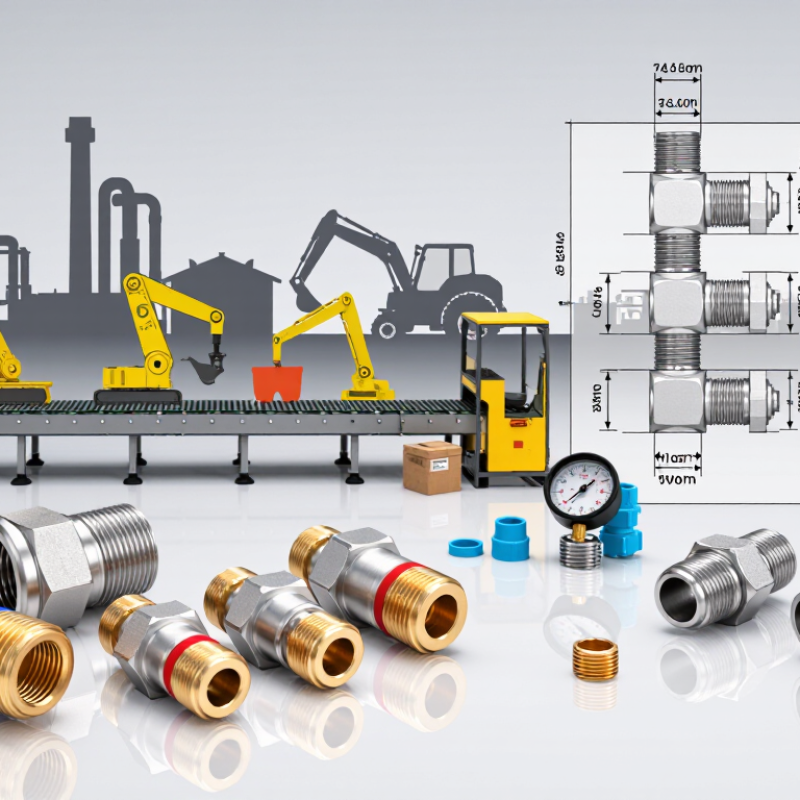
Global buyers should treat quick-connect standards as engineering requirements, not sales labels. ISO 7241 covers general-purpose hydraulic couplings, including interchange dimensions and performance testing. ISO 16028 addresses flat-face couplings, which reduce fluid loss during connection and limit external contamination. ISO 14541 focuses on two-pin mechanical connection couplings for general hydraulic applications.
The differences appear on a workshop floor. An ISO 16028 coupling leaves a flatter mating face, while an ISO 7241 coupling may suit broader general-purpose service. ISO 14541 can help when mechanical locking and repeatable alignment matter. Suppliers should provide pressure ratings, flow data, temperature limits, sealing materials, and test records. “Check the actual interface.”
A 2023 hydraulic equipment market report by MarketsandMarkets valued the sector at approximately USD 49.5 billion and projected it to reach USD 61.9 billion by 2028. This growth increases demand for compatible, traceable fittings across construction, agriculture, manufacturing, and mobile equipment. The report’s forecast is useful, though market estimates vary by methodology and region. That deserves reflection. A fitting can meet an ISO dimension and still fail through poor heat treatment, contamination, or incorrect installation. Global buyers should request sample inspection, cycle testing, and documented quality controls before approving large orders. Supplier experience matters most when standards meet real operating conditions.
China Top Fitting Quick Connect Suppliers for Global Buyers
Supplier Comparison by Pressure Ratings up to 700 bar and Flow Capacity
Global buyers comparing Quick Connect Fitting suppliers should begin with pressure evidence, not catalog language. A 700 bar rating sounds decisive. Yet the working limit may fall with heat, vibration, or repeated connection cycles. Ask for working pressure, burst pressure, test medium, and temperature range. Reliable suppliers provide traceable test reports, material certificates, and clear sealing specifications. Field inspections often show that thread choice and hose movement matter as much as steel strength.
Flow capacity requires a separate comparison. Two couplings rated at 700 bar can produce very different flow rates. Check flow at a stated pressure drop, such as 0.5 or 1 bar. Request Cv data, internal bore dimensions, and test conditions. A narrow poppet may improve pressure retention but create turbulence and heat. A larger passage can improve flow, but it may increase size, weight, and connection effort. Numbers without test conditions are weak evidence.
For excavators, test benches, and hydraulic tools, match capacity to actual duty cycles. Confirm peak pressure, oil viscosity, operating temperature, and expected cycles per day. Samples should be tested while hot and after contamination exposure. This part is often overlooked. Supplier documents may look complete, yet field performance can still vary. I would not rank a supplier by pressure alone. Verify locking force, leakage limits, interchange dimensions, and spare seal availability before approval. A practical trial can expose small handling problems early.
China Top Fitting Quick Connect Suppliers for Global Buyers
Material choice controls leakage, service life, and safe connection performance. For demanding applications, 316L stainless steel offers strong corrosion resistance and reliable mechanical strength. Its typical molybdenum content is 2–3%, according to ASTM A276 material requirements. That detail matters near salt spray, cleaning chemicals, and humid production areas. However, 316L is not universally corrosion-proof. Poor surface finishing can still create crevice corrosion.
Seal selection requires equal care. NBR commonly supports about -40°C to 108°C, depending on compound and pressure. FKM usually handles approximately -20°C to 200°C, with some formulations reaching higher temperatures. These ranges reflect data summarized in the ISO 23936-2 petroleum and natural gas materials standard. NBR generally suits mineral oils and pneumatic systems. FKM performs better with heat, fuels, and aggressive chemicals. It can still fail in hot water or steam. Small detail, major consequence.
Industry testing data shows that elastomer swelling can change sealing force by more than 20% after prolonged chemical exposure, according to the ASTM D471 rubber-property method. Suppliers should provide batch certificates, hardness values, and temperature test records. I would also request pressure-cycle testing, not only static pressure results. Real installations are less tidy. Dust, vibration, and rushed assembly expose weak decisions quickly. Temperature ratings are useful, but they are not guarantees.
| Selection Item | 316L Stainless Steel | NBR Seal | FKM Seal | Buyer Guidance |
|---|---|---|---|---|
| Primary function | Wetted body, sleeve, valve, or connection components | General-purpose elastomer sealing option | High-temperature and chemical-resistant elastomer sealing option | Confirm whether the quoted material applies to the body, seals, springs, balls, and retaining rings. |
| Typical continuous temperature range | Approximately −196°C to +300°C, subject to alloy condition, pressure, and connection design | Approximately −40°C to +100°C; some compounds may reach about +120°C | Approximately −20°C to +200°C; some compounds may reach about +230°C | Use the seal compound manufacturer’s certified range for the exact formulation and duty cycle. |
| Low-temperature performance | Excellent for cryogenic service when the complete coupling is designed and tested for it | Good general low-temperature flexibility, but performance decreases as the compound approaches its lower limit | Usually less suitable than NBR for low-temperature flexibility unless a low-temperature grade is specified | For cryogenic gases or liquids, request low-temperature leakage and cycling test data. |
| Resistance to oils and fuels | Very good corrosion resistance in many industrial environments; chloride exposure requires care | Good resistance to petroleum oils, mineral oils, and many hydraulic fluids | Excellent resistance to many mineral oils, fuels, and aggressive hydrocarbon fluids | Check fluid composition, additives, pressure, and temperature together rather than selecting by fluid name alone. |
| Resistance to water and steam | Generally suitable for water service; chloride concentration and temperature affect corrosion risk | Generally suitable for water, but hot-water and steam resistance is grade-dependent | Suitable for many dry-heat applications; hot-water and steam compatibility must be verified for the specific grade | For saturated steam, consider a steam-rated seal compound rather than relying only on the FKM or NBR name. |
| Chemical resistance | Strong general corrosion resistance; susceptible to pitting and crevice corrosion in high-chloride environments | Good with many oils and aliphatic hydrocarbons; limited with ozone, strong oxidizers, and some solvents | Very good with many fuels, oils, acids, and solvents; limited with some amines, ketones, and hot water or steam | Request a compatibility review when the media contains ketones, amines, concentrated acids, or high chloride levels. |
| Weathering and ozone resistance | Excellent for outdoor exposure when the surface finish and surrounding materials are appropriate | Limited to moderate; prolonged ozone and sunlight exposure can cause cracking | Excellent resistance to ozone, oxygen, and weathering | For outdoor hydraulic or pneumatic equipment, FKM generally provides longer seal life than standard NBR. |
| Typical application areas | Chemical processing, food and beverage equipment, instrumentation, high-purity systems, and marine service | General hydraulic oil, compressed air, fuel, and industrial fluid connections | Automotive fuel systems, chemical equipment, high-temperature hydraulics, and demanding industrial service | Application suitability depends on media, pressure, temperature, coupling cycle frequency, and cleanliness requirements. |
| Common connection formats | Threaded, tube-end, hose-barb, push-to-connect, and face-seal configurations | Compatible with many general-purpose quick-connect profiles when the seal groove is correctly designed | Compatible with many industrial quick-connect profiles where high-temperature sealing is required | Verify interchangeability by dimensional profile, valve type, locking mechanism, and standard—not by appearance. |
| Important specification checks for global buyers | Material grade, heat treatment, surface finish, corrosion testing, and traceability | Hardness, compound designation, compression set, fluid compatibility, and temperature rating | Hardness, compound designation, compression set, chemical compatibility, and high-temperature aging data | Ask for dimensional drawings, pressure-temperature curves, test reports, inspection records, and applicable conformity documents. |
| Best-fit selection summary | Select for corrosion resistance, cleanliness, durability, and demanding process environments | Select for cost-effective general service with petroleum-based fluids and moderate temperatures | Select for elevated temperatures, weathering, and many aggressive hydrocarbon environments | Final selection should be validated against the complete pressure, temperature, media, and cycling profile. |
Note: Temperature ranges are typical engineering guidelines, not universal ratings. Actual limits vary by coupling design, pressure, seal compound, media, surface finish, and applicable testing requirements.
For global buyers, evaluating Chinese quick connect fitting suppliers requires more than comparing prices and catalog photos. Quality verification should begin with an ISO 9001-certified quality system, but certification alone is not enough. Buyers should review inspection procedures, calibration records, and corrective-action reports.
Leak testing reveals problems that visual inspection may miss. A reliable supplier should define the test medium, pressure, holding time, and acceptable loss before production begins. Pressure-decay testing can expose damaged seals or incomplete machining. Sample reports should identify the lot number, operator, equipment, and test result. Small details matter.
Traceability connects each fitting to its material batch, production date, and inspection record. This becomes valuable when a shipment includes inconsistent performance. Cycle-life testing should also match real use, including repeated connection, disconnection, vibration, and pressure changes. A supplier may report thousands of cycles, yet the result means little without test conditions. I have seen impressive numbers supported by thin documentation. That weakness deserves attention. Buyers should request raw data, sample units, and clear failure criteria before approving volume orders. Physical verification can reveal rough threads, stiff sleeves, or minor leakage that paperwork overlooks.
Global buyers should compare more than unit prices when selecting quick connect fitting suppliers in China. MOQ often changes with material, thread type, sealing method, and customization. Standard fittings may support a lower trial quantity. Custom bodies can require tooling and a higher MOQ. Request sample pricing separately. A sample is not production proof.
Lead time needs a written breakdown. Ask when it starts: purchase order, drawing approval, deposit, or sample confirmation. A practical schedule may include machining, surface treatment, pressure testing, packing, and export documentation. Keep buffer days for holidays and port congestion. Delays happen.
Incoterms must match your logistics capability. FCA or FOB may suit buyers with strong freight control. CIF can simplify ocean booking, but risk transfer still needs careful review. DAP may reduce coordination work, yet import taxes usually remain the buyer’s responsibility. State the Incoterms version and named place in the quotation.
HS codes require equal attention. Quick connect fittings can receive different classifications based on material, design, and application. Do not copy a supplier’s code without checking with your customs broker. Confirm the code before shipment. Ask for material certificates, dimensional drawings, test records, and packing details. I would also verify whether carton labels match the invoice. Small inconsistencies can create expensive delays. A reliable supplier should answer clearly, even when the answer is inconvenient.
„Thanks to the LUVIR technology, the solder resist process could be switched directly from the previously used mask exposure to direct exposure. As an outstanding digital solution on the market, this technology has been able to demonstrate fast process times and superior quality on our certified conventional ink in production. This allowed us to fully digitize the solder mask process at low cost – without process or ink adjustments. An excellent benefit to our production in Rot am See.“
Ralf Göhringer (Head of Production WE Rot am See)
I would definitely recommend the Limata machine and team for a future company purchase
Michael Greenaway
Compunetics Inc.
“The Limata ldi has been amazing!! Best thing we did was buy this machine”
Richard Brady
GM
Circuitlabs
“Since 2019, we have been running the Limata X1000 LDI system (including LUVIR for solder mask imaging) in daily production as an addition to our current process with film. The machine was capable of properly exposing Taiyo PSR-4000 BN (DI) solder mask types on normal to high-copper boards using a new and unique direct imaging process. The machine operating interface is very user friendly which allowed for a quick technical training curve. The pre-registration processing reduced several seconds of production time at every print. Limata support and service staff is incomparable. They supported our team every step of the way at basically any time of the day or night, with literally, an immediate response time, customizing the software interface to best fit our Operations and needs.
We have exposed more than 8,000 prints since end of October, on various solder mask colors and some resist film panels. Limata, has proven to be very capable and innovative. They are a strong contender in the industry.
We have very much enjoyed this project, and working with the team!
Thank you Limata for the continued support and being a part of our growth.”
Bill Sezate
Vice President, GM
Summit Interconnect
As a replacement to our current contact exposure process with film, the LIMATA X2000 system including LUVIR-Technology was capable of properly exposing non-LDI solder mask types using a direct imaging process. The machine offers cutting edge software with a very intuitive operating interface which allowed for quick technician training curve. The dual drawer system combined with pre-registration processing reduced several seconds of production time at every machine cycle. Limata support and service staff is world class. They added software patches to keep production running at shortest possible response times, customized the software interface to best fit our in-house Operations system, and even wrote a step-by-step machine processing manual. As a result of the project, we have exposed more than 16,000 times on various product types and solder mask brands/colors. Limata, in a very short timeframe as a company, has definitely shown they are truly innovative and will be challenging the industry of direct imaging for the top spot.
Kevin Beattie
Process Engineer
TTM Technologies
Forest Grove Division
