Global demand for precision tube forming continues to grow across automotive, construction, aerospace, furniture, and energy equipment. Tube Benders now shape stainless steel exhaust lines, aluminum frames, copper refrigeration pipes, and complex hydraulic assemblies.
Grand View Research identifies metal forming machinery as a steadily developing industrial equipment segment, supported by automation and advanced manufacturing investment. MarketsandMarkets also highlights rising demand for computer-controlled forming systems, especially where repeatability and reduced material waste matter. These findings support closer attention to tube bending equipment, but market reports often group several machine categories together. That limitation deserves recognition.
This guide introduces China’s top 10 tube bender manufacturers for global buyers. The selection considers more than factory size or export claims. It examines bending diameter, wall-thickness control, tooling flexibility, servo accuracy, production capacity, inspection procedures, and after-sales support. A reliable manufacturer should explain springback compensation clearly and provide test results for real materials. Stainless steel behaves differently from mild steel. Small details matter.
Look for evidence.
For example, a capable supplier should demonstrate a 38-millimeter tube bend with consistent angles, clean surfaces, and minimal deformation. Certifications can support credibility, but they do not replace factory audits, sample testing, or technical communication. Some supplier information may be incomplete or self-reported. Buyers should verify it independently.
This introduction is therefore a practical starting point, not an absolute ranking. Performance depends on application, tooling, software, service response, and total ownership cost. The strongest choice is rarely the cheapest machine.
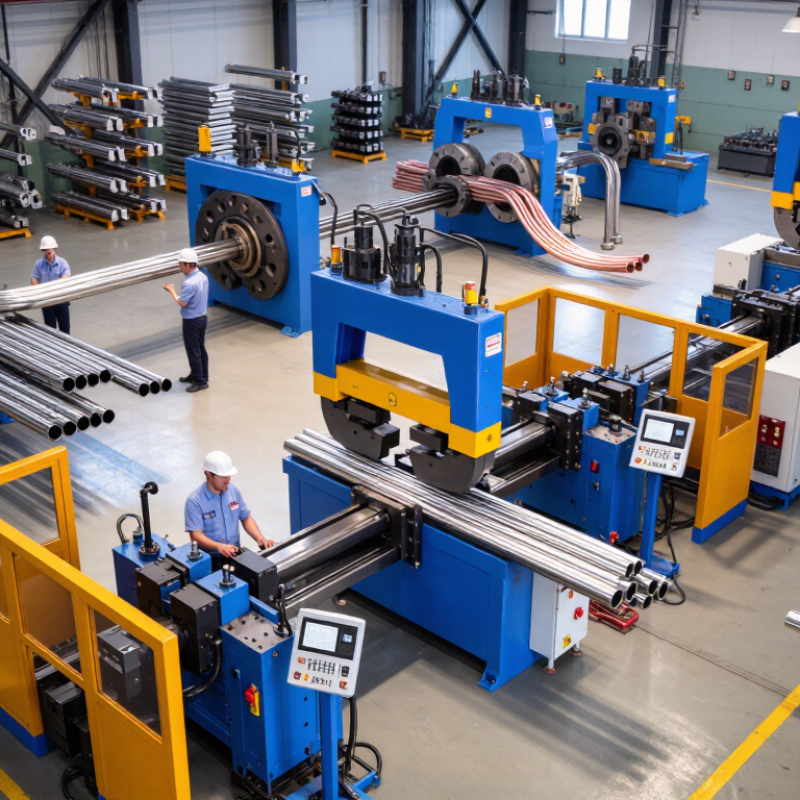
A tube bender is a machine that changes straight tubing into accurate curves without cutting the material. It may process steel, stainless steel, aluminum, copper, or selected plastic tubes. Common designs include rotary draw, roll, compression, and mandrel benders. Each method suits different wall thicknesses, bend radii, and production volumes.
In practical use, an operator first checks the tube diameter, wall thickness, material grade, and required centerline radius. The machine then clamps the tube and forms the curve around a die. A mandrel can support the inside wall during tight bends. This helps reduce wrinkles, flattening, and cracks. Small errors matter. A two-degree difference may affect final assembly.
Tube benders serve automotive frames, heat exchangers, furniture, construction equipment, and fluid systems. For global buyers comparing China’s top ten tube bender manufacturers, technical evidence matters more than polished claims. Ask for sample bends, tolerance data, tooling details, maintenance guidance, and operator training. Inspect weld quality, control cabinets, emergency stops, and calibration records.
A perfect bend is not guaranteed by a powerful motor. Material variation can still change results. I have seen specifications look complete while omitting minimum bend radius data. That omission deserves questions. Buyers should also confirm voltage, software language, spare parts, delivery testing, and service response. A short trial using the buyer’s actual tube is often more reliable than a catalog photograph.
| No. | Tube Bender Category | Typical Tube Material | Typical Tube Diameter Range | Common Bending Method | Typical Applications | Main Advantages |
|---|---|---|---|---|---|---|
| 1 | Manual Tube Bender | Copper, aluminum, thin-wall steel | Approximately 6–22 mm outside diameter | Lever, ratchet, or rotary hand bending | Plumbing, refrigeration, air-conditioning service | Low purchase cost, portable, and simple to operate |
| 2 | Hydraulic Tube Bender | Carbon steel, stainless steel, alloy steel | Approximately 20–100 mm outside diameter | Hydraulic ram with fixed or interchangeable dies | Pipelines, boilers, shipbuilding, structural frames | High forming force and suitability for thicker tubes |
| 3 | Electric Rotary Draw Bender | Mild steel, stainless steel, aluminum, copper | Approximately 12–80 mm outside diameter | Rotary draw bending with a pressure die and clamp die | Furniture, automotive parts, bicycles, general fabrication | Accurate bend angles and repeatable production |
| 4 | CNC Tube Bender | Carbon steel, stainless steel, aluminum, copper | Approximately 6–160 mm outside diameter | Programmable multi-axis rotary draw bending | Automotive exhausts, HVAC assemblies, aerospace components | High repeatability, complex geometries, and reduced setup time |
| 5 | Mandrel Tube Bender | Stainless steel, aluminum, titanium, thin-wall alloys | Approximately 12–100 mm outside diameter | Rotary draw bending supported by an internal mandrel | Vehicle exhausts, aircraft tubing, hydraulic lines | Controls wrinkling, flattening, and wall thinning on tight bends |
| 6 | Three-Roll Tube Bender | Carbon steel, stainless steel, aluminum | Approximately 20–200 mm outside diameter | Progressive roll forming over three rollers | Arches, rings, handrails, frames, and large-radius curves | Suitable for large radii and continuous curved sections |
| 7 | Orbital Tube Bender | Stainless steel and precision alloy tubing | Approximately 6–50 mm outside diameter | Controlled orbital or rotary forming around the tube axis | Semiconductor, pharmaceutical, laboratory, and clean-fluid systems | Good dimensional control for clean and precision tubing |
| 8 | Square and Rectangular Tube Bender | Mild steel, stainless steel, aluminum | Approximately 15–100 mm profile width or height | Profile rotary draw or roll bending | Metal furniture, gates, railings, trailers, and architectural frames | Forms hollow structural sections while preserving a consistent profile |
| 9 | End-Forming and Tube-Bending Cell | Steel, stainless steel, aluminum, copper | Approximately 10–80 mm outside diameter | Integrated bending, flaring, beading, swaging, or chamfering | Automotive fluid lines, heat exchangers, and appliance tubing | Combines several operations to reduce handling and production time |
| 10 | High-Production Multi-Stack Bender | Steel, stainless steel, aluminum, copper | Approximately 6–100 mm outside diameter | CNC rotary draw bending with multiple tool stacks | Automotive, HVAC, motorcycle, and mass-production components | Fast changeovers between tube sizes and improved production efficiency |
When comparing China’s top 10 tube bender manufacturers for global buyers, look beyond rankings and polished websites. A reliable supplier should explain machine structure, bending accuracy, control systems, and suitable tube materials. Ask for test results using your actual tube diameter, wall thickness, and bend radius. A serious manufacturer can usually provide sample videos, technical drawings, and clear tolerance data.
Experience becomes visible on the factory floor. Check whether operators inspect tooling, record machine settings, and protect finished equipment during export packing. Request customer references from markets with similar technical requirements. Review quality certificates, inspection reports, spare-parts availability, installation support, and response times. Do not trust vague promises. One overlooked detail, such as metric and imperial thread differences, can delay production.
Tips: Compare three written quotations with identical specifications. Ask who handles service after delivery. Confirm warranty limits, software updates, training hours, and packaging photos. If possible, arrange a live factory audit or independent inspection. A sample bend may look acceptable, yet springback or surface marks can appear later. That is where careful questioning matters. Even experienced buyers sometimes focus too heavily on price. That approach needs reconsideration when downtime costs more than the original saving.
China’s top ten tube bender manufacturers are often distinguished by practical engineering strengths, not advertising alone. Several specialize in CNC rotary draw machines for stainless steel, aluminum, and carbon steel tubes. Their equipment may handle diameters from small hydraulic lines to large structural sections. Servo-driven axes, programmable bending angles, and automatic tube feeding improve repeatability. Some suppliers also build compact models for workshops with limited floor space.
Manufacturers with strong export experience usually provide clear technical drawings, installation guidance, and remote troubleshooting. Better factories test each machine through trial bending before shipment. Buyers should request sample results, bend-radius data, and tolerance records.
A reliable supplier can explain springback compensation, tooling selection, and mandrel requirements in plain language. That detail matters. It reveals real process knowledge.
Other leading manufacturers focus on custom automation, including loading systems, barcode tracking, and multi-stack tooling. Some offer hydraulic machines because they remain suitable for heavy tubes and lower production volumes. Electrical safety, guarding, emergency stops, and documented maintenance procedures should receive careful attention. Factory visits can reveal useful facts, such as weld quality, spare-parts storage, and operator training. Still, rankings are not permanent. A technically impressive machine may disappoint when software support is slow or tooling costs are unclear. Buyers should compare total operating cost, not only the initial quotation.
China’s tube bender manufacturers increasingly combine CNC control, servo drives, and digital angle feedback. These systems improve repeatability when producing stainless steel, aluminum, copper, and mild steel tubes. Rotary draw bending suits precise elbows, while roll bending handles larger radii and longer sections. Mandrel support can reduce wrinkling and wall collapse.
Tooling determines much of the result. A correct clamp die, pressure die, and mandrel must match tube diameter, wall thickness, and alloy. Modern machines may include automatic lubrication, barcode setup, collision protection, and bending-data storage. These features help operators reproduce a program across multiple production shifts. Still, springback remains difficult. Thin tubes can change angle after release, even when the machine appears properly calibrated.
Applications range from vehicle exhaust lines and heat exchangers to HVAC coils, hydraulic assemblies, rail interiors, and architectural frames. For high-volume work, buyers should inspect cycle time, servo accuracy, tooling changeover, and sample-bending records. For custom work, software flexibility matters more than headline speed. Ask for material certificates, dimensional reports, and long-run testing. Factory visits can reveal practical details, such as oil leakage, noisy gearboxes, or poorly protected electrical cabinets. These small signs matter. A reliable supplier should explain rejected samples openly, not hide them.
Global buyers should compare process capability, not catalogue rankings. A reliable RFQ states tube outside diameter, wall thickness, material, bend radius, and required output. It should also specify ovality limits, springback control, tooling scope, and electrical standards. Vague requests create vague quotations.
Ask each Chinese manufacturer for sample bends, dimensional inspection records, and a factory acceptance test plan. Confirm whether testing covers repeatability, forming marks, mandrel performance, and emergency-stop functions.
The ISO Survey 2023 recorded 1,265,174 ISO 9001 certificates across 189 countries and economies. Certification helps, but it does not replace a site audit or production evidence.
Look for calibrated gauges, traceable inspection reports, and technicians who can explain failure patterns clearly.
Sourcing also requires logistics discipline. UNCTAD’s Review of Maritime Transport 2023 states that over 80% of global merchandise trade by volume moves by sea. Therefore, request packed dimensions, gross weight, export documents, spare-parts lists, and realistic shipment dates.
Clarify installation support and response times before payment. A video call can reveal much, yet it cannot prove long-term service quality. I would still inspect a finished machine before shipment. That extra step costs time. It may prevent expensive rework, delayed commissioning, and tooling surprises. Some buyers focus too heavily on the lowest price. That decision often looks reasonable until production starts.
„Thanks to the LUVIR technology, the solder resist process could be switched directly from the previously used mask exposure to direct exposure. As an outstanding digital solution on the market, this technology has been able to demonstrate fast process times and superior quality on our certified conventional ink in production. This allowed us to fully digitize the solder mask process at low cost – without process or ink adjustments. An excellent benefit to our production in Rot am See.“
Ralf Göhringer (Head of Production WE Rot am See)
I would definitely recommend the Limata machine and team for a future company purchase
Michael Greenaway
Compunetics Inc.
“The Limata ldi has been amazing!! Best thing we did was buy this machine”
Richard Brady
GM
Circuitlabs
“Since 2019, we have been running the Limata X1000 LDI system (including LUVIR for solder mask imaging) in daily production as an addition to our current process with film. The machine was capable of properly exposing Taiyo PSR-4000 BN (DI) solder mask types on normal to high-copper boards using a new and unique direct imaging process. The machine operating interface is very user friendly which allowed for a quick technical training curve. The pre-registration processing reduced several seconds of production time at every print. Limata support and service staff is incomparable. They supported our team every step of the way at basically any time of the day or night, with literally, an immediate response time, customizing the software interface to best fit our Operations and needs.
We have exposed more than 8,000 prints since end of October, on various solder mask colors and some resist film panels. Limata, has proven to be very capable and innovative. They are a strong contender in the industry.
We have very much enjoyed this project, and working with the team!
Thank you Limata for the continued support and being a part of our growth.”
Bill Sezate
Vice President, GM
Summit Interconnect
As a replacement to our current contact exposure process with film, the LIMATA X2000 system including LUVIR-Technology was capable of properly exposing non-LDI solder mask types using a direct imaging process. The machine offers cutting edge software with a very intuitive operating interface which allowed for quick technician training curve. The dual drawer system combined with pre-registration processing reduced several seconds of production time at every machine cycle. Limata support and service staff is world class. They added software patches to keep production running at shortest possible response times, customized the software interface to best fit our in-house Operations system, and even wrote a step-by-step machine processing manual. As a result of the project, we have exposed more than 16,000 times on various product types and solder mask brands/colors. Limata, in a very short timeframe as a company, has definitely shown they are truly innovative and will be challenging the industry of direct imaging for the top spot.
Kevin Beattie
Process Engineer
TTM Technologies
Forest Grove Division
