Choosing a China-based Dressing Table manufacturer for wholesale involves more than comparing unit prices. Buyers should examine materials, joinery, finishes, packaging, communication, and production consistency. A sample may look excellent beneath showroom lights, yet the next batch can reveal uneven paint or drawers that do not glide smoothly. Details matter.
This guide explores practical ways to assess potential suppliers, from reviewing factory capabilities to requesting clear specifications and production samples. Check details such as board thickness, edge banding, drawer runners, mirror protection, and carton design. Ask how the manufacturer handles changes in color, dimensions, or hardware before confirming an order. Written records help reduce misunderstandings, though they cannot prevent every production issue. That part deserves honest attention.
Wholesale buyers should also consider order quantities, lead times, customization options, quality checks, and shipping arrangements. A lower quotation may exclude important costs or provide less detailed packaging. Compare offers on the same specifications, and clarify what happens when finished products differ from approved samples. No supplier is ideal for every business. A factory suited to a large furniture chain may not fit a smaller retailer’s needs. By weighing product quality, communication, and repeat-order reliability together, buyers can make a more informed shortlist of Dressing Table manufacturers in China.
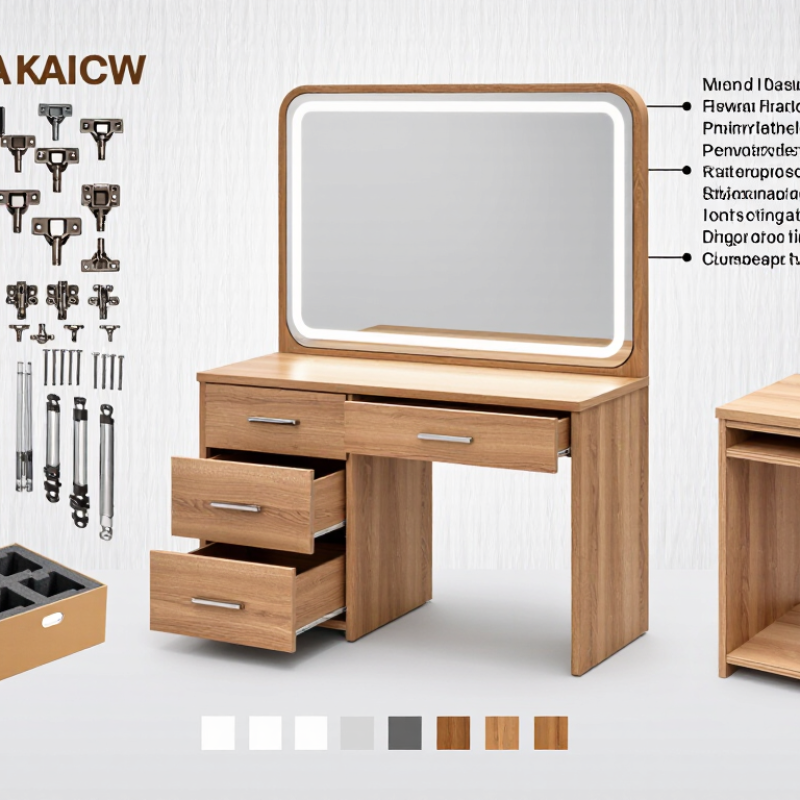
China’s dressing-table manufacturing sector is part of a broad furniture industry, not a separately measured category. The National Bureau of Statistics reported 740.7 million units of furniture output in 2023, down 4.3% year on year. The China National Furniture Association reported RMB 655.7 billion in revenue for above-designated-size furniture manufacturers that year, down 4.4%. These figures show the sector’s scale, but they do not measure dressing-table capacity specifically.
Factories may handle panel cutting, edge-banding, drawer assembly, mirror fitting, and carton packing under one roof. For wholesale buyers, inspect drawer alignment, slide movement, mirror protection, and finish consistency across a production batch. Small details matter. Ask suppliers to document materials, sample approval, minimum order quantities, lead times, and packing specifications before confirming an order. Check a finished sample under ordinary room lighting; glossy surfaces can hide uneven color until then. I would treat industry totals as context, not proof of a factory’s reliability. A short pilot order can reveal weak packaging or inconsistent assembly, though it adds time and cost.
Leading wholesale dressing table manufacturers offer more than attractive designs. They provide clear measurements, material specifications, and finish samples before bulk production. Check whether drawer slides open smoothly and mirror fittings stay secure during repeated use. Small details matter. A one-millimeter mismatch can affect assembly across a large order.
Reliable suppliers use documented quality checks at key production stages. Ask how they inspect surface scratches, color variation, edge finishing, and hardware alignment. Request a pre-production sample, then compare it with finished units. A polished catalog can still hide uneven drawer gaps. Production capacity, realistic lead times, and protective export packaging also deserve careful review. Communication should be specific, not just reassuring.
Tips: Confirm carton dimensions and loading plans before placing an order. Ask for written material and finish details, and clarify how defects are handled. Compare samples under ordinary room lighting; glossy finishes may look different in photographs. Even a capable manufacturer can miss a detail, so keep approval records and inspect the first production batch.
Wholesale buyers should assess a dressing-table supplier through records, samples, and repeatable production, not showroom polish. Grand View Research valued the global furniture market at USD 677.09 billion in 2022, but that figure cannot prove one factory’s reliability. Treat it as context. Request monthly output, current order load, defect rates, and lead times for the exact product type.
FAO’s Global Forest Resources Assessment 2020 reports 4.06 billion hectares of forest worldwide, around 31% of global land area. For wood-based panels, ask for material origin, panel grade, veneer thickness, and moisture specifications. Check these against a signed sample. Inspect drawer runners under load, edge banding at corners, and mirror mounts for movement. Certificates can help, but verify their scope and validity with the issuer.
To test capacity, compare the factory’s production calendar with machine schedules, staffing, and packaging plans. Ask for dated records from recent orders, not only a maximum-output claim. Run a pilot batch and inspect several units, including one pulled from the middle of the run. I would still be cautious: a strong sample does not guarantee consistent bulk quality. Ask for proof.
Wholesale pricing for dressing tables in China depends on more than the unit price. Materials, drawer hardware, mirror type, finish, and packaging all affect the quote. Ask for a cost breakdown, including sample fees, tooling charges, and shipping terms. A low quote can look attractive. Check what it leaves out.
Minimum order quantities vary by factory and product configuration. A standard design may have a lower MOQ than a table with a new color, size, or mirror shape. Ask whether mixed finishes can share one order, and confirm how quantities affect the unit price. For a first purchase, a smaller trial order may reduce inventory risk, though the per-unit cost could rise. That trade-off is easy to overlook.
Customization can cover tabletop dimensions, drawer layouts, handles, finishes, and packaging. Send a clear specification sheet with measurements and reference images; vague requests often lead to avoidable sample revisions. Request a pre-production sample and inspect details such as drawer alignment, edge finishing, and mirror stability. Keep the approved sample and written specifications for comparison during production. Even careful planning misses something now and then, so leave time for one revision before confirming the order.
For wholesale buyers comparing China dressing table manufacturers, quality checks should cover more than appearance. Request a production sample and compare its dimensions with the approved drawings. Check drawer alignment, smooth movement, joint strength, and finish consistency under bright light. A practical inspection also tests stability and applies reasonable weight to shelves and drawers. Record defects with photographs and agreed acceptance limits. Small color variations can happen, but vague standards invite disputes.
Tips: Ask for the material list, care instructions, and relevant test reports before placing a bulk order. Verify that certificates match the product, factory, and destination market; a certificate for another item may not apply. Keep one approved sample for comparison. Don’t skip this step.
International shipping needs early coordination. Confirm carton dimensions, gross weight, pallet details, and delivery terms with the supplier and freight forwarder. Ask whether packaging protects mirror panels and corners during handling. For wooden packaging, check whether destination rules require treatment or marking. Prepare consistent commercial invoices, packing lists, and product descriptions, then confirm tariff classification and required import documents with a qualified broker. Requirements vary by country. I’ve seen shipping plans look complete on paper, yet miss a small labeling detail; review the final documents before cargo leaves.
Approximate nominal internal volume is about 33.2 m³ for a 20-foot container, 67.7 m³ for a 40-foot container, and 76.3 m³ for a 40-foot high-cube container. Actual usable space depends on container specifications, carton dimensions, and the loading plan. For wholesale orders, confirm product and packaging quality before shipment, check which certifications or regulations apply in the destination market, and verify shipping documents and freight terms with your supplier and carrier.
„Thanks to the LUVIR technology, the solder resist process could be switched directly from the previously used mask exposure to direct exposure. As an outstanding digital solution on the market, this technology has been able to demonstrate fast process times and superior quality on our certified conventional ink in production. This allowed us to fully digitize the solder mask process at low cost – without process or ink adjustments. An excellent benefit to our production in Rot am See.“
Ralf Göhringer (Head of Production WE Rot am See)
I would definitely recommend the Limata machine and team for a future company purchase
Michael Greenaway
Compunetics Inc.
“The Limata ldi has been amazing!! Best thing we did was buy this machine”
Richard Brady
GM
Circuitlabs
“Since 2019, we have been running the Limata X1000 LDI system (including LUVIR for solder mask imaging) in daily production as an addition to our current process with film. The machine was capable of properly exposing Taiyo PSR-4000 BN (DI) solder mask types on normal to high-copper boards using a new and unique direct imaging process. The machine operating interface is very user friendly which allowed for a quick technical training curve. The pre-registration processing reduced several seconds of production time at every print. Limata support and service staff is incomparable. They supported our team every step of the way at basically any time of the day or night, with literally, an immediate response time, customizing the software interface to best fit our Operations and needs.
We have exposed more than 8,000 prints since end of October, on various solder mask colors and some resist film panels. Limata, has proven to be very capable and innovative. They are a strong contender in the industry.
We have very much enjoyed this project, and working with the team!
Thank you Limata for the continued support and being a part of our growth.”
Bill Sezate
Vice President, GM
Summit Interconnect
As a replacement to our current contact exposure process with film, the LIMATA X2000 system including LUVIR-Technology was capable of properly exposing non-LDI solder mask types using a direct imaging process. The machine offers cutting edge software with a very intuitive operating interface which allowed for quick technician training curve. The dual drawer system combined with pre-registration processing reduced several seconds of production time at every machine cycle. Limata support and service staff is world class. They added software patches to keep production running at shortest possible response times, customized the software interface to best fit our in-house Operations system, and even wrote a step-by-step machine processing manual. As a result of the project, we have exposed more than 16,000 times on various product types and solder mask brands/colors. Limata, in a very short timeframe as a company, has definitely shown they are truly innovative and will be challenging the industry of direct imaging for the top spot.
Kevin Beattie
Process Engineer
TTM Technologies
Forest Grove Division
