Fuel Rubber Hose is a small component with a demanding job. It carries fuel through vibration, heat, pressure changes, and tight engine spaces. For global buyers, choosing a supplier is not just a price comparison. Material compatibility, reinforcement, temperature range, dimensional accuracy, and consistent production all affect service life. A hose that looks correct on a sample may behave differently after months of use. Details matter.
This guide introduces ten Fuel Rubber Hose suppliers serving international markets and offers a practical starting point for comparison. It considers product range, manufacturing experience, quality controls, export readiness, and the clarity of technical support. Buyers should still check each hose against the fuel type, operating conditions, and equipment requirements in their own application. Ask for current datasheets, traceable test information, and confirmation of relevant certifications before placing an order. A clean cut end, secure clamp fit, and readable batch marking are practical clues during inspection. Verify the details. Supplier websites can be incomplete, and marketing language is not a substitute for evidence. Lead times, minimum order quantities, and regional service may also change, so confirm them directly. The ranking is an overview, not a guarantee that one supplier suits every project. That distinction can feel inconvenient. It is useful, though. A careful shortlist can reduce avoidable delays, mismatched specifications, and costly replacements while helping purchasing teams ask better questions.
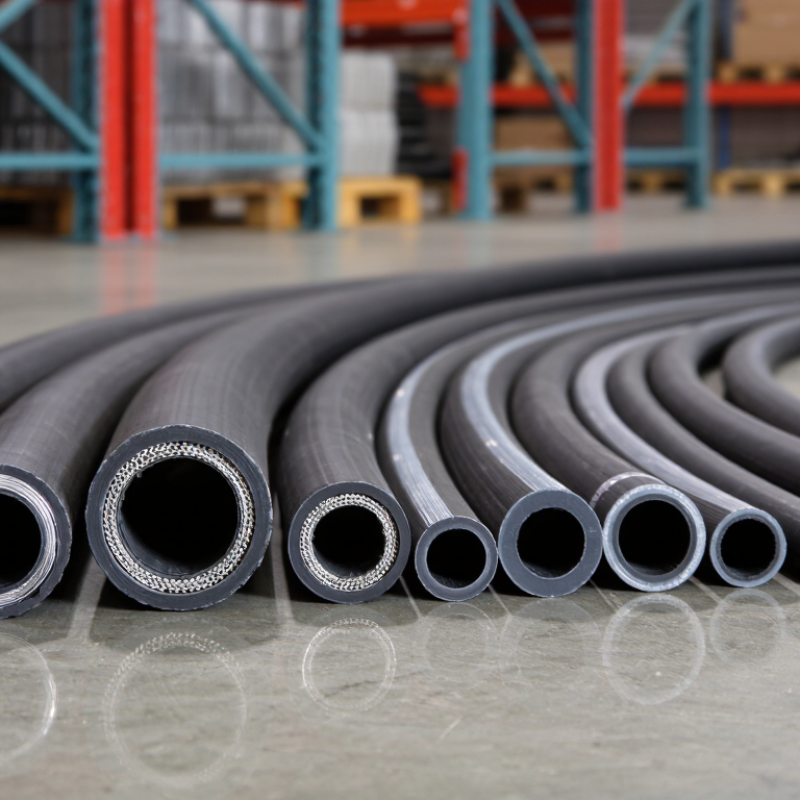
Fuel rubber hoses are flexible conduits that carry fuel between components such as a tank, pump, and engine. Unlike rigid metal tubing, they can accommodate vibration and small movements in a vehicle or machine. Their construction often includes a fuel-resistant inner tube, reinforcement, and a protective outer cover. They are not pipes.
The inner layer helps limit fuel contact with the reinforcement, while textile or other reinforcement helps the hose withstand operating pressure. The outer cover guards against abrasion, dirt, and some environmental exposure. Exact materials and ratings vary, so a hose must suit the fuel type, temperature, pressure, and intended application. A neat appearance alone proves little.
During operation, fuel moves through the hose as the pump supplies it to the next component. Secure fittings help prevent leaks, and a smooth routing path reduces kinks, rubbing, and excess bending. Small details matter. In a workshop, a technician might check for dampness near a connection, a cracked cover, or a hose pressed against a hot surface. These signs deserve attention, though appearance cannot confirm internal condition. I may be giving clamps too much attention, but a poorly seated connection can undermine an otherwise suitable hose.
Fuel hose selection starts with the route and fuel, not the catalogue label. Low-pressure feed and return lines differ from vapor lines and submersible in-tank hoses. Their walls face different pressures, temperatures, and exposure. Nitrile rubber can suit some petroleum fuels, while fluorinated rubber or a fluoropolymer inner layer may be chosen for tougher heat or fuel exposure. Compatibility is not automatic: ethanol content, temperature, and soak time matter. IEA’s Global EV Outlook 2024 reports nearly 14 million electric-car sales in 2023, about 18% of global sales. That transition changes the mix, but many combustion vehicles still need dependable fuel lines. Small details count.
For buyers, request evidence against the applicable SAE J30 hose category, then check the actual fuel blend and installation location. Review permeation, burst pressure, impulse, heat aging, and low-temperature flexibility test results. For in-tank use, confirm the hose is designed for continuous fuel immersion; an exterior hose may soften or swell. Reinforcement also matters: textile layers can support flexible low-pressure service, while wire reinforcement may serve higher-pressure applications. Ask for lot traceability and test conditions, not just a pass claim. A tidy datasheet can still omit clamp type, bend radius, or exposure duration. That gap deserves a follow-up.
A fuel hose can look flawless and still fail after months of heat, vibration, and fuel exposure. Evaluate suppliers by asking for test reports tied to the exact hose construction, not a similar product family. SAE J30 covers fuel and oil hose classifications and test methods; ISO 7840 addresses fire-resistant fuel hoses for small craft. For applicable ISO 7840 products, check documented performance in its 2.5-minute flame test. Ask which edition was used, who conducted the test, and whether the tested sample matches the production hose. Paperwork matters.
Request evidence for fuel compatibility, permeation, pressure, temperature, and aging tests. Reports should identify the liner, reinforcement, cover, dimensions, and test conditions. A vague “fuel resistant” claim tells you little. Ask for lot traceability, inspection records, and written change-control procedures, too. Then compare samples: bend them to the specified radius, inspect the cut ends, and verify markings remain legible. These checks do not replace laboratory testing. They can expose basic inconsistencies early. I would not treat a certificate as proof that every shipment is identical; that assumption is easy to make, and hard to defend after a failure. Verify lead times and production capacity against your actual order pattern, not a sales estimate.
| No. | Evaluation Dimension | What to Verify | Useful Evidence or Benchmark |
|---|---|---|---|
| 1 | Fuel Compatibility | Check compatibility with the specific fuel, additives, and blend expected in service. Do not assume a hose suitable for one fuel is suitable for another. | Request a written compatibility statement for the intended fuel, such as gasoline, diesel, or a specified ethanol or biodiesel blend, along with the applicable test data. |
| 2 | Applicable Standards | Confirm that the product is designed and tested for its intended application, such as automotive, marine, or fuel-dispensing service. | Check the exact standard edition and hose classification cited in the technical documents. Relevant examples include SAE J30 for fuel and oil hose applications, ISO 7840 for small-craft fuel hoses, and EN 1360 for fuel-dispensing hoses. |
| 3 | Pressure and Vacuum Ratings | Compare working pressure, proof or test pressure, burst pressure, and vacuum resistance with the operating conditions of the system. | Request a product datasheet stating the ratings and test methods. Check that the ratings apply at the required temperature and for the selected hose size. |
| 4 | Temperature Range | Verify the stated operating temperature range and whether it covers both the conveyed fuel and the surrounding environment. | Ask for published minimum and maximum service temperatures and any derating guidance. Confirm that the range is supported by product-specific documentation. |
| 5 | Construction and Materials | Review the tube, reinforcement, and cover materials, including whether the construction is suitable for the application and installation environment. | Request a construction description, material specifications, and available options for abrasion, weather, oil, or flame exposure where relevant. |
| 6 | Dimensional Accuracy | Check inside diameter, outside diameter, wall thickness, length tolerance, and bend requirements against the installation design. | Request dimensional tolerances and inspection records for the supplied size. Confirm that hose and fittings are compatible as an assembly. |
| 7 | Testing and Quality Control | Assess whether incoming materials, production batches, and finished hoses are inspected using documented procedures. | Ask for sample inspection reports, test methods, acceptance criteria, and the frequency of routine and batch testing. |
| 8 | Traceability and Documentation | Determine whether supplied products can be linked to production batches and whether technical documents are available for the destination market. | Look for batch or lot identification, certificates of conformity where applicable, current datasheets, and clear product labeling. |
| 9 | Supply Capability and Lead Time | Evaluate production capacity, minimum order quantities, replenishment lead times, and the ability to handle repeat orders consistently. | Request written lead-time estimates, capacity information for the required specifications, and a sample production or delivery schedule. |
| 10 | Export Readiness and After-Sales Support | Check export packaging, shipping documentation, communication responsiveness, complaint handling, and warranty terms. | Confirm available export documents, packaging requirements, response channels, warranty scope, and the process for investigating product issues. |
Evaluation note: Standards, ratings, and approvals are application- and market-specific. Verify current requirements and product-specific evidence before purchase.
A useful shortlist of ten fuel rubber hose suppliers should compare capability, not just quoted price. The profiles below represent distinct strengths: three focus on high-volume automotive production, two on custom hose dimensions, and two on fuel-resistant inner-tube compounds. Another supplier may specialize in reinforced, multi-layer construction; one may offer short production runs; and the final profile may emphasize regional inventory and technical support. These are comparison categories, not claims about named companies.
Demand makes dependable capacity important. OICA reported global motor vehicle production of about 93.5 million units in 2023, roughly 10 percent above 2022. That figure is not a hose-market forecast, but it signals the scale of vehicle manufacturing that suppliers serve. Ask each candidate for current test documentation, operating-temperature ranges, pressure ratings, and traceability details. Check the actual hose construction against the intended fuel and application. A neat catalogue page is not enough.
Request samples and inspect them closely. Look for consistent wall thickness, clean cut edges, and legible batch markings. Ask how the supplier handles compound changes and production delays. Small gaps in documentation matter. They can slow validation. A buyer may also compare minimum order quantities, lead times, and response speed, though these details can change by region. Supplier profiles are most useful when backed by recent records, not polished claims alone.
Global buyers comparing fuel rubber hose suppliers should verify product fit before discussing price. Check the hose’s intended fuel type, operating pressure, temperature range, and connection dimensions against the application. Request current test reports and material traceability records, then confirm which specifications apply to the destination market. Requirements can differ. A familiar certificate may not cover every product variant or shipment.
Tips: Ask for a sample and inspect its markings, flexibility, and end fittings. Confirm production lead time, minimum order quantity, packaging, and shipping documents in writing. Small details matter. Keep one approved sample for comparison when bulk goods arrive.
Delivery planning deserves the same attention as technical review. Ask suppliers how they protect hoses from crushing, moisture, and excessive heat during storage and transit. Clarify who checks the goods before dispatch and how shortages or damage are reported. Build time for document review and customs processing into the schedule. A spreadsheet helps, but it can miss a changed specification or an unrealistic transit estimate. Recheck details before payment and shipment; even careful teams occasionally overlook a small mismatch.
„Thanks to the LUVIR technology, the solder resist process could be switched directly from the previously used mask exposure to direct exposure. As an outstanding digital solution on the market, this technology has been able to demonstrate fast process times and superior quality on our certified conventional ink in production. This allowed us to fully digitize the solder mask process at low cost – without process or ink adjustments. An excellent benefit to our production in Rot am See.“
Ralf Göhringer (Head of Production WE Rot am See)
I would definitely recommend the Limata machine and team for a future company purchase
Michael Greenaway
Compunetics Inc.
“The Limata ldi has been amazing!! Best thing we did was buy this machine”
Richard Brady
GM
Circuitlabs
“Since 2019, we have been running the Limata X1000 LDI system (including LUVIR for solder mask imaging) in daily production as an addition to our current process with film. The machine was capable of properly exposing Taiyo PSR-4000 BN (DI) solder mask types on normal to high-copper boards using a new and unique direct imaging process. The machine operating interface is very user friendly which allowed for a quick technical training curve. The pre-registration processing reduced several seconds of production time at every print. Limata support and service staff is incomparable. They supported our team every step of the way at basically any time of the day or night, with literally, an immediate response time, customizing the software interface to best fit our Operations and needs.
We have exposed more than 8,000 prints since end of October, on various solder mask colors and some resist film panels. Limata, has proven to be very capable and innovative. They are a strong contender in the industry.
We have very much enjoyed this project, and working with the team!
Thank you Limata for the continued support and being a part of our growth.”
Bill Sezate
Vice President, GM
Summit Interconnect
As a replacement to our current contact exposure process with film, the LIMATA X2000 system including LUVIR-Technology was capable of properly exposing non-LDI solder mask types using a direct imaging process. The machine offers cutting edge software with a very intuitive operating interface which allowed for quick technician training curve. The dual drawer system combined with pre-registration processing reduced several seconds of production time at every machine cycle. Limata support and service staff is world class. They added software patches to keep production running at shortest possible response times, customized the software interface to best fit our in-house Operations system, and even wrote a step-by-step machine processing manual. As a result of the project, we have exposed more than 16,000 times on various product types and solder mask brands/colors. Limata, in a very short timeframe as a company, has definitely shown they are truly innovative and will be challenging the industry of direct imaging for the top spot.
Kevin Beattie
Process Engineer
TTM Technologies
Forest Grove Division
