Industrial Curtain Walls help factories, warehouses, and production facilities manage separation, visibility, and environmental control. Choosing a supplier in China takes more than comparing prices or browsing attractive project photos. Buyers need to understand how each company handles design, fabrication, installation support, and quality checks. A curtain wall that looks suitable in a brochure may not fit a facility’s ceiling height, workflow, or cleaning requirements. Details matter.
This guide explores leading Chinese suppliers and the practical questions buyers can ask before requesting a quotation. It considers product range, customization, material specifications, documented quality procedures, delivery capabilities, and experience with comparable projects. Ask for drawings, clear technical data, and references that match your intended application. Where possible, review samples or arrange a factory assessment. Small checks can prevent costly surprises.
No supplier is the best choice for every project. Some may offer strong customization but longer lead times; others may provide standard systems more quickly. Those trade-offs deserve careful review. This overview is a starting point, not a substitute for checking current credentials, project evidence, and written specifications. Requirements vary, and even experienced buyers can overlook a detail. The right supplier should be able to explain what its system can—and cannot—do.
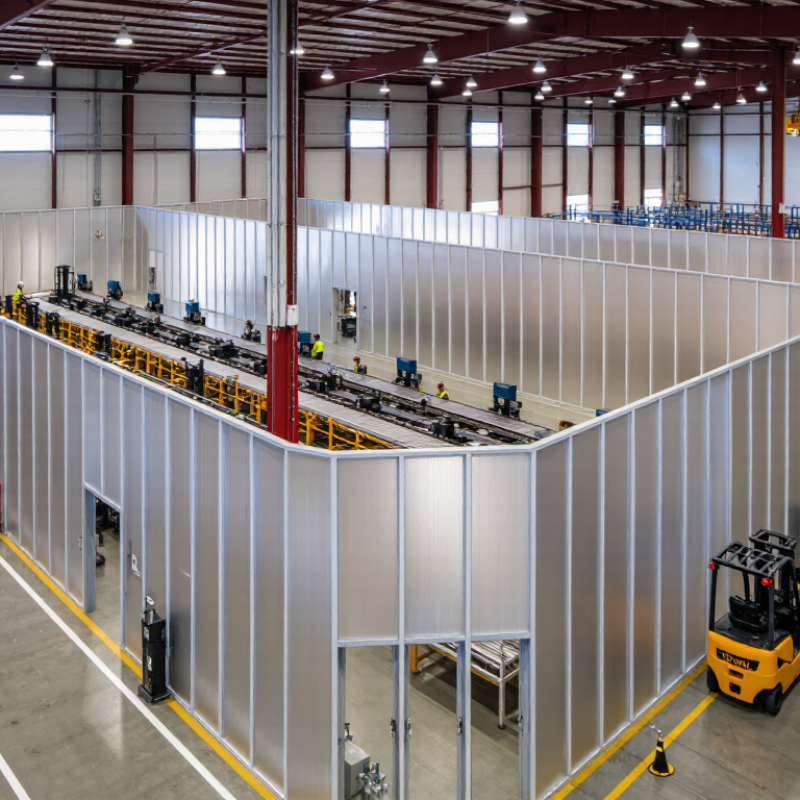
Industrial curtain wall systems form a non-load-bearing outer skin for factories, workshops, and warehouses. They help keep out wind and rain while allowing daylight into work areas. The building’s main frame carries structural loads; the curtain wall attaches to it through brackets and connections. That distinction matters when planning large openings or future equipment changes.
Typical systems combine aluminum framing with insulated glass, metal panels, or translucent sheets. A production hall might use clear glazing near offices and durable opaque panels beside machinery. In dusty or humid spaces, seals, drainage paths, and corrosion-resistant finishes need careful attention. Small details matter. Poorly managed joints can let water in, even when the panels look sound.
Applications vary with the work inside. A logistics facility may prioritize daylight and visibility, while a temperature-controlled plant needs better insulation and tighter air control. Designers should check wind loads, thermal movement, fire requirements, and cleaning access against the project’s actual conditions. Specifications are not a substitute for site review.
One awkward truth: the most attractive facade can become costly if replacement panels are difficult to source or reach. Regular inspections of sealants, fixings, and drainage help identify wear before it affects the interior.
When evaluating industrial curtain wall suppliers in China, request project-specific evidence, not polished brochures. Ask for full-size mock-up results covering air leakage, water penetration, structural strength, and thermal performance. Check the test method, laboratory accreditation, and whether the tested design matches your drawings. A small change in mullion spacing can affect results.
Energy performance deserves close attention. The IEA’s 2023 Global Status Report for Buildings and Construction estimated that buildings used 34% of global energy in 2022 and produced 37% of energy- and process-related CO₂ emissions. Ask suppliers for glass specifications, thermal-break details, and verified U-values. The World Green Building Council’s 2019 report, Bringing Embodied Carbon Upfront, also highlights the impact of construction materials. Request material traceability or environmental product data where available. Numbers need context.
Production capacity matters, but inspect the process behind the claim. Review sample corner joints, sealant application, coating consistency, and packaging for transport. Ask for recent project references with similar height, exposure, and installation conditions. Confirm who handles site measurements, replacement parts, and defect response. A factory visit helps. It is not foolproof. One weakness in many evaluations is relying on a single sample; real batches can vary.
Suggested evaluation weights for comparing suppliers. These percentages are a decision-making framework, not measured market rankings or supplier-specific results.
Assess project-specific evidence such as engineering documentation, quality records, production capacity, delivery plans, warranty terms, and itemized quotations.
Profiles of leading industrial curtain wall suppliers in China differ less by catalog size than by engineering depth. Large manufacturers typically combine aluminum extrusion, glass processing, fabrication, and project installation. This can simplify coordination on factories, logistics centers, and clean production buildings. Yet a broad service list proves little. Ask for project-specific test records, system drawings, and details of how suppliers handle corner joints, drainage paths, and thermal breaks. Small details matter.
The International Energy Agency and Global Alliance for Buildings and Construction reported that buildings accounted for 34% of global energy demand and 37% of energy- and process-related carbon emissions in 2022. That context makes thermal performance more than a brochure claim. Compare tested air leakage, water penetration, wind resistance, and U-values under the same standards. Request recent project references in similar climates, plus evidence that production batches match approved samples. A neat catalog is not proof. Site inspections help, though they can miss inconsistent quality between shifts. A supplier’s response to a failed test may reveal more than its sales presentation.
For industrial curtain wall projects in China, supplier comparison should start with verified capability, not catalogue claims. Ask how the team engineers pressure-equalized joints, continuous thermal breaks, and drainage paths around corners and openings. Then review test reports for the proposed assembly, including air leakage, water penetration, and wind-load performance. A laboratory result for one configuration may not cover a different glass build-up or fixing detail. Details matter.
Certifications are useful only when their scope matches the factory and product being purchased. Check current quality, environmental, and occupational safety certificates, plus the issuing body and covered site. The 2023 Global Status Report for Buildings and Construction, published by UNEP and GlobalABC, attributes 34% of global energy demand and 37% of energy- and process-related CO₂ emissions to buildings and construction in 2022. These figures cover the wider sector, not curtain walls alone, but they make thermal performance worth checking carefully. Not just logos.
Project references should match the job’s height, exposure, and installation conditions. Request comparable case records, approved mock-up results, inspection logs, and evidence of glass and aluminium traceability. Ask who resolves site changes when slab edges or anchors differ from drawings. A polished project list can hide gaps; even a capable supplier may have limited experience with your exact façade type. That deserves an honest conversation.
This comparison uses anonymized supplier profiles, not company rankings. Profiles describe common business models; certifications and project records must be verified for each shortlisted supplier.
| Supplier Profile | Typical Capabilities | Certifications and Compliance to Verify | Project Experience to Request | Key Technical Checks | Potential Best Fit |
|---|---|---|---|---|---|
| Integrated façade contractor | May combine façade design coordination, engineering, fabrication, installation, and project management. Scope varies by contract. | Check current ISO 9001 quality-management certification and its scope. Confirm applicable Chinese codes and project-specific testing requirements. | Request completed-project references, project scope, dates, façade system type, and client permission to verify delivery and installation responsibilities. | Review design coordination procedures, structural calculations, interface details, quality plans, installation method statements, and warranty terms. | Projects where one contractor is expected to coordinate design, supply, and site installation. |
| Engineering-led façade specialist | Typically emphasizes system design, performance calculations, shop drawings, and technical coordination; manufacturing or installation may be handled by partners. | Verify the legal entity, certificate validity, certification scope, and any project-specific qualifications required by the owner or local authority. | Ask for comparable project records showing system type, building use, design role, and how the proposed solution was tested or approved. | Assess wind-load assumptions, movement allowances, drainage strategy, thermal and acoustic targets, fire-safety interfaces, and drawing-review workflow. | Projects with demanding geometry, performance criteria, or extensive design coordination. |
| Export-oriented façade manufacturer | May offer production for overseas projects and experience coordinating packaging, shipping, documentation, and destination-market requirements. | Request applicable quality and environmental certificates, such as ISO 9001 or ISO 14001, and verify them with the issuing certification body. Confirm destination-country code compliance separately. | Request references for projects in the same destination market, including product scope, delivery record, installation arrangements, and client contacts where available. | Check material traceability, sample and mock-up procedures, inspection records, packing specifications, customs documentation, and responsibility for local approvals. | Projects requiring cross-border procurement or coordination with an overseas construction team. |
| Regional fabricator and installer | May provide local fabrication, site measurement, installation crews, and responsive coordination within its operating region. | Verify business and construction qualifications required for the actual project scope. Check safety-management documentation and the validity and scope of any stated ISO certification. | Review local references for similar building types, site conditions, installation scope, schedule performance, and after-sales response. | Inspect factory equipment and capacity, workforce planning, incoming-material checks, installation supervision, and site safety procedures. | Projects where local access, site coordination, and installation support are important. |
| Specialist renovation and retrofit supplier | May focus on façade replacement, remediation, refurbishment, or upgrading existing curtain wall systems. Capabilities differ substantially by supplier. | Confirm qualifications and permits applicable to renovation work, as well as project-specific requirements for working at height, fire safety, and occupied buildings. | Request retrofit references showing existing conditions, investigation scope, phasing, occupant-protection measures, and documented outcomes. | Review survey methods, compatibility with existing structure, concealed-condition allowances, temporary weather protection, and phased installation plans. | Existing buildings requiring façade repair, replacement, or performance upgrades. |
Buyer verification: Request current certificates issued to the contracting legal entity, confirm their scope and validity, and independently verify project references. For curtain wall work in China, check the applicable edition of GB/T 21086 and all project-specific national, local, and destination-market requirements with the design team and relevant authorities.
Choosing an industrial curtain wall supplier is less about comparing quotations than checking how each system performs under real site conditions. Ask for engineering calculations covering wind pressure, frame deflection, thermal movement, and the building’s exposure to rain and dust. Request test evidence for air leakage, water penetration, and structural performance, plus details on how samples were tested. A polished brochure is not enough. Details matter.
Energy performance also deserves attention, even in factories. The
The GlobalABC 2024 Global Status Report estimates that buildings and construction accounted for 32% of global energy demand and 34% of energy-related CO₂ emissions in 2023.
Those figures do not predict one project’s savings, but they show why glazing, thermal breaks, and installation quality matter. Compare whole-system values, not glass specifications alone. Check fabrication tolerances, corrosion protection, replacement-part availability, and the supplier’s record on similar building types. Visit a completed site if possible. I would still question any promise that lacks a clear test method; schedules are often optimistic, and that is easy to overlook. Ask who supervises installation and how defects are recorded and corrected.
„Thanks to the LUVIR technology, the solder resist process could be switched directly from the previously used mask exposure to direct exposure. As an outstanding digital solution on the market, this technology has been able to demonstrate fast process times and superior quality on our certified conventional ink in production. This allowed us to fully digitize the solder mask process at low cost – without process or ink adjustments. An excellent benefit to our production in Rot am See.“
Ralf Göhringer (Head of Production WE Rot am See)
I would definitely recommend the Limata machine and team for a future company purchase
Michael Greenaway
Compunetics Inc.
“The Limata ldi has been amazing!! Best thing we did was buy this machine”
Richard Brady
GM
Circuitlabs
“Since 2019, we have been running the Limata X1000 LDI system (including LUVIR for solder mask imaging) in daily production as an addition to our current process with film. The machine was capable of properly exposing Taiyo PSR-4000 BN (DI) solder mask types on normal to high-copper boards using a new and unique direct imaging process. The machine operating interface is very user friendly which allowed for a quick technical training curve. The pre-registration processing reduced several seconds of production time at every print. Limata support and service staff is incomparable. They supported our team every step of the way at basically any time of the day or night, with literally, an immediate response time, customizing the software interface to best fit our Operations and needs.
We have exposed more than 8,000 prints since end of October, on various solder mask colors and some resist film panels. Limata, has proven to be very capable and innovative. They are a strong contender in the industry.
We have very much enjoyed this project, and working with the team!
Thank you Limata for the continued support and being a part of our growth.”
Bill Sezate
Vice President, GM
Summit Interconnect
As a replacement to our current contact exposure process with film, the LIMATA X2000 system including LUVIR-Technology was capable of properly exposing non-LDI solder mask types using a direct imaging process. The machine offers cutting edge software with a very intuitive operating interface which allowed for quick technician training curve. The dual drawer system combined with pre-registration processing reduced several seconds of production time at every machine cycle. Limata support and service staff is world class. They added software patches to keep production running at shortest possible response times, customized the software interface to best fit our in-house Operations system, and even wrote a step-by-step machine processing manual. As a result of the project, we have exposed more than 16,000 times on various product types and solder mask brands/colors. Limata, in a very short timeframe as a company, has definitely shown they are truly innovative and will be challenging the industry of direct imaging for the top spot.
Kevin Beattie
Process Engineer
TTM Technologies
Forest Grove Division
