Lifting Bolts sit quietly beneath cranes, frames, engine assemblies, and temporary lifting points. Yet a small thread defect can create a serious failure. Global buyers therefore need more than attractive pricing. They need traceability, correct grades, tested capacity, and clear installation guidance.
The Fortune Business Insights report valued the global lifting equipment market at approximately USD 74.60 billion in 2024. It also forecasts continued growth through 2032. Grand View Research identifies construction, manufacturing, logistics, and energy as major demand sectors. These figures describe lifting equipment broadly, not Lifting Bolts alone. That distinction matters. Market growth cannot replace engineering judgment.
Ross Moloney, former chief executive of the Lifting Equipment Engineers Association, has stated, “Competence is the foundation of safe lifting.” His point applies directly to bolt selection. A buyer must examine working load limits, proof testing, thread form, material grade, corrosion protection, and certification. ISO 898-1 supports mechanical-property verification for carbon-steel fasteners. ASME B30.26 provides guidance for rigging hardware, including marking and inspection expectations. Regional requirements may still differ.
This guide examines the top 10 types of Lifting Bolts used by international buyers. It compares shoulder eye bolts, swivel eye bolts, lifting eyebolts, hoist rings, and specialized designs. The practical details are visible on a workshop floor: a stamped grade, a clean thread, a fully seated shoulder, and no bent eye. Some product descriptions remain incomplete. That is a weakness worth admitting. Buyers should verify manufacturer data, independent test records, and application limits before purchase. A bolt can look strong. Appearance is not proof.
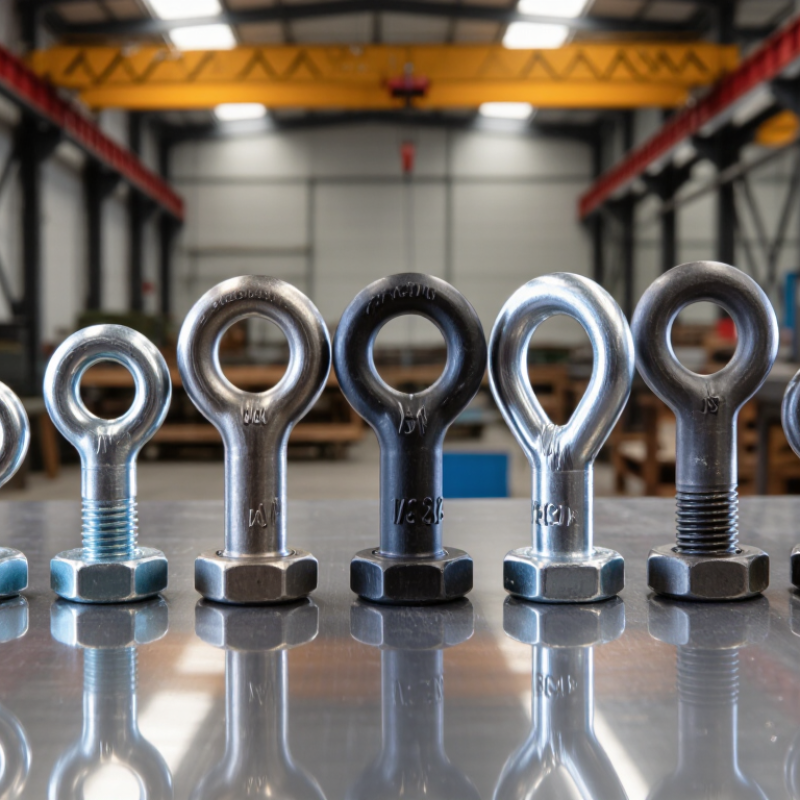
Lifting bolts are threaded lifting hardware designed to connect a load to a hoist, sling, or lifting fixture. Unlike ordinary bolts, they include a formed eye, shoulder, or swivel head for controlled force transfer. Common types include eye bolts, shoulder eye bolts, swivel lifting bolts, ring bolts, and hoist rings. Their shape affects installation, load direction, and handling performance.
A typical lifting bolt has a load-bearing head, a shank, and threaded engagement. The head receives the hook or sling. The shank transfers tension into the bolt body, while the threads secure it to the lifting point. Some designs use a shoulder to seat against the surface. Swivel versions allow limited rotation and can reduce twisting during movement. In practice, the bolt should carry force along its intended axis. Side loading can sharply reduce capacity. That detail is often underestimated.
Working principles are simple, but not forgiving. A properly seated bolt transfers lifting force through the head, shank, threads, and supporting structure. The receiving hole must match the thread size and condition. Damaged threads, bent heads, corrosion, or unclear markings require removal from service. I have seen clean-looking hardware fail inspection because the base material was too thin. A rating on the bolt cannot compensate for weak equipment.
Tips: Check the marked working load limit, thread engagement, and contact surface before every lift. Keep the load balanced and avoid sudden movement. Do not modify, weld, or force a lifting bolt into alignment. If the lifting angle is uncertain, stop and obtain qualified technical guidance.
This chart compares representative maximum working load limits commonly found across standard lifting-hardware categories. Actual capacity depends on thread size, material grade, load angle, installation method, and applicable standards such as DIN, EN, ASME, or ISO. Always verify the manufacturer’s marked WLL before use.
Lifting bolts support equipment handling, alignment, and controlled load movement. Their design must match the load path, thread engagement, and lifting direction. The ten main types include eye bolts, shoulder eye bolts, machinery eye bolts, ring bolts, swivel hoist rings, lifting-point bolts, T-head bolts, U-bolts, J-bolts, and lifting eyebolts with extended shanks.
Eye bolts provide a simple attachment point for vertical loads. Shoulder eye bolts offer better stability under limited side loading. Machinery eye bolts suit fixed equipment and maintenance tasks. Ring bolts use a closed ring for rope or hook connection. Swivel hoist rings rotate under load and reduce twisting. Lifting-point bolts combine a threaded fastener with a rotating eye. T-head bolts slide into machine slots for adjustable positioning. U-bolts clamp pipes, frames, or curved components. J-bolts anchor through holes or concrete structures. Extended-shank eyebolts reach recessed mounting points.
Each type has practical limits. A swivel ring may fit a compact housing, while a U-bolt needs matching saddle support. Thread quality matters. So does the base material. Installers should verify working load limits, thread depth, tightening torque, and inspection records before use. Never judge capacity by appearance alone. A large bolt can still fail in weak material.
Field experience shows that side loading causes frequent mistakes. Some fittings are intended only for straight-line lifting. Real installations are less perfect. Misalignment, corrosion, or uneven loading can change performance. Use certified hardware and follow applicable lifting regulations for every application.
| No. | Lifting Bolt Type | Typical Load Direction | Common Thread or Mounting Arrangement | Key Features | Typical Materials | Common Standards or References | Main Applications | Important Buying and Safety Checks |
|---|---|---|---|---|---|---|---|---|
| 1 | Shoulder Pattern Eye Bolt | Primarily vertical; some designs allow limited angular loading when correctly installed | Male machine thread with an integral shoulder | The shoulder supports the eye against the load surface and helps control bending compared with a plain eye bolt | Forged carbon steel or alloy steel; corrosion-resistant steel options are also available | ASME B30.26; dimensional designs may reference DIN 580 or manufacturer specifications | Machine bases, dies, molds, frames, and general material handling | Confirm full thread engagement, shoulder contact, rated angle, and specified torque; never side-load beyond the permitted rating |
| 2 | Plain Pattern Eye Bolt | Vertical lifting only in many designs | Male machine thread without a load-bearing shoulder | Simple and economical lifting point for straight-line loads; less suitable for angular loading | Forged steel, stainless steel, or galvanized steel | DIN 580 is commonly used for metric lifting eye bolts; always verify the actual product specification | Vertical lifting of equipment, covers, small assemblies, and removable panels | Do not use for angular lifts unless the manufacturer specifically permits it; the mounting face must be flat and strong |
| 3 | Eye Nut | Usually vertical; angular capacity depends on design and installation | Female machine thread that screws onto a projecting stud or bolt | Provides a removable lifting eye where a compatible male thread is already available | Forged carbon steel, alloy steel, or stainless steel | DIN 582 is a widely recognized reference for metric eye nuts | Jigs, fixtures, machinery, pressure equipment, and fabricated structures | Check stud strength, thread compatibility, seating, and nut orientation; the eye must align with the direction of pull |
| 4 | Swivel Hoist Ring | Designed for vertical and controlled angular loading around the swivel axis | High-strength mounting bolt, often with a swiveling load ring | Swiveling ring follows the load direction and reduces bending at the attachment point | Heat-treated alloy steel with alloy-steel mounting hardware | ASME B30.26; lifting-point requirements may also reference manufacturer test and marking procedures | Heavy machinery, molds, dies, steel structures, and engineered lifting fixtures | Use only the supplied or specified bolt; inspect pivot movement, thread engagement, seating surface, and marked WLL |
| 5 | Rotating Hoist Ring | Vertical and angular lifting; ring rotates under load in approved directions | High-strength bolt with a rotating load ring and engineered bearing components | Allows the lifting ring to rotate while loaded, helping maintain alignment during turning or tilting operations | Heat-treated alloy steel, often with hardened internal components | ASME B30.26 and the applicable lifting-point manufacturer specification | Die handling, mold changes, machine installation, and load turning | Verify the rated angle, rotation capability, bolt preload, thread condition, and required installation torque |
| 6 | Ball-Bearing Swivel Lifting Point | Multi-directional within the stated working-load limits | Bolted base with a rotating or swiveling eye supported by a bearing | Low-friction movement can help the eye align with changing sling angles and reduce unwanted torsion | Forged or machined alloy steel with bearing-grade internal components | ASME B30.26; product-specific proof-test and marking requirements apply | Complex machinery, lifting tables, molds, transport frames, and regularly reoriented loads | Check bearing condition, rotation range, bolt preload, WLL at the actual angle, and compatibility with the base material |
| 7 | Countersunk Flush Lifting Point | Vertical or angular according to the engineered design | Flush-mounted countersunk bolt or recessed mounting system | Leaves a low-profile or nearly flush surface when not in use, reducing interference with handling and assembly | High-strength alloy steel; some systems use stainless steel components for corrosion resistance | ASME B30.26 and the specific engineered lifting-point specification | Machine tables, transport fixtures, vehicle bodies, tooling, and low-clearance equipment | Verify countersink geometry, bolt grade, seating depth, base thickness, and correct torque; do not substitute ordinary countersunk screws |
| 8 | T-Slot Lifting Bolt | Generally vertical or limited-angle loading in compatible T-slots | T-head or T-nut engages a machine-table or extrusion slot | Fast repositioning without drilling or welding; useful where the supporting structure has standardized T-slots | Alloy steel or high-strength carbon steel, usually heat-treated | Applicable machine-table, extrusion, or fixture-system specifications; WLL is product-specific | Machine tools, modular workholding systems, assembly tables, and temporary fixtures | Check slot dimensions, engagement length, bolt grade, clamping surface, and load path; do not use outside the rated slot system |
| 9 | Weld-On Lifting Lug with Bolted Eye | Vertical or angular loading through a welded structural lug and removable bolt or pin | Welded base plate with an eye, bolt, shackle pin, or detachable lifting connection | Creates a dedicated lifting attachment on structures where a conventional threaded hole is unavailable | Weldable structural steel or alloy steel; connection hardware is typically high-strength steel | Design should consider ASME B30.26, AWS welding practice, and applicable structural design codes | Skids, tanks, frames, pressure equipment, containers, and fabricated assemblies | Requires qualified weld design and inspection; verify parent-metal strength, weld size, load path, edge distance, and fatigue exposure |
| 10 | Expansion or Mechanical Lifting Anchor Bolt | Primarily axial tension; shear and angle limits depend on the anchor design | Expansion sleeve, wedge, or mechanical anchoring mechanism installed in concrete or masonry | Can provide a temporary or permanent lifting attachment where no threaded steel hole is available | Carbon steel, zinc-plated steel, stainless steel, or high-strength alloy steel | Applicable EN 1992-4, ACI 318, ETA, or other local anchor-design requirements | Concrete panels, precast elements, construction components, and temporary lifting points | Verify concrete strength, embedment depth, edge distance, hole cleaning, installation torque, and certified lifting capacity |
Note: Working load limits are design- and size-specific. Always use the marked WLL, manufacturer instructions, approved lifting angles, and applicable local regulations. Inspect lifting bolts and attachment points before every use.
Choosing lifting bolts requires more than checking size. Common types include eye bolts, shoulder eye bolts, straight eye bolts, swivel eye bolts, hoist rings, weld-on lifting eyes, plate lifting bolts, anchor lifting bolts, U-bolts, and custom forged designs. Each type suits different load paths. A shoulder eye bolt may handle angled loads better, while a straight eye bolt usually needs a vertical pull. Confirm the working load limit, not the breaking load. Keep a margin for shock and uneven loading.
Materials affect durability and inspection results. Forged alloy steel offers high strength, while stainless steel resists corrosion but may have different load limits. Zinc-plated steel can suit dry indoor use. Threads may be metric, unified, coarse, or fine. Match the bolt thread exactly with the tapped hole or nut. Never force a mismatched thread. It may look secure.
Safety details decide performance. Check the load rating at the actual sling angle, temperature, and installation direction. Inspect for bent eyes, damaged threads, cracks, and corrosion. Use calibrated torque tools when the manufacturer specifies tightening values. The lifting point must seat fully against a clean, flat surface. No washers unless approved.
Local regulations and recognized lifting standards may differ, so buyers should request test certificates, material records, and clear inspection instructions. One concern remains: catalog ratings cannot replace a site assessment. Assumptions fail quickly around sharp edges, sudden movement, or poor alignment.
Top 10 Types of Lifting Bolts for Global Buyers
International Standards, Markings, and Certification for Global Buyers
Lifting bolts may look similar, but their legal status and working limits can differ sharply. ISO 3266 covers forged eyebolts for general lifting purposes, while ASME B30.26 addresses detachable rigging hardware. EN 1677-1 applies to components used in lifting slings. These standards are not interchangeable. A bolt designed for vertical loading may fail under angular loading.
Markings should remain readable after transport, paint, and repeated inspections. Buyers should check the working load limit, thread size, material grade, manufacturer identification, batch number, and applicable standard. Certificates should match the exact product, not only a similar model. Under European machinery rules, relevant lifting accessories require conformity assessment and technical documentation. CE marking may apply, but it is not a universal quality guarantee. Other markets may require different declarations or registration records.
The safety margin is practical, not theoretical. The UK Health and Safety Executive recorded 138 worker deaths from workplace injuries in Great Britain during 2023/24. Its lifting-equipment guidance repeatedly stresses inspection, competence, and safe working loads. That evidence matters when comparing suppliers. A laboratory test report can confirm strength, yet it may not prove correct installation or field condition. I have seen purchasing teams focus on certificates and overlook damaged threads. That is an uncomfortable gap. Global buyers should request drawings, test methods, traceability records, and inspection intervals before approving a lifting bolt.
Choosing among the top 10 lifting bolt types starts with the load path, not the catalogue photo. Eye bolts, shoulder eye bolts, swivel hoist rings, pad eyes, and lifting points serve different directions of force. A plain eye bolt may suit vertical lifting, but side loading can reduce its safety margin sharply. Check the working load limit, thread engagement, material grade, and lifting angle. ASME B30.26 covers rigging hardware, while ISO 898-1 helps verify mechanical properties for fasteners.
Inspection should be physical and repetitive. Look for bent eyes, stretched threads, impact marks, corrosion pits, and damaged identification stamps. Measure thread condition with a matching nut, then compare the part with its certificate. OSHA 29 CFR 1910.184 requires frequent sling inspections, and similar discipline is sensible for lifting bolts. The ILO reported nearly three million work-related deaths globally each year in its 2023 safety report. Hardware decisions deserve that level of seriousness.
Worldwide sourcing requires more than requesting a “certificate.” Ask for test reports, traceability, heat numbers, dimensional drawings, coating details, and proof-load procedures. Confirm whether the quoted capacity applies to axial loading or angular loading. Use independent inspection for first orders and high-value assemblies. A supplier may offer a lower price with thinner documentation. That is not always a bargain. I would also challenge my own assumptions: a familiar thread size does not prove compatibility, and a polished finish does not prove strength. Reference: International Labour Organization, A Call for Safer and Healthier Working Environments, 2023; ASME B30.26, Rigging Hardware.
„Thanks to the LUVIR technology, the solder resist process could be switched directly from the previously used mask exposure to direct exposure. As an outstanding digital solution on the market, this technology has been able to demonstrate fast process times and superior quality on our certified conventional ink in production. This allowed us to fully digitize the solder mask process at low cost – without process or ink adjustments. An excellent benefit to our production in Rot am See.“
Ralf Göhringer (Head of Production WE Rot am See)
I would definitely recommend the Limata machine and team for a future company purchase
Michael Greenaway
Compunetics Inc.
“The Limata ldi has been amazing!! Best thing we did was buy this machine”
Richard Brady
GM
Circuitlabs
“Since 2019, we have been running the Limata X1000 LDI system (including LUVIR for solder mask imaging) in daily production as an addition to our current process with film. The machine was capable of properly exposing Taiyo PSR-4000 BN (DI) solder mask types on normal to high-copper boards using a new and unique direct imaging process. The machine operating interface is very user friendly which allowed for a quick technical training curve. The pre-registration processing reduced several seconds of production time at every print. Limata support and service staff is incomparable. They supported our team every step of the way at basically any time of the day or night, with literally, an immediate response time, customizing the software interface to best fit our Operations and needs.
We have exposed more than 8,000 prints since end of October, on various solder mask colors and some resist film panels. Limata, has proven to be very capable and innovative. They are a strong contender in the industry.
We have very much enjoyed this project, and working with the team!
Thank you Limata for the continued support and being a part of our growth.”
Bill Sezate
Vice President, GM
Summit Interconnect
As a replacement to our current contact exposure process with film, the LIMATA X2000 system including LUVIR-Technology was capable of properly exposing non-LDI solder mask types using a direct imaging process. The machine offers cutting edge software with a very intuitive operating interface which allowed for quick technician training curve. The dual drawer system combined with pre-registration processing reduced several seconds of production time at every machine cycle. Limata support and service staff is world class. They added software patches to keep production running at shortest possible response times, customized the software interface to best fit our in-house Operations system, and even wrote a step-by-step machine processing manual. As a result of the project, we have exposed more than 16,000 times on various product types and solder mask brands/colors. Limata, in a very short timeframe as a company, has definitely shown they are truly innovative and will be challenging the industry of direct imaging for the top spot.
Kevin Beattie
Process Engineer
TTM Technologies
Forest Grove Division
