China is a major source of industrial motion-control equipment, including planetary gearboxes used in automation, packaging, robotics, and material handling. Yet “top manufacturer” is not a fixed title. A supplier that suits a compact conveyor may not suit a high-torque production line. Fit comes first.
This guide looks at how to evaluate leading planetary gearbox manufacturers in China, rather than relying on rankings alone. It considers product range, torque and speed specifications, materials, machining and assembly capabilities, testing practices, and technical support. A Gearbox Planetary Gear unit may look simple in a catalog, but details such as backlash, noise, lubrication, and thermal performance can shape its real-world service life. Buyers should also check whether a manufacturer can provide clear drawings, documented specifications, and consistent communication during customization. Small details matter.
Company claims deserve careful review. A polished website is not proof of quality, and a long product list does not confirm expertise in every application. Compare evidence, request relevant test records, and ask how the supplier handles maintenance questions or replacement parts. This approach takes more time. It can also reveal gaps that a quick price comparison misses. The manufacturers discussed here should be viewed through practical criteria, with the final choice matched to the equipment, operating conditions, and support the buyer actually needs.
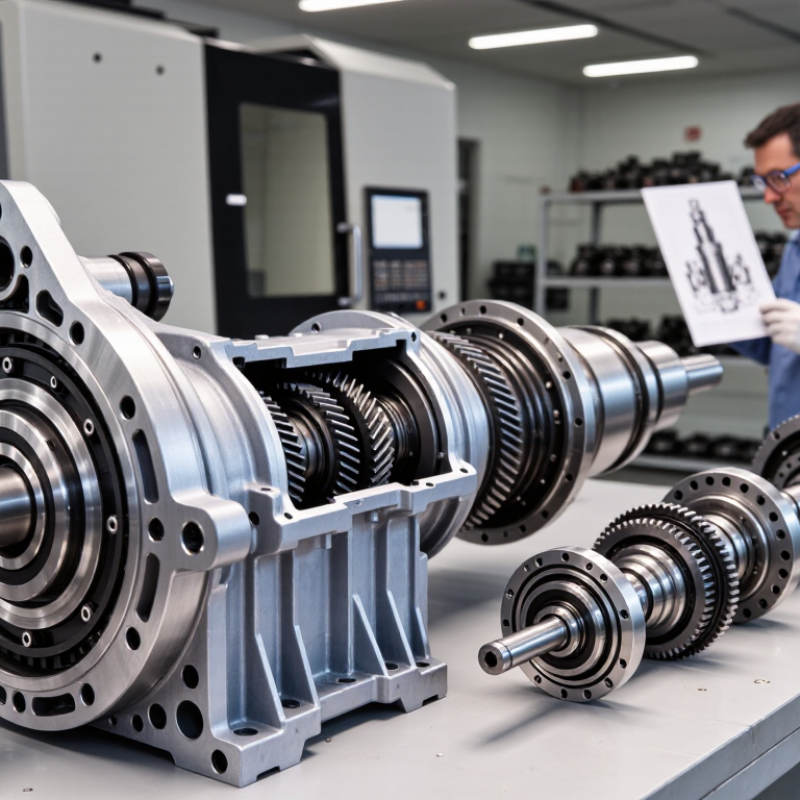
A planetary gearbox uses a central sun gear, surrounding planet gears, and an outer ring gear. The planets rotate around the sun while meshing with the ring. Depending on which part is fixed or driven, the mechanism reduces speed or changes output direction. Several planets share the load. This helps deliver high torque in a compact housing.
Small package, serious torque.
Still, compact does not mean maintenance-free: heat, lubrication, and alignment affect service life.
These units appear in robot joints, automated production lines, mobile equipment, and some wind-turbine systems.
The International Federation of Robotics reported 541,302 industrial robots installed worldwide in 2023 in World Robotics 2024. That figure does not mean every robot uses planetary gearing; joint loads and precision needs determine the design.
Wind power is another application. GWEC’s Global Wind Report 2024 recorded 117 GW of new wind capacity in 2023, supporting demand for reliable motion-control components. Planetary gearboxes may be used in turbine pitch or yaw drives, though configurations vary.
Selection should consider torque, ratio, duty cycle, backlash, and operating temperature—not torque alone. A missed detail here can become an expensive failure.
China’s planetary gearbox industry is best understood as a connected supply chain, not a simple list of factories. Upstream suppliers provide gears, bearings, housings, seals, and motor components. Gearbox manufacturers machine parts, assemble units, and test performance. Some focus on standard models, while others build to customer drawings or application requirements.
The market also includes system integrators and equipment makers. They select gear ratios, input speeds, mounting styles, and output configurations for automation, packaging, robotics, and material-handling systems. A compact gearbox beside a servo motor may serve a very different duty cycle from one driving a conveyor. Details matter. Buyers should check rated torque, backlash, noise, thermal limits, and documented test conditions, rather than relying on catalog figures alone.
Production capabilities vary widely between suppliers, even when product descriptions look similar. Some companies control machining and assembly in-house; others depend on outside component vendors. That can affect lead times and consistency, though it is not automatically a sign of poor quality. The picture is not perfectly tidy. A useful supplier review includes sample inspection, process records, warranty terms, and access to technical support. It also asks how the manufacturer handles wear, lubrication, and failures after installation.
Leading planetary gearbox manufacturers in China serve automation, robotics, packaging, and machine-tool applications. Compare suppliers by rated torque, backlash, efficiency, noise, service life, and documented testing—not price alone. Ask for test curves at your operating speed and load. A compact gearbox may fit the machine, yet still overheat during repeated starts. A polished catalogue is not proof of performance.
The International Federation of Robotics’ World Robotics 2024 report recorded 4,281,585 industrial robots operating worldwide in 2023, a 10% increase from 2022. This wider automation trend helps explain demand for precise, compact speed reducers; it does not measure planetary gearbox sales specifically. When assessing Chinese manufacturers, review material traceability, gear-treatment processes, inspection records, and sample-unit results. Check whether stated backlash applies to the delivered configuration. Small details matter.
Tips: Share your duty cycle, peak torque, mounting position, and ambient temperature before requesting a quotation. Ask for measurements from a real test, not just a standard table. Then verify fit on your own equipment; even careful supplier data cannot predict every installation.
Brand-neutral comparison framework: use these verifiable product and quality indicators to assess manufacturers. Standards indicate the scope of a test or management system; they do not establish a manufacturer ranking by themselves.
| Comparison Dimension | Data to Compare | Evidence to Request | Relevant Standard or Reference |
|---|---|---|---|
| Rated torque and service conditions | Rated output torque, peak torque, input speed, duty cycle, and operating temperature range for the specified model. | A model-specific datasheet that states load limits and operating conditions. | ISO 6336 series provides calculation methods for the load capacity of cylindrical spur and helical gears; confirm its applicability to the gearbox design. |
| Gear accuracy and backlash | Gear accuracy class, backlash specification, measurement method, and whether the stated values apply to the complete gearbox or individual gears. | Inspection records and a clear definition of backlash measurement conditions. | ISO 1328-1:2013 specifies an accuracy classification system for cylindrical gear flanks. |
| Transmission ratio and configuration | Available reduction ratios, number of stages, input and output arrangement, mounting options, and shaft or flange interfaces. | Dimensioned drawings and a configuration-specific quotation. | Compare drawings and model data against the application requirements; there is no single ratio range that applies to every planetary gearbox. |
| Efficiency and thermal performance | Efficiency by ratio and load, permitted input speed, heat dissipation assumptions, and thermal limits. | Test results identifying the model, ratio, lubricant, speed, load, and test conditions. | Efficiency is operating-condition dependent; compare results only when test conditions are comparable. |
| Bearing life and support design | Permitted radial and axial loads, bearing arrangement, and the assumptions used for calculated bearing life. | Load diagrams, bearing-life calculation inputs, and stated operating conditions. | ISO 281:2007 covers dynamic load ratings and rating life for rolling bearings. |
| Enclosure protection | The specified IP rating for the assembled product and any limitations related to orientation, seals, or operating environment. | Test documentation or a technical declaration that identifies the tested configuration. | IEC 60529 defines IP Code classifications for protection provided by enclosures. |
| Motor compatibility | Motor mounting interface, permitted motor dimensions, input speed, and coupling requirements. | Interface drawings and confirmation that the selected motor and gearbox combination has been checked. | IEC 60034-1 specifies rating and performance requirements for rotating electrical machines; it is relevant to the motor, not a gearbox quality ranking. |
| Quality management and traceability | Documented inspection controls, production traceability, nonconformance handling, and certificate scope and validity. | A current certificate verified with its issuer, plus sample inspection and traceability records for the relevant product site. | ISO 9001:2015 specifies quality management system requirements; certification alone does not guarantee product performance. |
| Warranty and after-sales support | Warranty duration and exclusions, spare-parts availability, response process, and technical support coverage. | Written warranty terms, service procedures, and the stated availability of replacement parts. | Terms are supplier-specific; compare them in writing rather than relying on general marketing claims. |
To identify leading suppliers for a specific application, compare like-for-like models using verified datasheets, drawings, test conditions, and quality documentation rather than an unsupported overall ranking.
Chinese planetary gearbox manufacturers differ less by product label than by the limits they can reliably meet. Some focus on standard ratios and compact units for conveyors or packaging lines. Others offer low-backlash designs for robotics, or higher-torque gearboxes for heavy machinery. Compare rated torque, backlash, efficiency, noise, and service life under stated operating conditions. A small backlash figure is not enough if the test method is unclear.
Demand provides useful context, but not a quality ranking. The International Federation of Robotics reported 541,302 industrial robot installations worldwide in 2023, with 276,288 installed in China. That scale supports a substantial automation supply chain; it does not prove that every local gearbox maker has equal precision or production control. Ask how units are inspected, what load tests are performed, and whether performance data covers the exact model you plan to buy. A catalog can look reassuring. Real applications are less tidy.
Tips: Request a test report for your operating speed and load, not just a general brochure. Check whether the quoted backlash applies after running-in, and confirm lead time for replacement parts. Small details matter. Do not treat a low price as proof of poor quality—or a polished specification sheet as proof of reliability.
Comparing planetary gearbox manufacturers in China takes more than checking catalog torque ratings. Ask suppliers to specify rated and peak torque, ratio, backlash, input speed, and duty cycle. Request dimensioned drawings and confirm that mounting points match your equipment. A precise answer is more useful than a broad promise. Details matter.
Review how components are machined, assembled, and inspected. Ask for material specifications, inspection records, and test results for noise, temperature, and efficiency. If possible, evaluate a sample under a load profile that resembles your real operating conditions. A gearbox that performs well on paper may behave differently after hours of repeated starts and stops. That difference matters.
Also examine engineering support, spare-part availability, lead times, and the process for handling design changes. Ask who will respond when operating conditions shift, and how performance concerns are documented. Clear records build confidence, but a certificate alone cannot prove suitability for every installation. No checklist removes all risk; buyers can overvalue polished documentation and overlook practical fit. A careful supplier should explain both what its data confirms and what still needs testing.
„Thanks to the LUVIR technology, the solder resist process could be switched directly from the previously used mask exposure to direct exposure. As an outstanding digital solution on the market, this technology has been able to demonstrate fast process times and superior quality on our certified conventional ink in production. This allowed us to fully digitize the solder mask process at low cost – without process or ink adjustments. An excellent benefit to our production in Rot am See.“
Ralf Göhringer (Head of Production WE Rot am See)
I would definitely recommend the Limata machine and team for a future company purchase
Michael Greenaway
Compunetics Inc.
“The Limata ldi has been amazing!! Best thing we did was buy this machine”
Richard Brady
GM
Circuitlabs
“Since 2019, we have been running the Limata X1000 LDI system (including LUVIR for solder mask imaging) in daily production as an addition to our current process with film. The machine was capable of properly exposing Taiyo PSR-4000 BN (DI) solder mask types on normal to high-copper boards using a new and unique direct imaging process. The machine operating interface is very user friendly which allowed for a quick technical training curve. The pre-registration processing reduced several seconds of production time at every print. Limata support and service staff is incomparable. They supported our team every step of the way at basically any time of the day or night, with literally, an immediate response time, customizing the software interface to best fit our Operations and needs.
We have exposed more than 8,000 prints since end of October, on various solder mask colors and some resist film panels. Limata, has proven to be very capable and innovative. They are a strong contender in the industry.
We have very much enjoyed this project, and working with the team!
Thank you Limata for the continued support and being a part of our growth.”
Bill Sezate
Vice President, GM
Summit Interconnect
As a replacement to our current contact exposure process with film, the LIMATA X2000 system including LUVIR-Technology was capable of properly exposing non-LDI solder mask types using a direct imaging process. The machine offers cutting edge software with a very intuitive operating interface which allowed for quick technician training curve. The dual drawer system combined with pre-registration processing reduced several seconds of production time at every machine cycle. Limata support and service staff is world class. They added software patches to keep production running at shortest possible response times, customized the software interface to best fit our in-house Operations system, and even wrote a step-by-step machine processing manual. As a result of the project, we have exposed more than 16,000 times on various product types and solder mask brands/colors. Limata, in a very short timeframe as a company, has definitely shown they are truly innovative and will be challenging the industry of direct imaging for the top spot.
Kevin Beattie
Process Engineer
TTM Technologies
Forest Grove Division
