Polyester remains the largest fiber category, supporting continued demand for reliable filament production equipment. Textile Exchange’s Materials Market Report 2024 estimates that global fiber production reached about 124 million tonnes in 2023, with polyester accounting for roughly 57 percent. That figure describes the fiber market, not POY machinery sales. The distinction matters.
POY Spinning And Winding systems turn molten polymer into partially oriented yarn and carefully wound packages. Operators watch quench airflow, godet speed, yarn tension, and package shape on the production floor. Small process changes can affect denier consistency, break rates, and downstream texturing performance. Numbers need context.
This guide examines manufacturers through practical criteria: line configuration, automation, energy use, package quality, production support, and access to spare parts. Published specifications are useful, but they do not tell the whole story. Actual output depends on polymer quality, plant conditions, maintenance, and the yarn specifications being produced. A fast machine is not automatically the right machine.
There is no universal ranking that fits every mill. A buyer making fine-denier yarn may value different winding controls than a plant focused on high-volume production. The manufacturers discussed here should therefore be compared against verified technical data, customer references, and application-specific trials. Claims deserve scrutiny. A careful shortlist begins with the process, not the brochure.
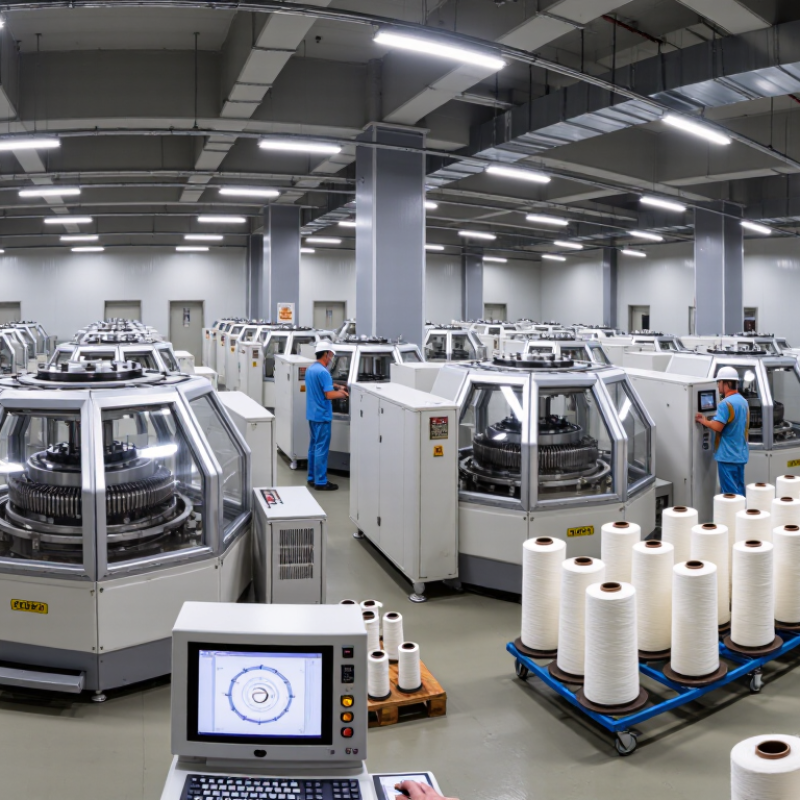
POY production begins with polymer melt passing through a metered extruder and fine filters. The melt exits spinneret holes as filaments, then cools in controlled cross-flow air. A finish applicator reduces friction before godets draw and stabilize the yarn. The winder builds packages while managing tension, speed, and package shape. Small details matter. Uneven quenching can create inconsistent filament properties, while poor tension control may cause breaks or soft packages.
Key components work as a connected system: extrusion and filtration govern melt consistency; the spinneret defines filament formation; quenching and finish application support stable handling; godets control yarn speed; and the winding head forms a usable package. Textile Exchange’s Materials Market Report 2024 estimates global fiber production reached 124 million tonnes in 2023, with polyester representing about 57%. This market context underlines polyester’s scale, but it is not a measure of POY machine output or efficiency. Actual performance depends on polymer quality, operating settings, maintenance, and product specifications.
Tips: Check filter pressure, quench airflow, and yarn tension together rather than in isolation. Record package defects and process settings for each run. Keep records. A neat package can still hide uneven filament quality, so inspection should include both winding and yarn tests.
| Process Stage | Key Machine Component | Function | Important Process or Quality Checks |
|---|---|---|---|
| Polymer preparation and melting | Extruder and melt delivery system | Melts polymer and conveys it to the spinning assembly at controlled conditions. | Melt temperature, pressure stability, and polymer cleanliness. |
| Melt filtration and metering | Filter pack and metering pump | The filter pack removes contaminants; the pump supplies a controlled polymer flow to the spinneret. | Filter pressure drop, flow consistency, and signs of blockage. |
| Filament formation | Spinneret and spinning pack | Distributes molten polymer through small capillaries to form continuous filaments. | Filament uniformity, spinneret condition, and absence of broken or blocked filaments. |
| Quenching and solidification | Quench-air chamber and airflow system | Cools the extruded filaments so they solidify before downstream handling. | Airflow uniformity, temperature consistency, and filament bundle stability. |
| Spin-finish application | Finish applicator and metering system | Applies a controlled finish to help manage friction and static during yarn processing. | Application consistency, finish condition, and yarn handling behavior. |
| Yarn forwarding and take-up control | Godet rolls and drive system | Guides and advances the filaments while controlling yarn speed and tension. | Roll speed, yarn tension, and synchronization between positions. |
| Optional yarn interlacing | Interlacing jet and compressed-air supply | Creates intermittent filament entanglements when an interlaced yarn construction is required. | Air pressure, jet condition, and consistency of interlace points. |
| Package winding | Winder, traverse mechanism, and package holder | Builds the yarn package by laying yarn onto a bobbin with controlled traverse and winding conditions. | Package shape, winding tension, traverse pattern, and package stability. |
| POY quality verification | Online monitoring and laboratory testing equipment | Checks yarn characteristics and helps identify process variation. POY is partially oriented and is commonly drawn in a later processing step. | Linear density, evenness, tensile properties, elongation, and package-to-package consistency. |
Note: Configuration and optional equipment vary by process design and yarn specification; no manufacturer or brand comparisons are included.
Melt spinning turns polymer chips into POY through a tightly controlled sequence. PET is melted, filtered, and pushed through a spinneret; fine filaments then cool in a quench chamber. At roughly 2,500–3,500 m/min, godets draw and stabilize the filaments before a winder lays them onto a package. The yarn remains partially oriented, leaving room for further drawing during texturing. Small details matter. A fluctuating quench or uneven finish can affect filament uniformity and winding tension.
The speed range is a practical operating window, not a quality guarantee. Operators monitor melt temperature, pressure, filament breaks, and package shape while adjusting take-up conditions. Higher speed can improve output, but it may also expose weaknesses in cooling or tension control. The Textile Exchange Materials Market Report 2024 estimates that polyester made up about 57% of global fiber production in 2023, underscoring the scale of polyester processing. That market figure does not prescribe a spinning speed; line settings depend on polymer grade, spinneret design, and equipment configuration. A neat package can still hide uneven yarn. That deserves checking.
Tips: Track denier variation and package hardness alongside line speed. Inspect freshly wound packages for soft edges, ridges, and loose wraps. If breaks rise after a speed increase, review quench airflow and finish application before pushing output further.
POY spinning and winding machines should be assessed against the yarn they need to produce, not just their maximum output. Filament count indicates how many continuous filaments make up a yarn bundle. Denier measures mass in grams per 9,000 meters. Check whether a specification refers to total denier or denier per filament; confusing the two can lead to unsuitable process settings. Small details matter.
Winding speed, usually stated in meters per minute, affects throughput, but faster is not always better. Higher speeds can make tension control and package formation more demanding. Look for operating data that describes stable production, not only a peak speed. A smoothly wound package should have even layers and firm edges, without loose sections or excessive hardness. These signs are worth checking during a machine trial.
Specifications need context. A machine set up for a particular filament count and denier may require different spinneret arrangements, take-up conditions, or winding adjustments for another yarn. Ask manufacturers how they verify speed, yarn tension, and package quality under the intended production conditions. I would not treat one catalog number as a guarantee; real results can shift with polymer properties, maintenance, and operator adjustments.
POY machine manufacturers typically build portfolios around polymer preparation, melt spinning, quenching, godets, and high-speed winding. Textile Exchange’s Materials Market Report 2024 estimates global fiber production reached 124 million tonnes in 2023, with polyester accounting for 57%. That demand makes line consistency important. Buyers should compare output per position, yarn count range, energy use, and package quality—not just headline speed.
Equipment portfolios differ in how they integrate spinning and winding. Some suppliers offer complete lines; others focus on winders, process controls, or retrofit components. Ask for test data at your intended polymer grade and denier. Check tension stability, automatic doffing, spare-part availability, and how quickly operators can clear a broken filament. A glossy specification sheet is not enough. Real production conditions are messier.
Tips: Request a sample package and review its density, edge shape, and unwinding behavior. Confirm utilities and floor-space needs before ordering. One detail is easy to overlook: a faster winder may not improve saleable output if upstream spinning stability is weak.
Typical operating temperature ranges associated with key stages of a PET POY line. Actual settings vary with polymer grade, line design, and production conditions.
Melt extrusion and the spinning beam operate at elevated temperatures to process PET, while cooler quench air helps solidify the filaments before winding.
POY line comparisons should begin with saleable kilograms, not brochure speed. Textile Exchange’s Materials Market Report 2024 puts global fiber output at 124 million tonnes in 2023. Polyester accounted for about 57%. That scale makes small efficiency gaps matter. Yet this is market context, not a POY machine benchmark.
Request output figures under matching filament count, denier, package size, and uptime assumptions. During a trial, record kilograms per position per hour, including doffs, yarn breaks, and startup waste. Speed alone misleads. Measure electricity at the line, then compare kilowatt-hours per kilogram of saleable yarn. The U.S. Department of Energy reports that motor-driven systems account for roughly 64% of U.S. industrial electricity use. This broad figure is not POY-specific, but it makes drive efficiency and standby loads worth checking.
Compare automation by counting manual interventions, not just installed sensors. Ask how long recipe changes take, how alarms are logged, and whether operators can trace breaks to a position. Check the meter. Treat unusually low energy claims carefully: measurement boundaries may exclude auxiliaries or idle time. A neat spreadsheet can hide that gap. Request trial logs and clarify what each figure includes before comparing quotations.
„Thanks to the LUVIR technology, the solder resist process could be switched directly from the previously used mask exposure to direct exposure. As an outstanding digital solution on the market, this technology has been able to demonstrate fast process times and superior quality on our certified conventional ink in production. This allowed us to fully digitize the solder mask process at low cost – without process or ink adjustments. An excellent benefit to our production in Rot am See.“
Ralf Göhringer (Head of Production WE Rot am See)
I would definitely recommend the Limata machine and team for a future company purchase
Michael Greenaway
Compunetics Inc.
“The Limata ldi has been amazing!! Best thing we did was buy this machine”
Richard Brady
GM
Circuitlabs
“Since 2019, we have been running the Limata X1000 LDI system (including LUVIR for solder mask imaging) in daily production as an addition to our current process with film. The machine was capable of properly exposing Taiyo PSR-4000 BN (DI) solder mask types on normal to high-copper boards using a new and unique direct imaging process. The machine operating interface is very user friendly which allowed for a quick technical training curve. The pre-registration processing reduced several seconds of production time at every print. Limata support and service staff is incomparable. They supported our team every step of the way at basically any time of the day or night, with literally, an immediate response time, customizing the software interface to best fit our Operations and needs.
We have exposed more than 8,000 prints since end of October, on various solder mask colors and some resist film panels. Limata, has proven to be very capable and innovative. They are a strong contender in the industry.
We have very much enjoyed this project, and working with the team!
Thank you Limata for the continued support and being a part of our growth.”
Bill Sezate
Vice President, GM
Summit Interconnect
As a replacement to our current contact exposure process with film, the LIMATA X2000 system including LUVIR-Technology was capable of properly exposing non-LDI solder mask types using a direct imaging process. The machine offers cutting edge software with a very intuitive operating interface which allowed for quick technician training curve. The dual drawer system combined with pre-registration processing reduced several seconds of production time at every machine cycle. Limata support and service staff is world class. They added software patches to keep production running at shortest possible response times, customized the software interface to best fit our in-house Operations system, and even wrote a step-by-step machine processing manual. As a result of the project, we have exposed more than 16,000 times on various product types and solder mask brands/colors. Limata, in a very short timeframe as a company, has definitely shown they are truly innovative and will be challenging the industry of direct imaging for the top spot.
Kevin Beattie
Process Engineer
TTM Technologies
Forest Grove Division
