A Roller Table Conveyor can look simple: parallel rollers, a sturdy frame, and a motor or gravity drive. Yet small design choices affect throughput, noise, maintenance, and how safely products move between workstations. In warehouses and production plants, these conveyors handle cartons, bins, and pallets across straight lines, curves, and transfer points. The right system should match the load, operating speed, available floor space, and connection requirements of the wider material-handling line.
This overview introduces ten manufacturers serving markets around the world. It considers practical factors such as product range, engineering support, customization, component quality, and service access. These details matter. A polished brochure cannot replace checking roller dimensions, rated capacity, drive options, installation needs, and support in your region. Some manufacturers specialize in standard modules; others focus on engineered systems for demanding applications. Their strengths are not interchangeable. No ranking can capture every plant’s reality, and company capabilities may change over time. That is worth remembering. Use this guide as a starting point, then confirm current specifications directly with each supplier. A careful comparison can help teams narrow their options without treating one brand as the automatic choice.
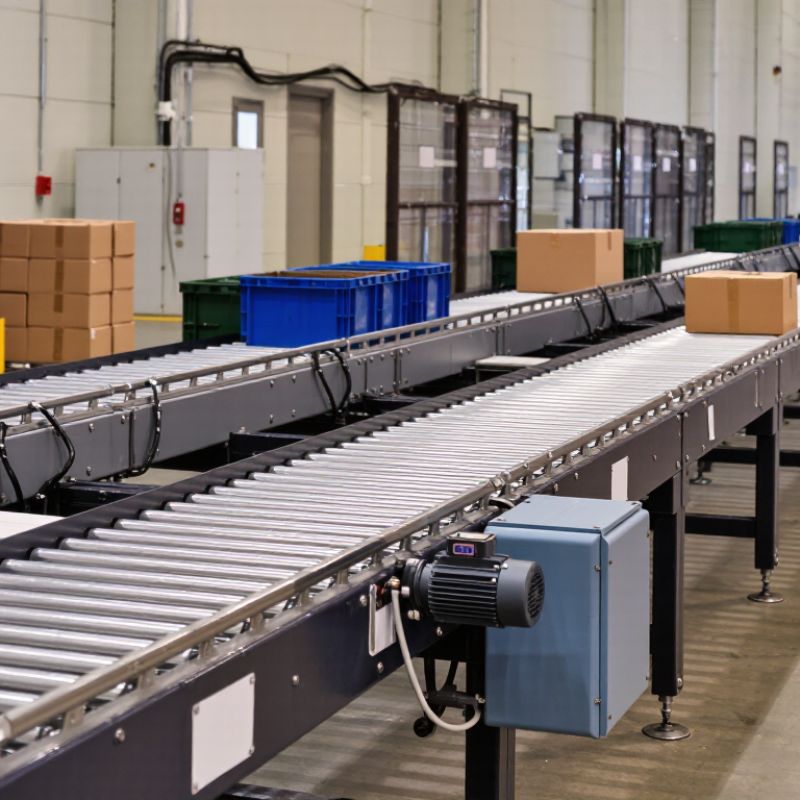
A roller table conveyor moves goods across a row of rotating cylinders mounted in a rigid frame. In gravity systems, a slight incline lets cartons or containers travel downhill. Powered versions use motors or drive belts to turn the rollers at a controlled speed. Roller spacing matters: small packages can catch between rollers, while heavy loads need adequate support.
These conveyors are common in warehouses, packing areas, and manufacturing lines. Workers may use them to move sealed cartons between inspection stations, or to feed components toward an assembly bench. At a loading area, a roller table can reduce repeated lifting over short distances. It does not remove every manual task. Operators still need clear access and a sensible working height.
The setup is not flawless.
Dust, loose labels, and damaged packaging can interrupt movement, especially around closely spaced rollers. A simple check of roller rotation, frame alignment, and load limits can reveal problems early. Conveyor performance also depends on the goods being handled; soft bags may sag, and irregular items may not track straight. Testing representative loads before installation is a practical step, though it can be overlooked when space is tight.
Comparing global roller table conveyor manufacturers starts with the actual load, not the catalogue headline. Check each roller’s rated capacity and the conveyor’s total load limit. A pallet carrying uneven weight can stress a frame differently from evenly stacked cartons. Confirm roller diameter, spacing, table width, and working height against the products moving through your facility. Fit matters.
Ask how the conveyor handles starts, stops, and frequent changes in direction. Drive type, speed range, guarding, and emergency-stop access affect daily operation. Request drawings and test data for the proposed configuration, rather than relying only on standard model specifications. Not just speed. A quiet demonstration with empty rollers may not reveal vibration or noise under load.
Compare frame materials, corrosion protection, replacement-part availability, and stated maintenance intervals. Ask what service response times mean in practice and whether spare rollers are stocked near your site. Review references from facilities with similar loads and operating hours. Pricing deserves scrutiny: installation, controls, commissioning, and training may sit outside the quoted equipment cost. That part is easy to overlook. A comparison sheet helps, but it cannot capture every site constraint; confirm clearances and floor conditions before choosing.
Profiles of ten leading roller table conveyor manufacturers are most useful when they compare engineering choices, not just catalog breadth. A strong supplier can explain roller diameter, pitch, frame loading, and transfer gaps in relation to the actual cartons or pallets. Look for details such as guarded chain drives, accessible bearing points, and replaceable rollers. These features matter on a busy line, where dust and repeated impacts expose weak maintenance access quickly.
The ten profiles can be read through distinct strengths: heavy-load frames, compact gravity sections, powered accumulation, modular layouts, hygienic construction, quiet operation, custom transfers, energy-conscious drives, fast installation, and regional service support. These are comparison lenses, not verified rankings. MHI and Deloitte’s 2024 Annual Industry Report found that 55% of surveyed supply-chain leaders planned to increase technology investment. That is broad supply-chain evidence, not a roller-conveyor market statistic, but it helps explain demand for adaptable equipment.
Ask each manufacturer for load ratings, maximum conveyor speed, noise data, and a layout showing service clearances. Request a test with representative loads, especially where cartons vary in width or arrive skewed. Small gaps can snag a loose strap. One caveat: published specifications rarely reveal performance after years of abrasive dust or uneven loading. A careful profile should separate documented test results from sales claims. MHI and Deloitte, 2024 Annual Industry Report.
Industry context: typical densities of materials commonly used in conveyor rollers.
Steel, aluminum alloy, and HDPE have typical densities of approximately 7,850, 2,700, and 950 kg/m³, respectively. Actual values vary by grade. This chart provides material context and does not compare or rank manufacturers.
Roller table conveyor manufacturers rarely build one design for every factory. Differences appear in roller spacing, frame strength, drive method, and controls. A line carrying light cartons may use gravity rollers and simple side guides. Heavy pallets need stronger shafts, closer support, and powered zones that reduce impact at transfer points. Small details matter.
In food packing, smooth, corrosion-resistant surfaces and accessible cleaning areas can be important. Automotive plants often need robust powered rollers to move heavy components between workstations. Distribution centers may favor modular sections, adjustable speeds, and accumulation zones for mixed parcels.
Gravity conveyors suit short, sloped routes with predictable loads; powered models handle longer distances and controlled movement. Curves and transfers also need careful sizing, or packages can skew and stall.
Specifications should reflect the actual load, environment, and maintenance routine, not just headline capacity. Operators may need access to bearings and drives without dismantling nearby sections. That sounds obvious, but it is often missed. Noise, dust, moisture, and uneven product bottoms can change performance in ways a clean-floor test will not show. No layout is perfect; a short trial with real products can reveal awkward gaps before installation.
Choosing a roller table conveyor supplier starts with the load, not the catalogue. Record the heaviest package, its base dimensions, and the required throughput. Ask for roller diameter, pitch, frame capacity, and allowable deflection under load. A small box can snag if the rollers are spaced too far apart. Test samples with your actual cartons, including uneven or soft-bottomed ones. Details matter.
The MHI 2024 Annual Industry Report found that 88% of surveyed supply chain professionals believe digital supply chains will become the predominant model within five years. That shift makes controls compatibility worth checking, even for a simple roller table. Confirm whether the supplier can provide sensor mounts, drive options, and clear interface documentation. Ask how changes to speed or line layout affect the quoted capacity. A polished drawing is useful, but it is not a load test.
Compare suppliers on service life and support, not just purchase price. Request maintenance intervals, spare-parts lead times, warranty exclusions, and written test results. If the conveyor will operate in dust, moisture, or frequent washdowns, specify those conditions before quotation. Ask for references from facilities handling similar products and duty cycles. Then check the assumptions. They can be wrong. A supplier’s response to a practical failure scenario may reveal more than a sales presentation.
„Thanks to the LUVIR technology, the solder resist process could be switched directly from the previously used mask exposure to direct exposure. As an outstanding digital solution on the market, this technology has been able to demonstrate fast process times and superior quality on our certified conventional ink in production. This allowed us to fully digitize the solder mask process at low cost – without process or ink adjustments. An excellent benefit to our production in Rot am See.“
Ralf Göhringer (Head of Production WE Rot am See)
I would definitely recommend the Limata machine and team for a future company purchase
Michael Greenaway
Compunetics Inc.
“The Limata ldi has been amazing!! Best thing we did was buy this machine”
Richard Brady
GM
Circuitlabs
“Since 2019, we have been running the Limata X1000 LDI system (including LUVIR for solder mask imaging) in daily production as an addition to our current process with film. The machine was capable of properly exposing Taiyo PSR-4000 BN (DI) solder mask types on normal to high-copper boards using a new and unique direct imaging process. The machine operating interface is very user friendly which allowed for a quick technical training curve. The pre-registration processing reduced several seconds of production time at every print. Limata support and service staff is incomparable. They supported our team every step of the way at basically any time of the day or night, with literally, an immediate response time, customizing the software interface to best fit our Operations and needs.
We have exposed more than 8,000 prints since end of October, on various solder mask colors and some resist film panels. Limata, has proven to be very capable and innovative. They are a strong contender in the industry.
We have very much enjoyed this project, and working with the team!
Thank you Limata for the continued support and being a part of our growth.”
Bill Sezate
Vice President, GM
Summit Interconnect
As a replacement to our current contact exposure process with film, the LIMATA X2000 system including LUVIR-Technology was capable of properly exposing non-LDI solder mask types using a direct imaging process. The machine offers cutting edge software with a very intuitive operating interface which allowed for quick technician training curve. The dual drawer system combined with pre-registration processing reduced several seconds of production time at every machine cycle. Limata support and service staff is world class. They added software patches to keep production running at shortest possible response times, customized the software interface to best fit our in-house Operations system, and even wrote a step-by-step machine processing manual. As a result of the project, we have exposed more than 16,000 times on various product types and solder mask brands/colors. Limata, in a very short timeframe as a company, has definitely shown they are truly innovative and will be challenging the industry of direct imaging for the top spot.
Kevin Beattie
Process Engineer
TTM Technologies
Forest Grove Division
