In the ever-evolving landscape of medical devices, the Squeezing Needle Testing Machine stands out for its critical role in quality assurance. As we approach 2026, advancements in technology drive innovation in this field. The demand for precision and reliability has never been more urgent. Companies must keep pace to remain competitive.
These machines test the integrity and functionality of needles used in various medical procedures. Engineers and manufacturers rely on their accuracy to ensure patient safety. A reliable Squeezing Needle Testing Machine can make a significant difference in manufacturing efficiency and product quality. Many machines on the market promise excellent performance and results. However, discerning the best among them can be challenging.
Not all machines are created equal. It's important to evaluate each option based on design, user experience, and maintenance needs. Some machines may excel in one area but lag in another. This inconsistency requires careful consideration. Evaluating the best technologies fosters a culture of innovation and safety in the industry. As we delve into the top options for 2026, let's explore what truly sets these machines apart.
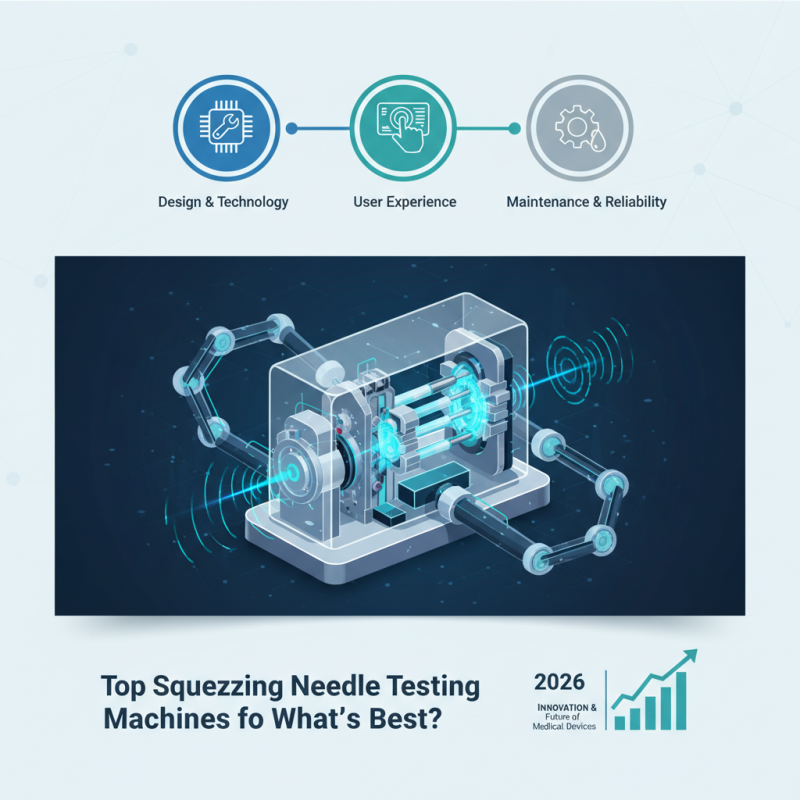
Squeezing needle testing machines play a vital role in quality control in various industries. They are essential for evaluating the performance and durability of needles used in textiles, medical devices, and other applications. These machines simulate real-world conditions by applying pressure to needles, ensuring they meet safety and quality standards.
The importance of these machines cannot be overstated. A well-functioning needle can prevent serious issues in end products. Poor-quality needles can lead to material damage or even cause injuries. Therefore, manufacturers must invest in reliable squeezing needle testing machines to ensure product safety. Choosing the right machine requires careful consideration, as even small errors in testing could result in significant consequences.
Staying updated on advancements in testing technology is crucial. The industry constantly evolves, introducing new features and improvements. However, not all machines meet the specific needs of every manufacturer. It’s important to choose a machine that aligns with particular testing requirements. Reflecting on past experiences can guide this decision-making process. Investing time in research and evaluation can lead to better testing outcomes, ultimately enhancing product integrity.
When selecting a squeezing needle testing machine, key features are crucial for optimal performance. A recent industry report indicates that accuracy is paramount, with devices boasting a precision rate of over 98% being the most sought after. This high level of accuracy ensures that the testing results are reliable and reduce the margin of error in critical applications.
Moreover, user-friendly interfaces enhance operational efficiency. Machines equipped with touchscreen controls and adaptable settings allow operators to fine-tune tests quickly. A study revealed that around 70% of operators prefer devices that minimize the learning curve. Advanced data logging capabilities can also provide insights over time, making it easier to track performance trends.
Durability cannot be overlooked either. Machines constructed from high-quality materials tend to have longer lifespans, leading to reduced maintenance costs. However, the journey to finding the perfect machine is not always linear. It's essential to evaluate not only initial costs but also long-term service options and manufacturer support. Choosing the right squeezing needle testing machine is as much about forward-thinking decisions as it is about technical specifications.
When selecting the top squeezing needle testing machines for 2026, it's essential to consider various brands and their unique features. These machines are crucial in ensuring the quality and reliability of medical devices. Many manufacturers are pushing the boundaries of technology, offering innovations that promise greater accuracy and efficiency.
In recent years, there has been a noticeable trend toward automation. Machines now come with advanced data analytics and user-friendly interfaces. Choosing the right model involves understanding your specific needs—whether it’s for high-volume testing or specialized applications. Additionally, some brands are still working on integrating better safety features. These enhancements are important but sometimes lag behind initial promises.
However, not every model on the market lives up to expectations. As advancements emerge, older machines might become less relevant, making it vital to keep an eye on industry developments. Reliability is key, but not all brands deliver consistently. Users must do thorough research, share their experiences, and sometimes rethink their choices to ensure optimal performance in this evolving marketplace.
| Model | Test Speed (samples/min) | Accuracy (%) | User Rating (out of 5) | Price Range ($) |
|---|---|---|---|---|
| Model A | 120 | 99.5 | 4.8 | 5000 - 7000 |
| Model B | 150 | 98.0 | 4.6 | 6000 - 8000 |
| Model C | 100 | 97.5 | 4.4 | 4000 - 6000 |
| Model D | 130 | 99.0 | 4.7 | 5500 - 7500 |
| Model E | 140 | 98.5 | 4.9 | 7000 - 9000 |
As the demand for innovative testing technologies grows, understanding the performance and reliability of squeezing needle testing machines becomes crucial. Recent industry reports indicate that the global needle testing market is expected to reach $500 million by 2026. This growth highlights the importance of selecting machines that not only perform well but also ensure consistency and accuracy in testing processes.
Performance metrics often include speed, sensitivity, and durability. High-performing machines typically complete tests within 60 seconds, offering rapid results crucial for manufacturers. Reliability, on the other hand, is assessed through consistent test outcomes over time, which is essential for quality assurance. Some industry statistics reveal that machines with a 90% reliability rating tend to drive better production efficiency.
However, not all machines meet these standards effectively. Some exhibit issues with test variances or calibration challenges, leading to potential failure in quality control. A significant 20% of users report dissatisfaction with the reliability aspects of their current testing machines. This indicates the need for further evaluation and improvement among manufacturers.
As the healthcare sector evolves, squeezing needle testing technology is set for significant advancements by 2026. Innovations will enhance precision and reliability. These improvements aim to address current challenges. For instance, many existing machines struggle with consistency in results. New designs could incorporate advanced sensors to ensure better accuracy. This would help mitigate human error during testing.
Future trends also indicate a push towards automation. Machines may use AI algorithms to analyze data in real-time. Such features could dramatically reduce testing time. However, the integration of technology raises concerns. Will these automated systems maintain the same quality as manual tests? Industry experts emphasize the need for thorough validation processes. Trust in these machines is vital for patient safety.
Moreover, sustainability is becoming a focal point. The development of eco-friendly materials for machine components is gaining traction. While these initiatives are promising, their effectiveness remains to be seen. Balancing durability and environmental impact is complex. Designers face the challenge of creating machines that are both sustainable and high-performing. The pursuit of efficiency and green practices will shape the future landscape of squeezing needle testing technology.
„Thanks to the LUVIR technology, the solder resist process could be switched directly from the previously used mask exposure to direct exposure. As an outstanding digital solution on the market, this technology has been able to demonstrate fast process times and superior quality on our certified conventional ink in production. This allowed us to fully digitize the solder mask process at low cost – without process or ink adjustments. An excellent benefit to our production in Rot am See.“
Ralf Göhringer (Head of Production WE Rot am See)
I would definitely recommend the Limata machine and team for a future company purchase
Michael Greenaway
Compunetics Inc.
“The Limata ldi has been amazing!! Best thing we did was buy this machine”
Richard Brady
GM
Circuitlabs
“Since 2019, we have been running the Limata X1000 LDI system (including LUVIR for solder mask imaging) in daily production as an addition to our current process with film. The machine was capable of properly exposing Taiyo PSR-4000 BN (DI) solder mask types on normal to high-copper boards using a new and unique direct imaging process. The machine operating interface is very user friendly which allowed for a quick technical training curve. The pre-registration processing reduced several seconds of production time at every print. Limata support and service staff is incomparable. They supported our team every step of the way at basically any time of the day or night, with literally, an immediate response time, customizing the software interface to best fit our Operations and needs.
We have exposed more than 8,000 prints since end of October, on various solder mask colors and some resist film panels. Limata, has proven to be very capable and innovative. They are a strong contender in the industry.
We have very much enjoyed this project, and working with the team!
Thank you Limata for the continued support and being a part of our growth.”
Bill Sezate
Vice President, GM
Summit Interconnect
As a replacement to our current contact exposure process with film, the LIMATA X2000 system including LUVIR-Technology was capable of properly exposing non-LDI solder mask types using a direct imaging process. The machine offers cutting edge software with a very intuitive operating interface which allowed for quick technician training curve. The dual drawer system combined with pre-registration processing reduced several seconds of production time at every machine cycle. Limata support and service staff is world class. They added software patches to keep production running at shortest possible response times, customized the software interface to best fit our in-house Operations system, and even wrote a step-by-step machine processing manual. As a result of the project, we have exposed more than 16,000 times on various product types and solder mask brands/colors. Limata, in a very short timeframe as a company, has definitely shown they are truly innovative and will be challenging the industry of direct imaging for the top spot.
Kevin Beattie
Process Engineer
TTM Technologies
Forest Grove Division
