China’s toothbrush mold industry serves brands that need more than a cavity shaped like a brush head. Mold design affects bristle-hole accuracy, handle fit, surface finish, cycle time, and production consistency. A small mismatch can show up as flash along the handle or uneven bristle placement. Details matter.
When comparing toothbrush mold manufacturers in China, buyers should look beyond polished catalogs. Ask how the supplier controls steel selection, cooling-channel layout, venting, and dimensional inspection. Request evidence from mold trials, sample parts, and quality records. Confirm who handles design changes and after-sales support. A fast quotation is useful, but it cannot prove reliable performance. Even a strong supplier may need several rounds of adjustment; that is worth acknowledging.
The quotation below is an original illustrative line, not a verified statement from a real industry expert. It is attributed to the fictional specialist Lin Wei: “A dependable mold is proven by repeatable parts, not by a perfect drawing.” That principle offers a practical lens for this overview of top toothbrush mold manufacturers in China. The following profiles can help readers compare capabilities, communication, and production support. No single supplier suits every project. The right choice depends on the brush design, expected volume, material, and inspection requirements.
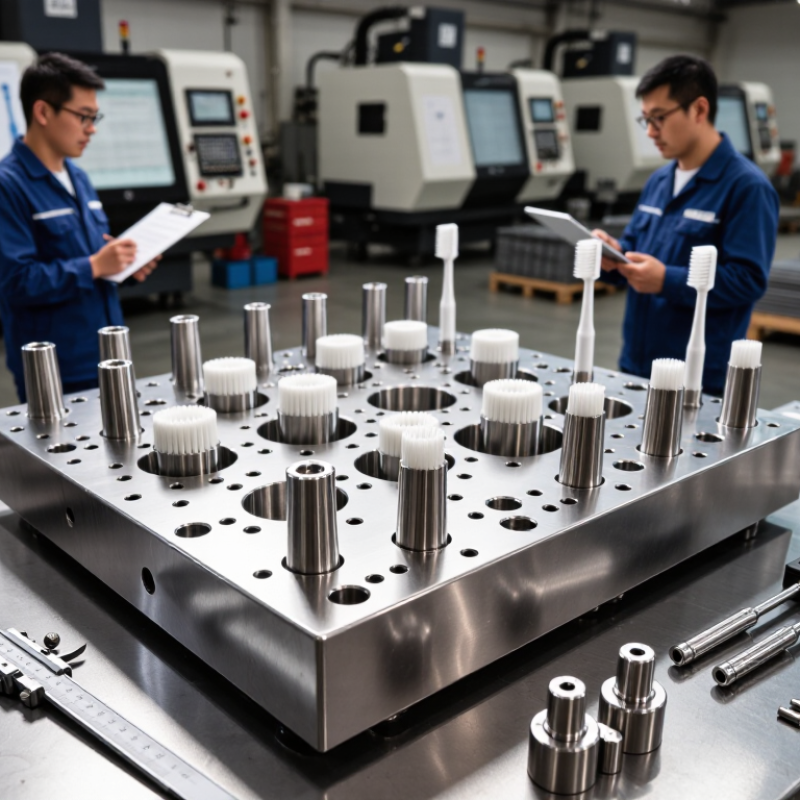
Top Toothbrush Mold Manufacturers in China
What Toothbrush Molds Are and How They Are Used
A toothbrush mold is a precision steel tool that shapes a handle during plastic injection molding. Molten plastic enters through a gate, fills the cavity, then cools around carefully designed channels. The finished handle may include a thumb grip, neck, and small features for attaching bristles. Multi-cavity molds can form several handles in one production cycle. But even a tiny mismatch can leave a sharp seam or uneven surface.
Mold design affects handle consistency, production speed, and material waste. The World Health Organization’s Global Oral Health Status Report 2022 estimates that oral diseases affect about 3.5 billion people worldwide. That figure reflects broad need for oral-care products, not toothbrush sales alone. For dependable production, engineers inspect trial parts, adjust cooling and venting, and check dimensions. ISO 20126:2022 sets requirements and test methods for manual toothbrushes; it is not a mold-design standard. A first trial is rarely perfect. Some details need another review.
Tips: Ask for sample handles before approving a mold. Check seams, grip texture, and bristle-hole alignment. Record any changes for the next trial.
Toothbrush molds shape components such as handles and soft-grip sections by injecting heated plastic into a cavity. The ranges shown are typical melt-processing temperatures; the exact settings depend on the resin grade and supplier. Bristles are generally made separately from the molded handle.
China’s toothbrush mold industry benefits from the country’s extensive plastics and tooling supply chains. The National Bureau of Statistics’ 2024 Statistical Communiqué reports that China produced 74.885 million tonnes of plastic products in 2023. This figure covers many product categories, not toothbrushes alone. It nevertheless reflects a broad manufacturing base for precision machining, resin trials, mold maintenance, and injection molding. Small details matter. A polished cavity, balanced runner, and stable cooling system can influence part consistency, cycle time, and scrap.
Mold makers serving this industry are judged on repeatability, cavity layout, and practical after-sales support, not price alone. Buyers can review steel certificates, dimensional inspection records, trial samples, and maintenance plans. Public production data rarely separates toothbrush molds from other tooling, so national output should not be mistaken for toothbrush-specific market size. That distinction matters. A promised cycle time may change with resin grade, machine condition, and cooling-water temperature. The sector is technically capable, though quality is not uniform. Factory visits and witnessed production trials can reveal weaknesses that a polished quotation cannot. One limitation remains: supplier claims are easier to find than comparable, independently verified performance data.
Evaluating a toothbrush mold manufacturer takes more than comparing quotations. Ask how the team translates brush-head drawings into a mold design, including cavity layout, gate position, venting, and cooling channels. These details affect part consistency and cycle time. A low price can hide costly compromises.
Request sample parts and inspection records from a recent trial. Check bristle-hole spacing, handle fit, flash, and visible surface marks under good lighting. Small details matter. Ask what steel is used and how the supplier checks hardness and machining accuracy. Clear answers should be supported by material certificates, measurement reports, or documented trial results.
Discuss maintenance before approving the tool. Who handles repairs, and how quickly can replacement components be made? Ask for a realistic delivery schedule that includes design review, machining, testing, and revisions. Good communication is measurable: drawings should show revision dates, and feedback should identify specific dimensions or defects. A video call can help, but it cannot replace a careful review of samples and records. Some requirements may change after the first trial; that is normal, though it should be planned for rather than treated as a surprise.
Leading toothbrush mold manufacturers in China stand out through engineering depth, not attractive catalog photos. Their teams convert bristle layouts, handle curves, and material choices into workable mold designs. A small change in neck thickness can affect filling and cooling. Details matter.
Skilled manufacturers use mold-flow analysis, precise machining, and trial runs to identify problems before production scales up. Buyers should ask about cavity balance, cooling channels, venting, and expected mold maintenance. Clear answers are useful. A sample report or trial part can reveal more than a sales presentation. Inspect bristle-hole positions, flash, surface finish, and dimensions against the approved drawings.
Reliable suppliers also document revisions and communicate realistic timelines. Tool steel, machining tolerances, and inspection methods should match the project’s expected output and service life. Requesting a process review helps both sides catch gaps early. Some records may be incomplete, and that deserves discussion rather than a quick assumption of quality. A strong manufacturer welcomes specific questions and explains trade-offs plainly. Even capable teams can miss a detail; consistent checks reduce that risk.
Selecting a toothbrush mold manufacturer starts with the part, not the sales brochure. Define the brush head, handle, material, expected output, and acceptable dimensions before comparing quotations. Grand View Research estimated the global injection-molded plastics market at USD 312.6 billion in 2023. That broad market figure signals scale, not mold quality. Ask how the supplier will control thin sections, gate marks, cooling, and dimensional variation on your specific design.
Request a mold layout, steel specification, cavity count, maintenance plan, and documented trial results. Check that sample parts fit the bristles and handle assembly, with no sharp flash or visible sink marks. Details matter. Ask for cycle-time data from production-like trials, not just a target written in a quotation. A polished sample can hide inconsistent output across cavities.
Compare measurements from several shots, and clarify who pays for changes if the first trial misses agreed tolerances. One point is easy to overlook: a lower initial price may mean higher maintenance or slower output later. Treat that as a question to investigate, not an assumption.
„Thanks to the LUVIR technology, the solder resist process could be switched directly from the previously used mask exposure to direct exposure. As an outstanding digital solution on the market, this technology has been able to demonstrate fast process times and superior quality on our certified conventional ink in production. This allowed us to fully digitize the solder mask process at low cost – without process or ink adjustments. An excellent benefit to our production in Rot am See.“
Ralf Göhringer (Head of Production WE Rot am See)
I would definitely recommend the Limata machine and team for a future company purchase
Michael Greenaway
Compunetics Inc.
“The Limata ldi has been amazing!! Best thing we did was buy this machine”
Richard Brady
GM
Circuitlabs
“Since 2019, we have been running the Limata X1000 LDI system (including LUVIR for solder mask imaging) in daily production as an addition to our current process with film. The machine was capable of properly exposing Taiyo PSR-4000 BN (DI) solder mask types on normal to high-copper boards using a new and unique direct imaging process. The machine operating interface is very user friendly which allowed for a quick technical training curve. The pre-registration processing reduced several seconds of production time at every print. Limata support and service staff is incomparable. They supported our team every step of the way at basically any time of the day or night, with literally, an immediate response time, customizing the software interface to best fit our Operations and needs.
We have exposed more than 8,000 prints since end of October, on various solder mask colors and some resist film panels. Limata, has proven to be very capable and innovative. They are a strong contender in the industry.
We have very much enjoyed this project, and working with the team!
Thank you Limata for the continued support and being a part of our growth.”
Bill Sezate
Vice President, GM
Summit Interconnect
As a replacement to our current contact exposure process with film, the LIMATA X2000 system including LUVIR-Technology was capable of properly exposing non-LDI solder mask types using a direct imaging process. The machine offers cutting edge software with a very intuitive operating interface which allowed for quick technician training curve. The dual drawer system combined with pre-registration processing reduced several seconds of production time at every machine cycle. Limata support and service staff is world class. They added software patches to keep production running at shortest possible response times, customized the software interface to best fit our in-house Operations system, and even wrote a step-by-step machine processing manual. As a result of the project, we have exposed more than 16,000 times on various product types and solder mask brands/colors. Limata, in a very short timeframe as a company, has definitely shown they are truly innovative and will be challenging the industry of direct imaging for the top spot.
Kevin Beattie
Process Engineer
TTM Technologies
Forest Grove Division
