Choosing a supplier for the Vacuum Brazing Process is not just a price comparison. A sound partner must understand alloy compatibility, joint clearances, furnace uniformity, and the limits of each production run. Small details matter. A few microns of gap variation can affect how filler metal flows. A poorly placed thermocouple can also hide a cold spot inside a dense load.
This guide compares ten suppliers for global buyers, focusing on practical capabilities rather than polished claims alone. It considers materials experience, process documentation, inspection methods, production capacity, and communication across borders. Ask for sample records. Review how a supplier handles a failed braze, not only a successful one. Some capabilities are difficult to compare from public information, so buyers should verify critical details directly.
Brazing authority Robert L. Peaslee is a useful reference point for the field. The following line is an editorial summary, not a verbatim quotation: “Reliable brazing begins with controlling the joint, the materials, and the heat.” That principle captures the work well, though it does not answer every sourcing question. Real components bring awkward geometries, mixed metals, and cost pressure. No supplier is ideal for every job. The strongest choice is the one that can explain its process, show relevant evidence, and identify risks before parts enter the furnace. That takes more than a brochure.
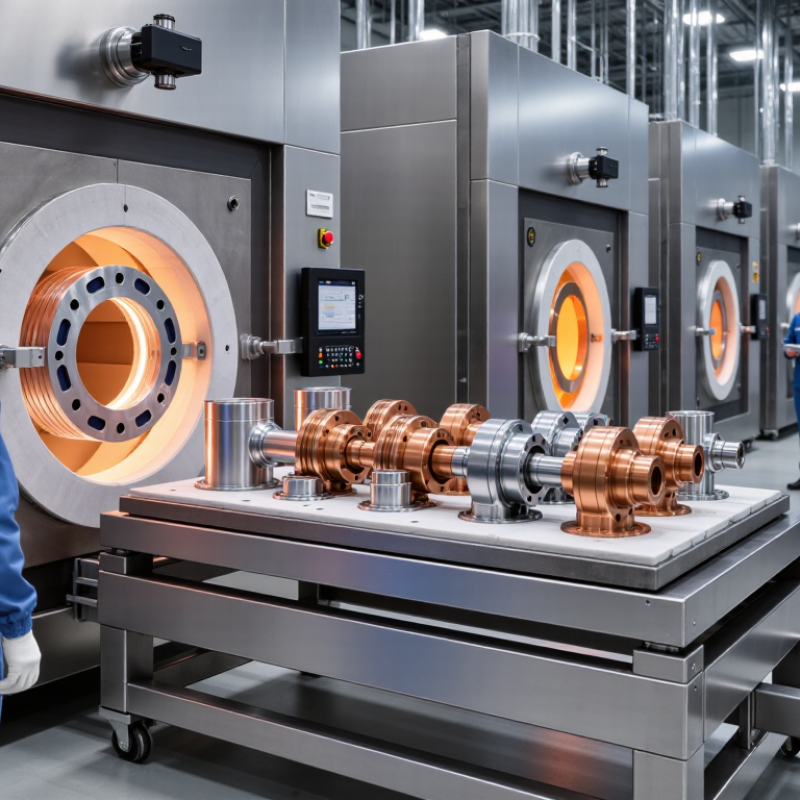
Vacuum brazing joins metal parts by heating them in a chamber with very little oxygen. A filler metal melts and flows into narrow gaps, while the base parts stay solid. The controlled atmosphere helps limit oxidation and often removes the need for flux. The result can be a clean, strong joint across complex assemblies. It is not magic. Poor fit, contamination, or an unsuitable alloy can still cause failure.
Global industries use the process for heat exchangers, aerospace components, and automotive thermal systems, where consistent joints and intricate passages matter. The International Energy Agency’s Global EV Outlook 2024 reports nearly 14 million electric cars sold worldwide in 2023, about 18% of all car sales. That growth increases demand for compact cooling hardware, including brazed battery plates and heat exchangers. Vacuum brazing can support these designs, but cycle time and tooling costs may not suit every part.
Tips: Check alloy compatibility, joint clearance, and surface cleanliness before production. Ask suppliers to document furnace temperature and vacuum records. Small details matter. A sample run can reveal distortion or leakage before full-scale manufacturing. Don’t assume a polished surface proves joint quality.
For global buyers, supplier evaluation should begin with evidence of process control, not furnace size. Ask for the qualified temperature range, temperature-uniformity mapping, vacuum records, and calibration intervals. Check whether the supplier has brazed your alloy combination and part geometry. A thin joint and a heavy fixture may heat differently. Request a trial run using representative parts, with acceptance limits agreed before production. The IEA’s Energy Efficiency 2023 report estimates that industry uses about 37% of global energy. This makes energy per cycle and load utilization useful questions, alongside throughput and maintenance response.
Tips: Ask for actual cycle logs. Confirm how operators handle alarms, leaks, and out-of-spec runs. Review sample inspection records, not just a capability statement. Where possible, visit the plant and observe loading, cleaning, fixturing, and post-braze inspection.
Compare suppliers on traceability, repeatability, and communication. Can they link each batch to its recipe, operator, and inspection results? Do they explain how they control joint clearance and filler-metal placement? Request documented evidence against your drawing and product requirements; a general quality certificate alone cannot prove process fit. No scorecard removes every doubt. A small qualification batch may still reveal distortion or uneven flow that paperwork misses. Also review capacity, lead times, and contingency plans before committing to recurring orders.
A useful shortlist compares ten distinct supplier profiles, rather than ten similar furnace shops.
A high-volume production specialist suits repeat orders and stable part designs; ask how it tracks batch consistency.
A precision-focused processor handles thin sections and tight dimensional requirements, where even slight distortion matters.
An aerospace-oriented supplier may offer documented process controls and traceable batch records. Verify these against your own quality needs.
A medical-device specialist can support clean, carefully controlled production, but its actual experience with your materials is more important than its label.
A regional job shop may provide direct engineering access and shorter shipping routes.
An in-house furnace builder can adapt fixtures or cycles to unusual geometries, though equipment ownership alone proves little.
An alloy-and-filler specialist helps assess joint design, filler selection, and compatibility between metals.
A prototype supplier is useful for small runs and early process trials.
A multi-site processor may offer capacity across regions, but confirm that each site uses consistent procedures.
A consulting-led supplier can help diagnose weak joints or leaks before production scales.
Details matter.
Compare sample joints, inspection methods, furnace uniformity records, and the supplier’s response to a failed test. Ask for a clear description of cleaning, fixturing, and acceptance criteria. A neat brochure is not proof.
Even experienced teams can miss a detail, so share drawings and operating conditions early. A practical supplier will explain trade-offs plainly, including limits in repeatability, lead time, or part size.
A vacuum brazing supplier’s capabilities show up in more than furnace size. Ask whether its equipment can hold stable temperatures across your part’s full geometry. Thin-walled assemblies and dense joints may respond differently to heat. Details matter. Request sample process records showing temperature uniformity, vacuum level, and cycle repeatability. These records can reveal more than a polished capability sheet.
Certifications help buyers compare quality systems, but their scope matters. ISO 9001 can indicate controlled procedures and corrective-action practices. For aerospace work, AS9100 may be relevant; specialized accreditation can apply to particular processes. Verify the certificate’s validity, facility, and approved scope directly. A certificate is useful, but it does not prove that a supplier has brazed your exact alloy combination. Still, verify. Ask for documented experience with similar materials, joint clearances, and service conditions.
Compare inspection options as carefully as production capacity. Suppliers may offer visual checks, leak testing, dimensional reports, or destructive examination on agreed samples. Ask how they trace each batch from incoming material through final inspection. A practical review includes a sample inspection report and a discussion of failure handling. One uncomfortable question is worth asking: what happens when a joint passes inspection but later fails in service? The answer may expose gaps in reporting or process learning. Not every supplier will fit every part, and a larger furnace is not automatically a better match.
Choosing a vacuum brazing supplier starts with the part, not the sales brochure. Share drawings, base alloys, joint clearances, and expected service conditions. Ask how the supplier controls furnace temperature, vacuum level, and heating cycles. Details matter. A capable team should explain how these variables affect wetting, distortion, and joint strength.
Review evidence from comparable work. Request sample inspection reports, leak-test results where relevant, and records linking each production lot to its furnace cycle. Ask what happens when a braze joint fails inspection. A clear answer is more useful than a promise of zero defects. If possible, inspect a trial batch and check dimensions, visual consistency, and test data against your own acceptance criteria.
Global buyers should also assess practical reliability. Confirm production capacity, lead times, packaging for long-distance transport, and how technical questions are handled across time zones. Discuss material sourcing and change control before placing repeat orders. Ask for references, but verify claims through specific project details rather than broad testimonials. No checklist removes all risk; even a well-run audit can miss problems that appear only at scale. Track early deliveries closely, compare actual results with quoted performance, and revisit assumptions when designs or volumes change.
„Thanks to the LUVIR technology, the solder resist process could be switched directly from the previously used mask exposure to direct exposure. As an outstanding digital solution on the market, this technology has been able to demonstrate fast process times and superior quality on our certified conventional ink in production. This allowed us to fully digitize the solder mask process at low cost – without process or ink adjustments. An excellent benefit to our production in Rot am See.“
Ralf Göhringer (Head of Production WE Rot am See)
I would definitely recommend the Limata machine and team for a future company purchase
Michael Greenaway
Compunetics Inc.
“The Limata ldi has been amazing!! Best thing we did was buy this machine”
Richard Brady
GM
Circuitlabs
“Since 2019, we have been running the Limata X1000 LDI system (including LUVIR for solder mask imaging) in daily production as an addition to our current process with film. The machine was capable of properly exposing Taiyo PSR-4000 BN (DI) solder mask types on normal to high-copper boards using a new and unique direct imaging process. The machine operating interface is very user friendly which allowed for a quick technical training curve. The pre-registration processing reduced several seconds of production time at every print. Limata support and service staff is incomparable. They supported our team every step of the way at basically any time of the day or night, with literally, an immediate response time, customizing the software interface to best fit our Operations and needs.
We have exposed more than 8,000 prints since end of October, on various solder mask colors and some resist film panels. Limata, has proven to be very capable and innovative. They are a strong contender in the industry.
We have very much enjoyed this project, and working with the team!
Thank you Limata for the continued support and being a part of our growth.”
Bill Sezate
Vice President, GM
Summit Interconnect
As a replacement to our current contact exposure process with film, the LIMATA X2000 system including LUVIR-Technology was capable of properly exposing non-LDI solder mask types using a direct imaging process. The machine offers cutting edge software with a very intuitive operating interface which allowed for quick technician training curve. The dual drawer system combined with pre-registration processing reduced several seconds of production time at every machine cycle. Limata support and service staff is world class. They added software patches to keep production running at shortest possible response times, customized the software interface to best fit our in-house Operations system, and even wrote a step-by-step machine processing manual. As a result of the project, we have exposed more than 16,000 times on various product types and solder mask brands/colors. Limata, in a very short timeframe as a company, has definitely shown they are truly innovative and will be challenging the industry of direct imaging for the top spot.
Kevin Beattie
Process Engineer
TTM Technologies
Forest Grove Division