The global market for dinosaur attractions is expanding beyond museums, reaching family parks, retail displays, educational venues, and themed events. Themed Entertainment Association and AECOM’s 2023 Theme Index reported strong worldwide attendance across major theme parks. This growth increases demand for durable, visually accurate prehistoric displays. A Velociraptor Dinosaur Statue can become a focal point, especially when its claws, feather details, and alert posture are carefully modeled.
This guide examines leading suppliers through practical procurement criteria. These include sculpting quality, fiberglass or resin durability, weather resistance, customization, production capacity, packaging, and international delivery experience. Grand View Research’s global toys market analysis also indicates continuing growth in experience-led and educational products. However, a statue is not a simple toy. Buyers should request material specifications, paint-system details, installation guidance, and recent project references. For public venues, suppliers should also explain how their products support applicable local safety requirements.
Supplier websites can be persuasive, but photographs may hide surface flaws, weak joints, or inconsistent scale. No ranking is perfect. Pricing can also change with shipping, crating, taxes, animation, and installation. That part is easy to underestimate. Our comparison therefore combines published company information, industry reports, product evidence, and buyer-focused questions. It also recognizes regional strengths, from large-scale manufacturing in Asia to customized fabrication in Europe and North America. The goal is not to promote the cheapest option. It is to identify dependable partners that deliver convincing detail, stable quality, and practical after-sales support.
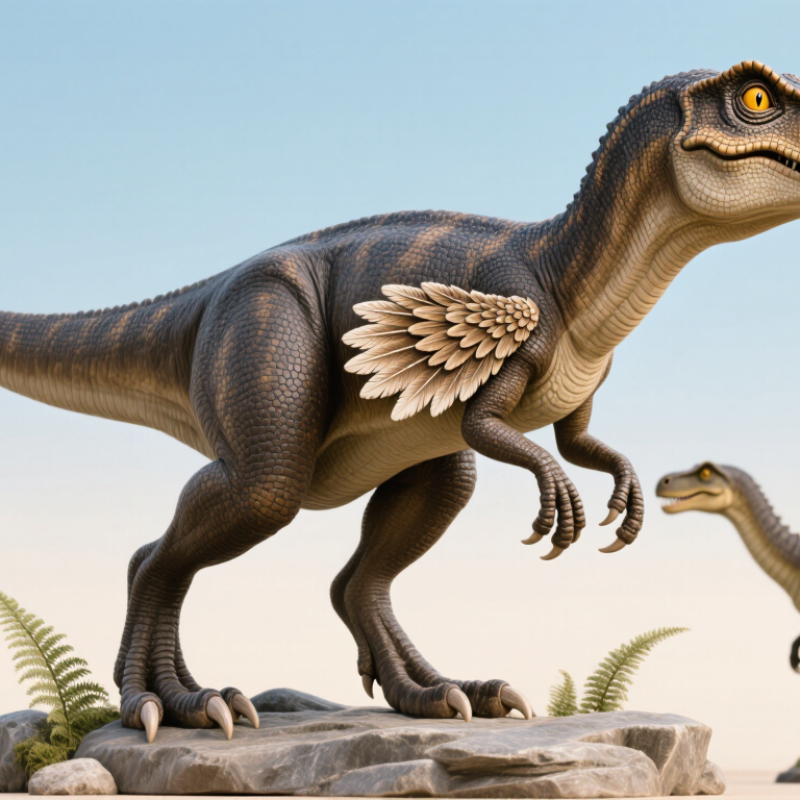
Velociraptor dinosaur statues are available in several styles. Museum-style replicas emphasize scientific accuracy and natural posture. Entertainment-focused models use dramatic claws, raised tails, and open jaws. Life-size statues suit parks, exhibitions, and themed attractions. Smaller pieces work better for classrooms, gardens, and private collections.
Material selection affects appearance, strength, and maintenance. Fiberglass offers a lightweight structure with detailed surface texture. Reinforced resin creates sharp scales and durable indoor displays. Steel frames support larger outdoor statues and reduce movement in strong wind. Cement and carved stone provide weight, but they require stronger foundations. Paint should resist ultraviolet exposure, moisture, and repeated cleaning. Cheap coatings often fade first.
Reliable suppliers should provide dimensions, material specifications, structural drawings, and recent production photos. Ask how the statue is packed and anchored. This matters more than a polished sales image. Custom suppliers can adjust skin color, pose, mouth position, and fossil-inspired details. Scientific references should guide the design, although some artistic choices remain unavoidable. A perfect replica is not always possible. Even experts may debate feather coverage and exact anatomy. Buyers should inspect sample surfaces for bubbles, cracks, uneven paint, and weak joints before approving large orders. A slightly oversized model can overwhelm a small venue, while a tiny statue may disappear outdoors.
When evaluating Velociraptor statue suppliers worldwide, examine their experience, materials, and production records. A dependable supplier should explain its sculpting process clearly. Ask whether the statue uses fiberglass, resin, or another documented material. Request close photographs of the claws, teeth, eyes, and textured skin. Small details reveal workmanship. A professional supplier will also provide exact dimensions, weight, color options, and installation requirements.
Supplier evidence matters more than polished website language. Review recent project references, production videos, and independent customer feedback. Check whether the company can produce a sample or a detailed prototype before full manufacturing. Consistent communication is important across time zones. Replies should address technical questions, not only prices. Written specifications should cover packaging, inspection procedures, replacement parts, and delivery schedules. Vague promises deserve caution.
I once underestimated how much packaging affects large animal statues. A beautiful sculpture can arrive with cracked fingers or bent supports. Ask for crate photographs and impact protection details. Confirm the supplier’s quality checks before shipment. Measurements should be verified twice. Mistakes happen. The key is whether the supplier records them and improves the process. Compare several quotations using the same specifications, rather than choosing the lowest figure. An experienced evaluator should also inspect surface finishing, balance, weather resistance, and mounting points. These practical checks create stronger evidence than attractive catalog images.
Leading regions for Velociraptor dinosaur statue manufacturing include China, Southeast Asia, Europe, and North America. China has extensive fiberglass, steel, silicone, and sculpting facilities, especially in coastal industrial areas. Its suppliers often support large outdoor displays, museum replicas, and custom amusement installations. Production capacity is usually strong, but quality can vary between workshops.
Vietnam, Thailand, and Indonesia are developing competitive capabilities in molded fiberglass and hand-painted decorative statues. These regions may offer flexible customization and attractive labor costs. Europe is more associated with museum-oriented work, detailed sculpting, and conservation-aware materials. North American manufacturers often focus on themed attractions, educational exhibits, and project-based engineering.
Realistic anatomy matters. A knowledgeable supplier should discuss scale, posture, skin texture, feather coverage, internal steel framing, and weather resistance. Historical Velociraptors were smaller than many popular film designs, and scientific interpretations continue to change. That distinction deserves attention.
Ask for production photographs.
Outdoor statues need UV-resistant coatings, sealed joints, drainage points, and stable anchoring plans. Indoor pieces may prioritize surface detail instead. I have found that sample approval is useful, yet it is not perfect; paint colors can shift under different lighting, and digital previews may hide seams. Buyers should review material specifications, packing methods, installation drawings, and inspection procedures before ordering. A lower price can reflect thinner fiberglass, weaker frames, or rushed finishing rather than genuine efficiency.
Top Velociraptor Dinosaur Statue Suppliers Worldwide?
When comparing worldwide suppliers, examine quality before dramatic appearance. A credible supplier should explain the statue’s materials, scale, construction, and scientific references. Ask whether the skeleton follows current paleontological research or artistic interpretation. Velociraptor reconstructions may differ in feather coverage, posture, and coloration. Transparent suppliers clearly identify those choices. Request close photographs of the skull, claws, joints, and surface finish. Small details often expose rushed craftsmanship.
Safety requires equal attention. Outdoor statues should resist moisture, sunlight, temperature changes, and strong wind. Fiberglass, resin, steel frames, and protective coatings need suitable specifications. Check the base design, anchor points, weight distribution, and installation instructions. Sharp claws or unstable feet can create avoidable hazards. Suppliers should provide material information and relevant test documents. Do not rely only on polished showroom images. A physical sample, factory video, or independent inspection offers stronger evidence.
Authenticity is not the same as realism. A glossy dinosaur can still contain inaccurate anatomy. Look for references from reputable museums, academic publications, or qualified consultants. Ask how the supplier controls color consistency, mold quality, and production changes. Batch records and clear warranty terms also support reliability. No supplier gets every detail right; scientific interpretations change. I might once prioritize an impressive pose, but structural safety matters more than a theatrical silhouette. A careful buyer should record defects, request corrections, and compare the delivered statue with the approved drawings.
Choosing a top velociraptor dinosaur statue supplier requires more than comparing catalog prices. Small resin figures may cost 100–500 USD, while 1.5–3-meter fiberglass statues often range from 1,500–6,000 USD. Oversized museum-style pieces can exceed 10,000 USD. These are practical market ranges, not fixed quotations. Material thickness, internal steel support, painting detail, and installation strongly affect the final price.
Customization deserves careful review. According to Grand View Research, the global 3D printing market was valued at about 20.37 billion USD in 2023, showing how digital modeling supports faster custom production. Ask suppliers for a scaled drawing, surface samples, color references, and one revision round. “Looks accurate” is too vague. A weak specification can create an expensive mistake. Check whether the quoted service includes mold charges, packaging, inspection photos, and replacement parts.
Shipping can change the decision. UNCTAD reports that maritime transport carries over 80% of global merchandise trade by volume, so sea freight usually suits large statues. Request both FOB and delivered pricing, plus crate dimensions and gross weight. Reliable suppliers should explain lead times, export documents, damage claims, and installation guidance. The World Bank’s 2023 Logistics Performance Index also shows major differences in logistics reliability between countries. A cheaper workshop may still cost more after delays, port fees, or poor communication. Supplier service is part of the product.
„Thanks to the LUVIR technology, the solder resist process could be switched directly from the previously used mask exposure to direct exposure. As an outstanding digital solution on the market, this technology has been able to demonstrate fast process times and superior quality on our certified conventional ink in production. This allowed us to fully digitize the solder mask process at low cost – without process or ink adjustments. An excellent benefit to our production in Rot am See.“
Ralf Göhringer (Head of Production WE Rot am See)
I would definitely recommend the Limata machine and team for a future company purchase
Michael Greenaway
Compunetics Inc.
“The Limata ldi has been amazing!! Best thing we did was buy this machine”
Richard Brady
GM
Circuitlabs
“Since 2019, we have been running the Limata X1000 LDI system (including LUVIR for solder mask imaging) in daily production as an addition to our current process with film. The machine was capable of properly exposing Taiyo PSR-4000 BN (DI) solder mask types on normal to high-copper boards using a new and unique direct imaging process. The machine operating interface is very user friendly which allowed for a quick technical training curve. The pre-registration processing reduced several seconds of production time at every print. Limata support and service staff is incomparable. They supported our team every step of the way at basically any time of the day or night, with literally, an immediate response time, customizing the software interface to best fit our Operations and needs.
We have exposed more than 8,000 prints since end of October, on various solder mask colors and some resist film panels. Limata, has proven to be very capable and innovative. They are a strong contender in the industry.
We have very much enjoyed this project, and working with the team!
Thank you Limata for the continued support and being a part of our growth.”
Bill Sezate
Vice President, GM
Summit Interconnect
As a replacement to our current contact exposure process with film, the LIMATA X2000 system including LUVIR-Technology was capable of properly exposing non-LDI solder mask types using a direct imaging process. The machine offers cutting edge software with a very intuitive operating interface which allowed for quick technician training curve. The dual drawer system combined with pre-registration processing reduced several seconds of production time at every machine cycle. Limata support and service staff is world class. They added software patches to keep production running at shortest possible response times, customized the software interface to best fit our in-house Operations system, and even wrote a step-by-step machine processing manual. As a result of the project, we have exposed more than 16,000 times on various product types and solder mask brands/colors. Limata, in a very short timeframe as a company, has definitely shown they are truly innovative and will be challenging the industry of direct imaging for the top spot.
Kevin Beattie
Process Engineer
TTM Technologies
Forest Grove Division
