Automatic transmissions are among the most contamination-sensitive assemblies in any vehicle. Dozens of hydraulic passages, valves operating at tight tolerances, clutch packs, and precision gears all depend on clean fluid and clean surfaces to function. A single metal chip left in a valve body bore can cause a shift complaint, a solenoid failure, or a warranty comeback. For transmission rebuilders, remanufacturers, and service shops, cleaning is therefore not a routine chore—it is a core quality competency that determines whether a rebuilt transmission lasts. This article explains how ultrasonic cleaning handles the most difficult transmission components, including valve bodies, gears, and housings, and how to set up an ultrasonic cleaning machine process that delivers the cleanliness these parts demand.
⚙️
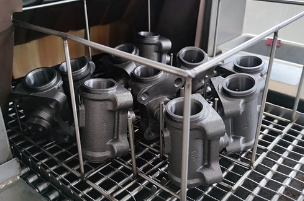
A modern valve body is a maze of cross-drilled bores, valve spools, accumulator bores, separator-plate channels, and solenoid ports. Some passages are only a few millimeters wide, and many intersect at angles that trap debris with no straight-through path. Housings contain fluid galleries, bolt holes
Transmission components carry a mixture of very different soils:
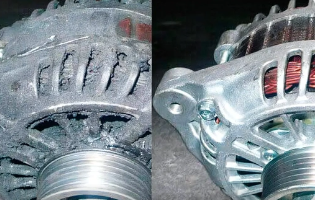
Residual contamination in a rebuilt transmission causes: Hard, delayed, or erratic shifts; Solenoid failures; Contamination of new plates; Repeated comebacks; and Warranty claims. A transmission component cannot be judged clean by appearance alone.
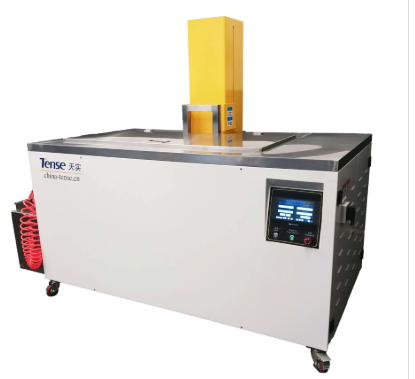
The industry standard range of ultrasonic cleaning equipment ranges from 140 to 2300 liters capacity. They are designed for cleaning and descaling of all types of parts, components and accessories. All equipment in this line can incorporate a lifting platform that facilitates loading and unloading of parts.
Hot tanking, solvent soaking, and cabinet spray washers address surface grease but struggle with transmission internals. Spray jets cannot penetrate the valve body’s labyrinth of bores, and solvent soaking does not mechanically lift metal fines from cross-holes.
An industrial ultrasonic cleaner creates cavitation—millions of microscopic bubbles that implode throughout the liquid. Benefits include:
Disassembly Is Essential: The valve body should be fully stripped: valves, springs, pins, and plates removed. Solenoids usually follow separate procedures.
Recommended Process:
Use 28–40 kHz for hardened steel. Include rust inhibitor in final rinse. Avoid cleaning friction material in the same bath to prevent fiber contamination.
Large-tank cleaning (TS-UD series) is ideal. Pre-scrape gasket material. Use filtration and oil skimming to handle heavy sludge loads.
Transmission rebuilding is a cleanliness business. Ultrasonic cavitation cleans every flooded surface simultaneously, ensuring high-quality results. Get the process right in a properly sized ultrasonic cleaning machine, and your rebuilt transmissions will leave the bench genuinely clean.
For help configuring an ultrasonic system, contact Tense with your component dimensions.
Q: Can I clean a transmission valve body without fully disassembling it?
A: Not reliably. Stuck valves and sealed plates prevent solution from reaching every bore. Fully strip the valve body before cleaning.
Q: What frequency should I use for aluminum valve bodies?
A: 40 kHz is the typical starting point with an aluminum-safe detergent to avoid etching precision bores.
Q: Are transmission solenoids safe in an ultrasonic cleaner?
A: Generally not in heated aqueous production baths. Many rebuilders replace them or follow specific manufacturer procedures.
Q: Can I clean the whole transmission case in one cycle?
A: Yes, if the tank is large enough. A lifting machine helps significantly with large cases to ensure all galleries fill and drain.
„Thanks to the LUVIR technology, the solder resist process could be switched directly from the previously used mask exposure to direct exposure. As an outstanding digital solution on the market, this technology has been able to demonstrate fast process times and superior quality on our certified conventional ink in production. This allowed us to fully digitize the solder mask process at low cost – without process or ink adjustments. An excellent benefit to our production in Rot am See.“
Ralf Göhringer (Head of Production WE Rot am See)
I would definitely recommend the Limata machine and team for a future company purchase
Michael Greenaway
Compunetics Inc.
“The Limata ldi has been amazing!! Best thing we did was buy this machine”
Richard Brady
GM
Circuitlabs
“Since 2019, we have been running the Limata X1000 LDI system (including LUVIR for solder mask imaging) in daily production as an addition to our current process with film. The machine was capable of properly exposing Taiyo PSR-4000 BN (DI) solder mask types on normal to high-copper boards using a new and unique direct imaging process. The machine operating interface is very user friendly which allowed for a quick technical training curve. The pre-registration processing reduced several seconds of production time at every print. Limata support and service staff is incomparable. They supported our team every step of the way at basically any time of the day or night, with literally, an immediate response time, customizing the software interface to best fit our Operations and needs.
We have exposed more than 8,000 prints since end of October, on various solder mask colors and some resist film panels. Limata, has proven to be very capable and innovative. They are a strong contender in the industry.
We have very much enjoyed this project, and working with the team!
Thank you Limata for the continued support and being a part of our growth.”
Bill Sezate
Vice President, GM
Summit Interconnect
As a replacement to our current contact exposure process with film, the LIMATA X2000 system including LUVIR-Technology was capable of properly exposing non-LDI solder mask types using a direct imaging process. The machine offers cutting edge software with a very intuitive operating interface which allowed for quick technician training curve. The dual drawer system combined with pre-registration processing reduced several seconds of production time at every machine cycle. Limata support and service staff is world class. They added software patches to keep production running at shortest possible response times, customized the software interface to best fit our in-house Operations system, and even wrote a step-by-step machine processing manual. As a result of the project, we have exposed more than 16,000 times on various product types and solder mask brands/colors. Limata, in a very short timeframe as a company, has definitely shown they are truly innovative and will be challenging the industry of direct imaging for the top spot.
Kevin Beattie
Process Engineer
TTM Technologies
Forest Grove Division
