A Portable Ring Light is a compact lighting tool designed to soften shadows and brighten a subject in close-up photos or videos. It often clips onto a phone, sits on a small stand, or folds into a bag. The circular LEDs create even, forward-facing light, which can help when a window is unavailable or overhead lighting looks harsh. Small details matter. A bright light is not always flattering; distance, angle, and room color also affect the result. A light placed too close may create glare on glasses or pale, washed-out skin.
This guide explains how portable ring lights work, what features to compare, and where their limits show. We’ll look at brightness settings, color temperature, power options, mounting styles, and everyday uses such as video calls, makeup, and product photos. Not magic. A ring light cannot replace good framing, a steady phone, or thoughtful exposure settings. It may also feel cumbersome if you only need a quick snapshot. That matters. Before choosing one, consider how you plan to use it, how long it needs to run, and whether its size fits your setup. Specs can be confusing, and advertised brightness alone rarely tells the whole story. A practical choice should suit your camera, workspace, and budget—not merely look impressive in a product photo.
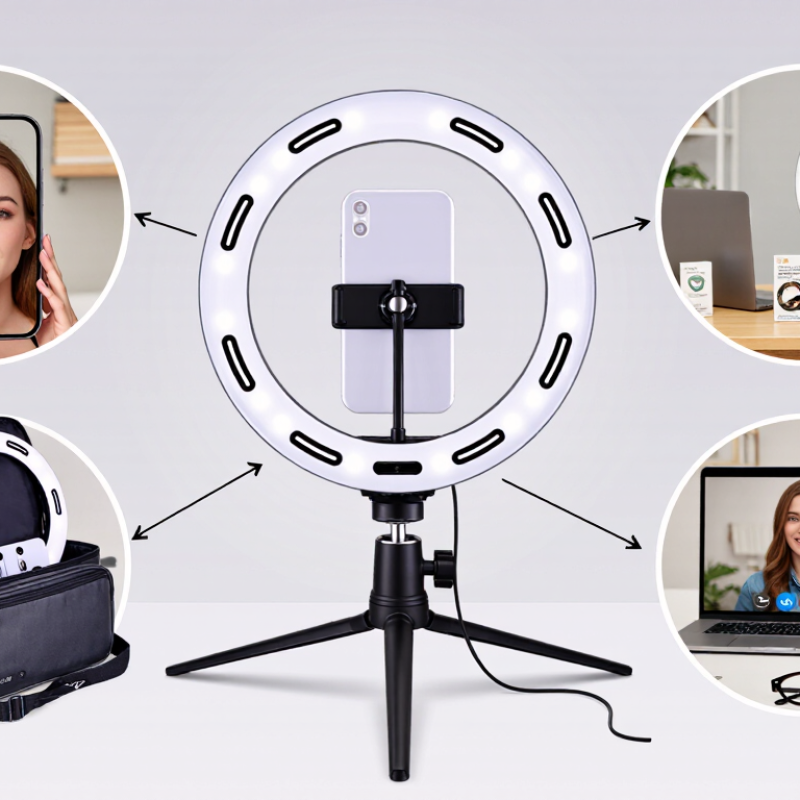
A portable ring light is a compact circular light designed to brighten a subject from a nearby position. Many models include a phone holder and adjustable brightness, while some run on rechargeable batteries and others connect to USB power. The ring shape spreads light around a camera lens, creating even illumination and a small reflection in the eyes. Small, but useful.
Its purpose is to make faces, hands, or small objects easier to see on camera. For a video call, place the light near eye level and soften it with a lower brightness setting. For makeup or close-up product photos, move it slightly farther away if highlights look harsh. Not magic. It cannot fix poor focus, a distracting background, or strong sunlight coming from behind you.
A portable light works best when it suits the space and task. Check its battery life, color-temperature options, and mounting stability before relying on it for a long recording. One limitation is easy to overlook: ring lights can flatten facial shadows, which may make an image look less natural. A window or room lamp may sometimes give a more pleasing result. Try both, then judge the actual image rather than the light alone.
A portable ring light combines a circular LED array, a frame, and a way to hold a phone or camera. The LEDs provide fairly even light around the lens, which can soften small shadows on a face. A diffuser, when included, reduces the sharpness of individual light points. The frame may be plastic or metal, with a hinge or folding sections for storage. Small parts matter.
The mount is often a spring-loaded phone clamp or a threaded connection for a small camera. Some lights include a flexible arm, while others attach directly to a stand. Power usually comes from a rechargeable battery or a USB cable; check the product details, since designs differ. Brightness and color controls may sit on the frame or on a small inline controller. Buttons can be fiddly.
Portability depends on more than weight. A light that folds flat and fits beside a notebook is easier to carry than one with a wide, rigid base. Yet compact hinges can wobble if the phone is heavy, and a small battery may need frequent charging at high brightness. That trade-off is easy to overlook. For a stable setup, keep the phone centered and test the mount before recording. A ring light can make close-up video clearer, but it will not replace a larger light in a dim room.
A portable ring light places several small LEDs in a circle around a central opening. A diffuser softens their output, helping reduce harsh highlights on a face or nearby object. Because the light surrounds the camera or phone, it reaches the subject from many directions at once. This can soften shadows beneath the nose and chin. The result is often more balanced than light from a single lamp placed to one side. Still, “even” does not mean shadow-free.
Distance and angle matter. Move the light closer, and its illumination tends to look softer across the subject, though the lit area becomes smaller. A light set too high can leave shadows under the eyes. Glasses may catch bright circular reflections, and shiny surfaces can show a visible ring. Small details matter. The ring’s shape and position influence where those reflections appear, so a quick test frame is useful before recording.
Tips: Keep the light near eye level, then adjust its distance gradually. Check your face and background in the preview. If the light feels flat, turn it slightly off-axis or lower its brightness. Don’t expect one setting to suit every room.
Portable ring lights come in three common forms: clip-on phone lights, folding tabletop models, and compact lights with a tripod. Clip-on versions suit quick video calls, but their small LEDs can create harsh reflections in glasses. Tabletop models offer more room for diffusion and angle adjustments. Tripod styles usually provide a wider, more even light, though they take longer to set up.
Look for adjustable brightness and color temperature, measured in kelvins. A warm setting can soften skin tones indoors; a cooler setting may suit daylight. A stated CRI of 90 or higher can help colors appear more natural, though results depend on the room and camera. USB-powered models are convenient near a laptop, while battery-powered lights work away from outlets. Check the mount, too. A loose phone clamp is frustrating.
It is not magic. DataReportal counted 5.04 billion social media user identities worldwide in January 2024, while Wyzowl’s 2024 survey found that 91% of businesses used video marketing. These reports show video’s reach, not ring-light sales. For everyday creators, portability and stable color may matter more than maximum brightness. A tiny ring light can still leave dark shadows under the chin. That trade-off is easy to miss.
Clip-on lights are compact for phones and laptops, tabletop lights suit desks, and larger tripod-mounted lights provide a broader light source. These are approximate common size ranges; products vary by model.
A portable ring light is a compact circular light that can be positioned near a camera or phone. In portrait photography, it gives the face soft, fairly even illumination and reduces harsh shadows under the eyes. The circular shape can also create a distinct catchlight in the subject’s eyes. Small detail, noticeable effect. Creators often use one for makeup demonstrations, product close-ups, and self-portraits, especially when window light changes throughout the day.
For video creation, a ring light can brighten a presenter during tutorials, interviews, or live streams. A dimmable model helps balance the face with the room, while an adjustable mount makes it easier to frame the shot. Place the light close to the lens for an even, direct look; move it slightly to one side for more facial texture. Glasses may reflect the circle, and shiny packaging can show bright hotspots. Adjust the angle or lower the output rather than relying on editing to fix every glare. A ring light is not a cure for poor lighting: it can flatten a scene or make the background look dull. Check the result on camera before recording. Even a small position change can matter.
„Thanks to the LUVIR technology, the solder resist process could be switched directly from the previously used mask exposure to direct exposure. As an outstanding digital solution on the market, this technology has been able to demonstrate fast process times and superior quality on our certified conventional ink in production. This allowed us to fully digitize the solder mask process at low cost – without process or ink adjustments. An excellent benefit to our production in Rot am See.“
Ralf Göhringer (Head of Production WE Rot am See)
I would definitely recommend the Limata machine and team for a future company purchase
Michael Greenaway
Compunetics Inc.
“The Limata ldi has been amazing!! Best thing we did was buy this machine”
Richard Brady
GM
Circuitlabs
“Since 2019, we have been running the Limata X1000 LDI system (including LUVIR for solder mask imaging) in daily production as an addition to our current process with film. The machine was capable of properly exposing Taiyo PSR-4000 BN (DI) solder mask types on normal to high-copper boards using a new and unique direct imaging process. The machine operating interface is very user friendly which allowed for a quick technical training curve. The pre-registration processing reduced several seconds of production time at every print. Limata support and service staff is incomparable. They supported our team every step of the way at basically any time of the day or night, with literally, an immediate response time, customizing the software interface to best fit our Operations and needs.
We have exposed more than 8,000 prints since end of October, on various solder mask colors and some resist film panels. Limata, has proven to be very capable and innovative. They are a strong contender in the industry.
We have very much enjoyed this project, and working with the team!
Thank you Limata for the continued support and being a part of our growth.”
Bill Sezate
Vice President, GM
Summit Interconnect
As a replacement to our current contact exposure process with film, the LIMATA X2000 system including LUVIR-Technology was capable of properly exposing non-LDI solder mask types using a direct imaging process. The machine offers cutting edge software with a very intuitive operating interface which allowed for quick technician training curve. The dual drawer system combined with pre-registration processing reduced several seconds of production time at every machine cycle. Limata support and service staff is world class. They added software patches to keep production running at shortest possible response times, customized the software interface to best fit our in-house Operations system, and even wrote a step-by-step machine processing manual. As a result of the project, we have exposed more than 16,000 times on various product types and solder mask brands/colors. Limata, in a very short timeframe as a company, has definitely shown they are truly innovative and will be challenging the industry of direct imaging for the top spot.
Kevin Beattie
Process Engineer
TTM Technologies
Forest Grove Division
