Dry Granulation plays a vital role in pharmaceutical production. Its efficiency lies in its ability to produce granules without liquid binders. Dr. Emily Foster, a prominent expert in pharmaceutical manufacturing, emphasizes, "Optimization in Dry Granulation can significantly reduce production time and costs."
In recent years, many pharmaceutical companies have turned to Dry Granulation. This process minimizes the risk of degradation in heat-sensitive materials. The resulting granules enhance flowability and compression, key factors in tablet formulation. However, not all processes are perfect. Some challenges remain. Equipment calibration and powder properties can affect outcomes.
Success with Dry Granulation requires continuous improvement and evaluation. Manufacturers must stay updated on best practices. Innovations in this field can lead to better product quality. Ultimately, harnessing the potential of Dry Granulation can pave the way for more sustainable and cost-effective pharmaceutical products.
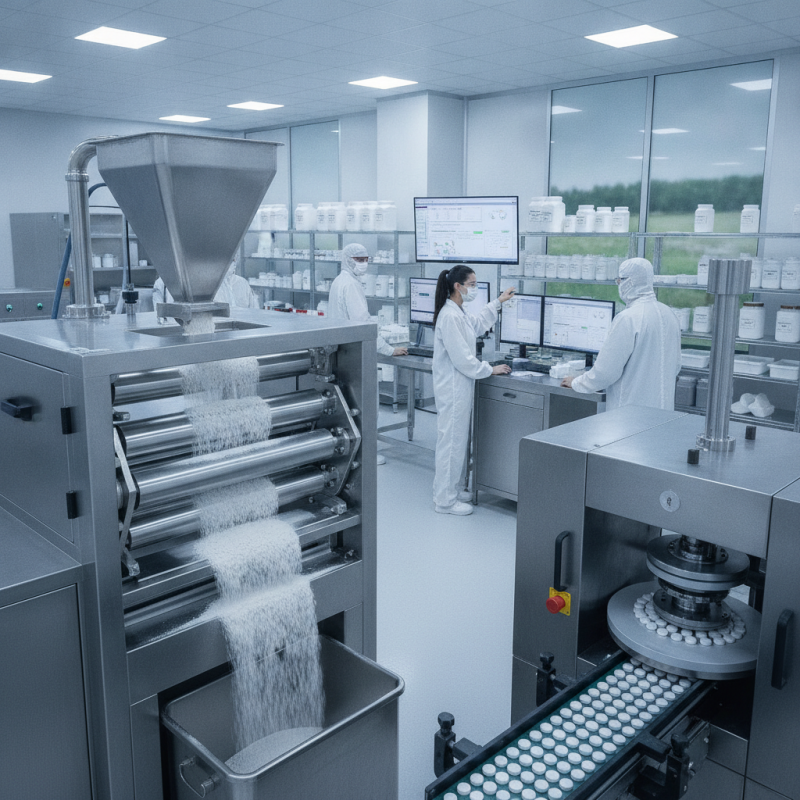
Dry granulation is a critical process in pharmaceutical production, enhancing the efficiency and quality of final products. It involves compressing powder into granules without using liquid. This method is particularly useful for heat-sensitive materials that cannot withstand wet granulation. According to recent studies, dry granulation can reduce processing time by up to 30%, which is vital in today's fast-paced pharmaceutical industry.
Understanding the operational mechanics of dry granulation is essential. It utilizes roller compactors or tablet presses to create granules with a uniform size and density. Consistent granule size improves flowability and ensures uniformity in tablet production. Notably, data from the Pharmaceutical Technology journal indicates that products processed through dry granulation exhibit less variation in dosage, enhancing product reliability.
However, challenges such as moisture sensitivity and the need for precise compaction pressure can complicate the process.
Moreover, dry granulation’s limitations prompt reflection. For instance, while it suits many formulations, it might not be ideal for all powder types. Some materials may require additives to enhance binding, complicating formulation development. Balancing efficiency and drug stability remains a constant challenge. As the pharmaceutical industry evolves, continual improvements are necessary to address these complexities effectively.
Dry granulation is a pivotal process in pharmaceutical production, noted for its efficiency and effectiveness. One key advantage is that it eliminates the need for liquid binders. This not only reduces processing time but also mitigates the risk of moisture-sensitive ingredients. Consequently, the final product maintains a consistent quality, which is crucial in pharmaceutical applications.
Another significant benefit of dry granulation is its suitability for heat-sensitive materials. In wet granulation, heat can compromise drug stability. Dry granulation, on the other hand, utilizes mechanical force to achieve granulation, preserving the integrity of sensitive compounds. However, this method can lead to variability in granule size if not monitored carefully, which might impact dosage uniformity.
Implementing dry granulation allows for scalable production. It requires less equipment and space compared to traditional wet methods. This can lead to significant savings in both time and costs. Nevertheless, varying powder characteristics pose challenges during processing. The right formulation and machine settings are vital to ensure that issues like segregation or inconsistent flow rates do not occur. Continuous refinement and optimization are essential for achieving the best results.
This chart illustrates the comparison between dry and wet granulation methods in pharmaceutical production, showcasing production time, cost, equipment complexity, and moisture content. Dry granulation typically offers quicker production times, lower costs, simpler equipment, and reduced moisture content compared to wet granulation.
Dry granulation is an effective method in pharmaceutical production. The right equipment plays a crucial role in streamlining this process. Key devices include roller compactors, granulators, and tablet presses. Each piece of equipment must be selected carefully to ensure efficiency.
Roller compactors compress powder into sheets, which can be broken down into granules. This method reduces the need for liquid binders. Setting the right pressure is essential. It's a balance; too high can over-compress, while too low produces insufficient granules.
Tips: Regular maintenance of equipment ensures consistent performance. Keep an eye on wear and tear to avoid unplanned downtime. Staff training is vital for optimal operation. Experienced operators can recognize when things go wrong, preventing larger issues.
Granulators break down materials into the desired size. Choosing the right granulator influence the final product's quality. Adjusting the speed and method can lead to different results. Experimenting periodically can improve processes but may result in unexpected outcomes.
Quality control in dry granulation is crucial for effective pharmaceutical production. This method involves creating granules from powders through compression. Ensuring uniformity and consistency in size is vital. Consistent granule sizes enhance flow properties and tablet density. However, variations can occur due to factors like moisture content and particle size distribution. These inconsistencies can affect final product quality.
Implementing robust quality control measures is essential. Regularly monitoring the granulation process helps identify deviations early. Techniques like near-infrared spectroscopy can assess composition in real-time. This allows for quick adjustments, minimizing batch failures. Additionally, performing stability testing on granules can reveal how they perform under different conditions. However, not all granulation methods yield the same results. Some techniques may require more adjustments than others, which can complicate the quality control process.
Documentation plays a significant role in maintaining quality standards. Accurate records help trace issues back to specific production batches. This transparency aids in improving processes over time. Reviewing previous batches can reveal trends or recurring problems. A well-established feedback loop is essential. Continuous learning and adjustment in the dry granulation process ultimately lead to higher quality pharmaceutical products.
| Parameter | Description | Standard Value | Measurement Method |
|---|---|---|---|
| Moisture Content | Amount of water in the granules | 3% - 5% | Loss on Drying |
| Particle Size Distribution | Size variation of granules | 100 - 500 µm | Sieve Analysis |
| Bulk Density | Weight of granules per unit volume | 0.4 - 0.8 g/cm³ | Graduated Cylinder Method |
| Hardness | Strength of the granules | 4 - 8 kg | Tablet Hardness Tester |
| Flowability | Ease with which granules flow | Carr Index < 15 | Flowability Tester |
Dry granulation has gained traction in the pharmaceutical industry due to its efficiency and cost-effectiveness. Case studies highlight its successful implementation across various companies. For instance, a recent study by the International Journal of Pharmaceutics reported that companies adopting dry granulation achieved up to a 30% reduction in production time. This method is particularly praised for minimizing moisture involvement, which is crucial for moisture-sensitive drugs.
In real-world applications, one major pharmaceutical manufacturer revamped their production line to incorporate dry granulation. This shift resulted in a significant increase in yield quality. Reports indicated that product consistency improved by 20%, reducing batch failures. However, challenges remain. The variability in powder characteristics sometimes complicates the granulation process. As a result, companies must invest in thorough material characterization and process optimization.
Furthermore, a survey conducted by the Pharmaceutical Technology revealed that 65% of manufacturers faced issues with scale-up during the transition to dry granulation. While many successfully adopted this technology, it is essential to acknowledge areas for improvement. The need for continued research and development is critical to overcoming these challenges and achieving greater efficiency.
„Thanks to the LUVIR technology, the solder resist process could be switched directly from the previously used mask exposure to direct exposure. As an outstanding digital solution on the market, this technology has been able to demonstrate fast process times and superior quality on our certified conventional ink in production. This allowed us to fully digitize the solder mask process at low cost – without process or ink adjustments. An excellent benefit to our production in Rot am See.“
Ralf Göhringer (Head of Production WE Rot am See)
I would definitely recommend the Limata machine and team for a future company purchase
Michael Greenaway
Compunetics Inc.
“The Limata ldi has been amazing!! Best thing we did was buy this machine”
Richard Brady
GM
Circuitlabs
“Since 2019, we have been running the Limata X1000 LDI system (including LUVIR for solder mask imaging) in daily production as an addition to our current process with film. The machine was capable of properly exposing Taiyo PSR-4000 BN (DI) solder mask types on normal to high-copper boards using a new and unique direct imaging process. The machine operating interface is very user friendly which allowed for a quick technical training curve. The pre-registration processing reduced several seconds of production time at every print. Limata support and service staff is incomparable. They supported our team every step of the way at basically any time of the day or night, with literally, an immediate response time, customizing the software interface to best fit our Operations and needs.
We have exposed more than 8,000 prints since end of October, on various solder mask colors and some resist film panels. Limata, has proven to be very capable and innovative. They are a strong contender in the industry.
We have very much enjoyed this project, and working with the team!
Thank you Limata for the continued support and being a part of our growth.”
Bill Sezate
Vice President, GM
Summit Interconnect
As a replacement to our current contact exposure process with film, the LIMATA X2000 system including LUVIR-Technology was capable of properly exposing non-LDI solder mask types using a direct imaging process. The machine offers cutting edge software with a very intuitive operating interface which allowed for quick technician training curve. The dual drawer system combined with pre-registration processing reduced several seconds of production time at every machine cycle. Limata support and service staff is world class. They added software patches to keep production running at shortest possible response times, customized the software interface to best fit our in-house Operations system, and even wrote a step-by-step machine processing manual. As a result of the project, we have exposed more than 16,000 times on various product types and solder mask brands/colors. Limata, in a very short timeframe as a company, has definitely shown they are truly innovative and will be challenging the industry of direct imaging for the top spot.
Kevin Beattie
Process Engineer
TTM Technologies
Forest Grove Division
