Why Choose an MCB Riveting Machine for Production?
Modern miniature circuit breaker production demands stable force, repeatable alignment, and dependable cycle control. A Mcb Riveting Machine addresses these needs by joining internal components with controlled pressure and consistent rivet formation. Manual assembly may appear flexible, but small alignment errors can create loose connections, damaged housings, or costly rework.
The International Federation of Robotics reported 541,302 industrial robots installed worldwide in 2023, showing continued investment in automated production. Deloitte’s 2024 Smart Manufacturing Survey also found that 86% of manufacturers consider smart manufacturing important for competitiveness. These figures support a practical shift toward automated riveting, especially where factories produce thousands of breakers daily. One machine can reduce operator fatigue, stabilize output, and record essential production data. The improvement is visible: cleaner riveting points, fewer rejected shells, and more predictable takt times.
Dr. Elena Marquez, an industrial fastening specialist, explains, “A riveting system earns its value through repeatability, not speed alone.” That principle matters. A fast machine with poor calibration can multiply defects. A properly selected Mcb Riveting Machine should match rivet diameter, breaker design, material strength, and required output. It should also support guarding, emergency stops, maintenance access, and traceable quality checks.
The answer is not always yes. Smaller workshops may need a semi-automatic solution first. Product changes can also make dedicated tooling expensive. Still, for stable, high-volume MCB production, automated riveting offers measurable consistency, lower rework risk, and stronger process control. The machine is only part of the answer. Skilled setup remains essential.
Why Choose an MCB Riveting Machine for Production?
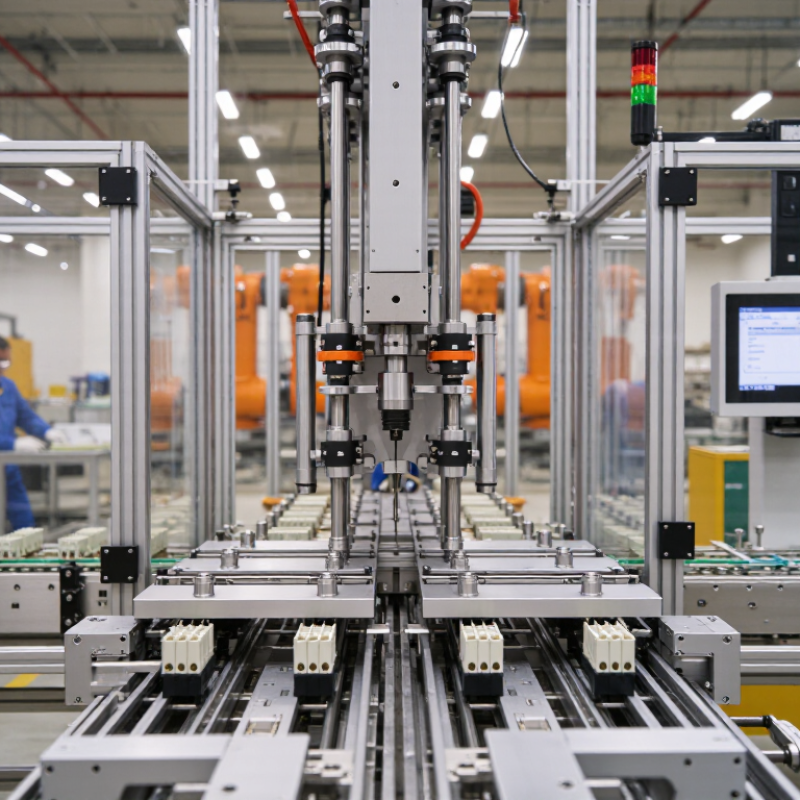
An MCB riveting machine is production equipment designed to join parts inside miniature circuit breakers. It applies controlled force to secure terminals, contacts, and other internal components. Depending on the design, the machine may use pneumatic, hydraulic, or servo-driven riveting. It can also include automatic feeding, positioning, and inspection functions. These features help maintain consistent joints across large production runs.
A reliable riveting process improves assembly speed and reduces variation between breakers. Stable riveting force supports accurate electrical contact and mechanical strength. It also limits operator fatigue during repetitive work. However, no machine fits every MCB structure. Tooling, rivet size, component tolerance, and production volume must be checked carefully. In practice, a small trial run often reveals issues that drawings miss. That practical step is easy to overlook.
Tips: Confirm the rivet material and diameter before selecting equipment. Test joint height, holding force, and contact alignment regularly. Keep a sample record from each production batch. Calibrate sensors and pressing units on a planned schedule. Clean the feeding track daily. Small debris can cause large defects. Choose adjustable tooling when product models may change. Good maintenance matters.
An MCB riveting machine joins miniature circuit-breaker components with controlled force and repeatable cycle timing. The chart uses a transparent planning model: one production station, 90% availability, and the following cycle-time scenarios. Output is calculated as 3,600 ÷ cycle time × 90%. Lower cycle time increases capacity while improving process consistency.
Planning assumptions: Manual assembly = 20 seconds per unit, semi-automatic riveting = 8 seconds per unit, automatic MCB riveting = 3 seconds per unit.
An MCB riveting machine joins internal components with controlled pressure and repeatable timing. Its operation begins when a feeder presents each circuit-breaker part in the correct position. A fixture then holds the housing steady. Sensors confirm alignment before the riveting cycle starts. Small errors matter.
The upper punch presses the rivet against a forming die. The metal expands and locks the contact, terminal, or support in place. Force, stroke distance, and cycle time must match the rivet material. Excessive pressure may deform the housing. Too little pressure can create a loose connection. That failure may appear later.
During production, operators check sample assemblies with visual inspection and pull testing. They look for cracks, tilted rivets, uneven heads, and movement under light force. A clean cycle is not guaranteed. Material hardness, rivet length, and fixture wear can change the result. Production records help identify these changes early. A reliable machine needs careful setup, not only speed.
Why Choose an MCB Riveting Machine for Production?
Which MCB Production Tasks Can It Perform?
An MCB riveting machine supports several assembly tasks with controlled force and repeatable positioning. It can join moving contacts, fixed contacts, terminal parts, and internal support components. Depending on the breaker design, it may also secure trip-mechanism parts and arc-chamber structures. Small differences matter here. A rivet set too tightly can restrict movement, while weak forming may cause looseness during testing.
In practical production, the machine can feed rivets, locate components, apply forming pressure, and eject completed units. Servo-driven systems can control stroke length, riveting force, and cycle timing. Sensors may detect missing parts, incorrect placement, or incomplete rivet forming. Operators can review force-displacement data and connect results with batch records. This helps maintenance teams identify tool wear before defects increase.
The process still needs judgment. Tooling must match rivet diameter, material, and component thickness. Samples should be checked for pull strength, movement, insulation clearance, and visual damage. A clean-looking joint is not always a reliable joint. I have seen production teams focus on speed while overlooking feed alignment and fixture wear. That mistake can create repeated faults. Regular calibration, practical operator training, and clear inspection limits make the machine more dependable in daily MCB production.
| MCB Production Task | Typical Parts Involved | Machine Operation | Main Control Points | Production Benefit |
|---|---|---|---|---|
| Fixed-contact riveting | Fixed contact, contact carrier, and solid or semi-tubular rivet | Feeds and positions the contact assembly, then forms the rivet head to create a permanent mechanical joint. | Rivet type, forming force, stroke, contact orientation, and final rivet-head geometry | Consistent contact retention and reduced variation in the current-carrying assembly |
| Moving-contact riveting | Moving contact, contact arm, spring-related carrier, and rivet | Aligns the moving contact with its carrier and performs controlled cold forming of the rivet. | Contact position, angular alignment, rivet height, deformation, and free movement after joining | Improves repeatability of the switching mechanism and helps prevent loose contact components |
| Contact-arm subassembly joining | Copper or copper-alloy contact arm, support plate, and rivet | Joins stamped conductive parts without welding, soldering, or adding heat to the assembly. | Part flatness, hole alignment, joining force, and absence of cracks or excessive burrs | Provides a clean mechanical connection and avoids heat-affected areas on conductive parts |
| Terminal subassembly riveting | Terminal support, busbar, clamp component, or other metal parts where the product design specifies riveted joining | Places the metal parts in a dedicated fixture and forms the specified rivet connection. | Terminal orientation, joint tightness, electrical contact area, and dimensional conformity | Supports repeatable assembly of selected terminal designs; screw-clamp terminals are assembled by separate processes |
| Mechanism-link riveting | Trip link, latch link, lever, pivot plate, and retaining rivet | Forms a pivot or permanent joint while maintaining the designed movement between mechanism parts. | Joint clearance, pivot freedom, rivet-head profile, and mechanism travel | Reduces manual adjustment and helps maintain consistent operating characteristics |
| Arc-chute or internal support joining | Metal arc runners, support plates, brackets, or other components designed for riveted assembly | Positions selected internal metal components and completes the specified rivet-forming operation. | Support spacing, part orientation, rivet integrity, and clearance from insulating components | Improves assembly consistency in products that use riveted internal supports |
| Rivet feeding and orientation | Solid, semi-tubular, or tubular rivets specified by the product drawing | Uses a hopper, vibratory bowl, linear feeder, or other feeding system to deliver rivets in the correct orientation. | Feed rate, rivet orientation, jam detection, empty-bowl detection, and part separation | Reduces manual loading, prevents missing-rivet conditions, and supports continuous production |
| In-process quality inspection | Completed riveted assemblies and machine-process data | Checks presence, position, rivet-head condition, forming height, or force-displacement data when sensors are integrated. | Inspection limits must be defined by the product drawing, control plan, and applicable test requirements | Detects missing, misaligned, or improperly formed joints before final assembly |
| Automatic transfer between stations | Stamped parts, rivets, fixtures, and completed subassemblies | Transfers components between feeding, positioning, riveting, inspection, and unloading stations using indexing or robotic handling. | Cycle synchronization, fixture repeatability, sensor feedback, safety interlocks, and changeover settings | Improves line consistency, lowers direct handling, and makes process traceability easier |
Note: The actual riveting positions, rivet dimensions, force settings, cycle time, and inspection limits depend on the MCB design, material, tooling, and production requirements. Screw-terminal assembly, insulation fitting, electrical testing, and final trip testing normally require separate dedicated processes.
An MCB riveting machine gives manufacturers more consistent assembly quality than manual riveting. Each rivet receives controlled pressure, stroke, and positioning. This reduces loose joints, damaged housings, and inconsistent contact alignment. Operators can also load components more safely and repeatably.
Production speed is another practical benefit. The International Federation of Robotics reported 541,302 industrial robots were installed worldwide in 2023. This figure reflects a wider shift toward automated production. A riveting machine supports that shift by shortening cycle times and reducing dependence on repetitive manual work. It can also connect with conveyors, sensors, and inspection stations. Small improvements matter.
Quality records become clearer, too. Many machines can store cycle counts, pressure values, and fault signals. These records help engineers trace defects before large batches leave the line. Deloitte’s 2024 Smart Manufacturing and Operations Survey found that 86% of manufacturing leaders expect smart manufacturing to become a major competitiveness driver within five years. That expectation is reasonable, but automation is not a magic shortcut. Poor tooling still creates poor rivets. Maintenance, calibration, and operator training remain essential. A practical factory should test material variation, noise, and changeover time before investing. The best result comes from matching machine control with real production conditions, not from buying the most complex equipment.
Choosing the right MCB riveting machine starts with the product, not the advertised cycle speed. Measure the breaker body, terminal layout, rivet diameter, and required riveting force. Small differences can affect alignment and contact reliability. A machine should support your actual models, including future variations.
Ask for a production trial using your own components. Watch the riveting head closely. Does it center the rivet without marking the housing? Check stroke stability, feeding accuracy, and noise during continuous operation. Automatic feeding can reduce labor, but it may add adjustment points. Simple fixtures are often easier to maintain. That matters on a busy factory floor.
Review the control system and quality records before purchase. Force, displacement, and cycle data can help operators identify loose or over-formed rivets. Confirm that rejected parts can be separated automatically. Also inspect guarding, emergency stops, tooling access, and maintenance procedures. Experienced technicians should be able to change common tooling without excessive downtime. Ask about spare parts and training, too.
Do not judge the machine from one successful sample. Run a longer test.
A spreadsheet may look convincing, yet it cannot show feeding jams after several hours. Some manufacturers also underestimate changeover time. Record real measurements, operator feedback, and defect rates during the trial. Then compare output, reliability, serviceability, and total operating cost against your production plan.
„Thanks to the LUVIR technology, the solder resist process could be switched directly from the previously used mask exposure to direct exposure. As an outstanding digital solution on the market, this technology has been able to demonstrate fast process times and superior quality on our certified conventional ink in production. This allowed us to fully digitize the solder mask process at low cost – without process or ink adjustments. An excellent benefit to our production in Rot am See.“
Ralf Göhringer (Head of Production WE Rot am See)
I would definitely recommend the Limata machine and team for a future company purchase
Michael Greenaway
Compunetics Inc.
“The Limata ldi has been amazing!! Best thing we did was buy this machine”
Richard Brady
GM
Circuitlabs
“Since 2019, we have been running the Limata X1000 LDI system (including LUVIR for solder mask imaging) in daily production as an addition to our current process with film. The machine was capable of properly exposing Taiyo PSR-4000 BN (DI) solder mask types on normal to high-copper boards using a new and unique direct imaging process. The machine operating interface is very user friendly which allowed for a quick technical training curve. The pre-registration processing reduced several seconds of production time at every print. Limata support and service staff is incomparable. They supported our team every step of the way at basically any time of the day or night, with literally, an immediate response time, customizing the software interface to best fit our Operations and needs.
We have exposed more than 8,000 prints since end of October, on various solder mask colors and some resist film panels. Limata, has proven to be very capable and innovative. They are a strong contender in the industry.
We have very much enjoyed this project, and working with the team!
Thank you Limata for the continued support and being a part of our growth.”
Bill Sezate
Vice President, GM
Summit Interconnect
As a replacement to our current contact exposure process with film, the LIMATA X2000 system including LUVIR-Technology was capable of properly exposing non-LDI solder mask types using a direct imaging process. The machine offers cutting edge software with a very intuitive operating interface which allowed for quick technician training curve. The dual drawer system combined with pre-registration processing reduced several seconds of production time at every machine cycle. Limata support and service staff is world class. They added software patches to keep production running at shortest possible response times, customized the software interface to best fit our in-house Operations system, and even wrote a step-by-step machine processing manual. As a result of the project, we have exposed more than 16,000 times on various product types and solder mask brands/colors. Limata, in a very short timeframe as a company, has definitely shown they are truly innovative and will be challenging the industry of direct imaging for the top spot.
Kevin Beattie
Process Engineer
TTM Technologies
Forest Grove Division