Choosing the right fryer can shape service speed, food consistency, and daily operating costs. Electric Chip Fryers offer controllable heat and can suit kitchens that need dependable frying without a gas connection. Picture a lunch rush: baskets of chips enter the oil, staff adjust cooking cycles, and the next order is already waiting. Stable temperature recovery matters here, though actual performance depends on fryer design, oil volume, batch size, and incoming food temperature.
For owners and kitchen managers, the decision involves more than the purchase price. Compare capacity with peak demand, check available electrical supply, and consider how easily staff can drain, clean, and maintain the unit. A compact countertop model may work for a café, while a larger floor-standing fryer may better serve a busy restaurant. Not every kitchen needs the biggest machine. That is easy to overlook. Practical checks should include manufacturer specifications, warranty terms, service access, and the cost of replacement parts. Ask a qualified supplier or technician to confirm installation requirements for your site.
Electric models can provide precise controls, but they are not an automatic answer to every kitchen problem. They still require safe working practices, regular cleaning, suitable ventilation, and trained staff. Oil quality also affects flavour and results; even a well-built fryer cannot compensate for neglected oil. The choice is not always obvious. By weighing workload, space, energy use, and maintenance realistically, businesses can judge whether Electric Chip Fryers fit their menu and service routine. A little uncertainty is useful: test assumptions against actual orders before committing.
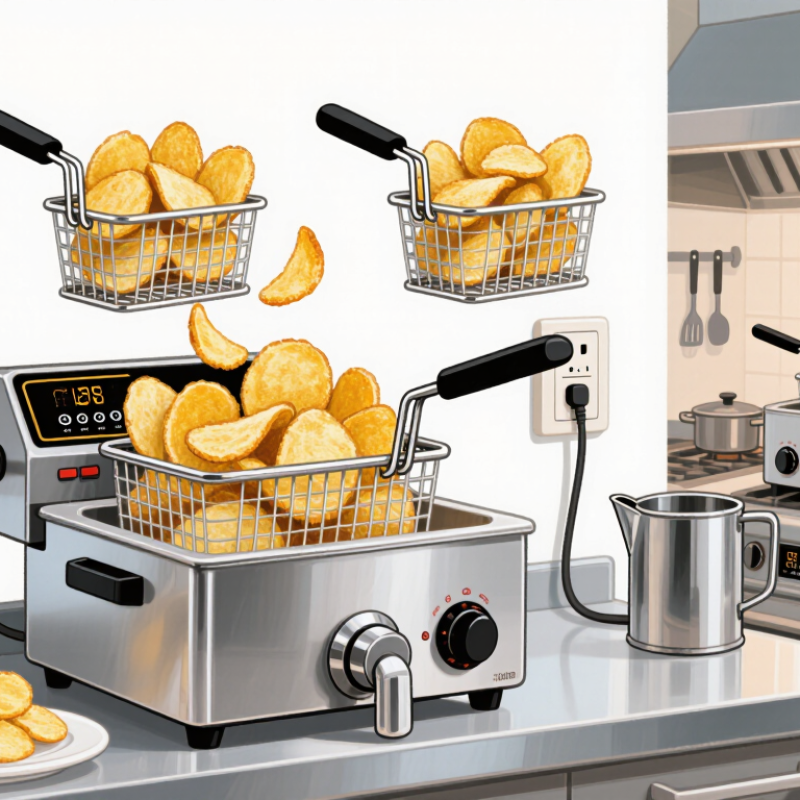
An electric chip fryer converts electrical energy into heat through elements positioned in or beneath the oil vat. In immersed-element models, metal tubes warm the oil directly; other designs transfer heat through the vat base. Oil moves as it heats, but temperature can vary around the vat, especially when baskets are crowded. That matters. A load of cold, damp chips can quickly lower the oil temperature, slowing cooking and leaving the crust less crisp. Allowing the fryer to recover between batches can help produce more consistent results.
The control panel sets the target temperature, while a thermostat or sensor monitors the oil and switches the elements on and off. A clear display makes routine checks easier, but it is not a substitute for maintenance. Sensor accuracy can drift, and residue around the elements may affect heating. Real kitchens are messier than diagrams. Staff should follow the fryer’s operating instructions, keep oil levels within the marked range, and clean the vat as directed. Checking oil temperature with a suitable thermometer can reveal whether the displayed reading matches conditions in the vat. These small checks help explain why a fryer heats unevenly before it affects a whole service.
Deep frying commonly uses oil temperatures in the 160–190°C range. In an electric chip fryer, heating elements warm the oil in the vat, while the thermostat and controls switch heat on and off to maintain the selected setpoint. The best setting depends on the food and the equipment manufacturer’s guidance.
Why Choose Electric Chip Fryers for Your Business?
ENERGY STAR Benchmark: Electric Fryers Require at Least 80% Cooking Efficiency
An electric chip fryer can make energy use easier to assess, but the rating matters more than the power source alone. ENERGY STAR’s benchmark for qualifying commercial electric fryers is at least 80% cooking efficiency. This means a substantial share of the energy input heats food under standardized test conditions. It does not mean every electric fryer meets that level. Check the specific model’s certification and test information. Small detail, real difference.
Efficiency figures are useful, but they do not guarantee lower bills. Actual costs depend on local electricity rates, operating hours, and kitchen habits. During a lunch rush, repeated small batches can slow temperature recovery; oversized loads can also lower oil temperature. Keep the fryer properly loaded and follow its operating guidance. Routines slip. That matters.
When comparing equipment, consider cooking efficiency alongside capacity, power requirements, ventilation, and service access. A highly efficient fryer may still be a poor fit if it cannot handle peak demand. Ask for test documentation, then compare expected output with your busiest service period. The numbers help, but your kitchen’s workflow should make the final call.
Choose an electric chip fryer by measuring your busiest service period, not your average daily sales. Record how many portions you need per hour and the usual portion size. Then check whether the vat can handle practical batch loads without crowding the basket. A larger vat is not automatically faster. Overloading can reduce oil temperature and produce uneven chips. Leave enough room for hot oil to circulate and for staff to lift baskets comfortably.
Recovery time matters just as much. Ask how quickly the fryer returns to its working temperature after a realistic load, not an empty-basket test. Recovery depends on heating power, oil volume, food temperature, and how often baskets enter the vat. Frozen chips may place a different demand on the fryer than fresh-cut chips. Include the full cycle in your estimate: loading, frying, draining, and reloading. The estimate will still be imperfect; a busy lunch rush rarely follows a neat spreadsheet. A short trial with your own portions can reveal whether the vat size and recovery rate suit your actual service.
Commercial frying commonly uses an oil temperature of 325–375°F, but that range is a working guide, not a fixed rule. The right setting depends on the food, its size, and how quickly the fryer recovers after loading. Small shifts matter. A crowded basket can pull the oil temperature down, leaving chips greasy or unevenly colored. A reading that climbs too high may darken the outside before the center cooks through.
An electric chip fryer makes temperature adjustments straightforward, but its display should not be treated as unquestionable. Check it against a suitable thermometer and follow the equipment instructions. Keep loads consistent, and give the oil time to recover between batches. Watch the food, too: pale, limp chips may suggest low heat or an overloaded basket, while rapid browning can signal excessive heat. These signs are useful, though they are not precise measurements. Even a tidy temperature log can miss differences in batch size or food moisture. That is a limitation worth noting when settings seem inconsistent.
An electric chip fryer can simplify installation, but its power demand needs checking before it arrives. Read the unit’s nameplate for voltage, phase, and amperage, then ask a qualified electrician to compare those figures with your available service. A high-capacity fryer may need a dedicated circuit or upgraded wiring. That can affect both installation time and cost. Measure the route to the cooking area, too; a narrow doorway can complicate delivery.
Ventilation still matters. Electric heating avoids combustion gases, but frying produces heat, steam, and airborne grease. A properly sized hood and grease filters help manage them. Have a ventilation professional assess the space and local requirements. Do not assume an existing hood is adequate just because another fryer used it. That assumption can be costly.
Ownership costs depend on more than the electricity bill. Check your tariff and expected hours of use, then compare energy use with your current equipment. Oil remains a major expense: crumbs, overheating, and poor filtering can shorten its usable life. Track oil top-ups and replacement dates for a few weeks; the numbers may surprise you. Small habits matter. Still, real kitchens are messy, and staff routines vary. Build cleaning time and oil disposal into your operating plan, rather than relying on ideal conditions.
„Thanks to the LUVIR technology, the solder resist process could be switched directly from the previously used mask exposure to direct exposure. As an outstanding digital solution on the market, this technology has been able to demonstrate fast process times and superior quality on our certified conventional ink in production. This allowed us to fully digitize the solder mask process at low cost – without process or ink adjustments. An excellent benefit to our production in Rot am See.“
Ralf Göhringer (Head of Production WE Rot am See)
I would definitely recommend the Limata machine and team for a future company purchase
Michael Greenaway
Compunetics Inc.
“The Limata ldi has been amazing!! Best thing we did was buy this machine”
Richard Brady
GM
Circuitlabs
“Since 2019, we have been running the Limata X1000 LDI system (including LUVIR for solder mask imaging) in daily production as an addition to our current process with film. The machine was capable of properly exposing Taiyo PSR-4000 BN (DI) solder mask types on normal to high-copper boards using a new and unique direct imaging process. The machine operating interface is very user friendly which allowed for a quick technical training curve. The pre-registration processing reduced several seconds of production time at every print. Limata support and service staff is incomparable. They supported our team every step of the way at basically any time of the day or night, with literally, an immediate response time, customizing the software interface to best fit our Operations and needs.
We have exposed more than 8,000 prints since end of October, on various solder mask colors and some resist film panels. Limata, has proven to be very capable and innovative. They are a strong contender in the industry.
We have very much enjoyed this project, and working with the team!
Thank you Limata for the continued support and being a part of our growth.”
Bill Sezate
Vice President, GM
Summit Interconnect
As a replacement to our current contact exposure process with film, the LIMATA X2000 system including LUVIR-Technology was capable of properly exposing non-LDI solder mask types using a direct imaging process. The machine offers cutting edge software with a very intuitive operating interface which allowed for quick technician training curve. The dual drawer system combined with pre-registration processing reduced several seconds of production time at every machine cycle. Limata support and service staff is world class. They added software patches to keep production running at shortest possible response times, customized the software interface to best fit our in-house Operations system, and even wrote a step-by-step machine processing manual. As a result of the project, we have exposed more than 16,000 times on various product types and solder mask brands/colors. Limata, in a very short timeframe as a company, has definitely shown they are truly innovative and will be challenging the industry of direct imaging for the top spot.
Kevin Beattie
Process Engineer
TTM Technologies
Forest Grove Division
