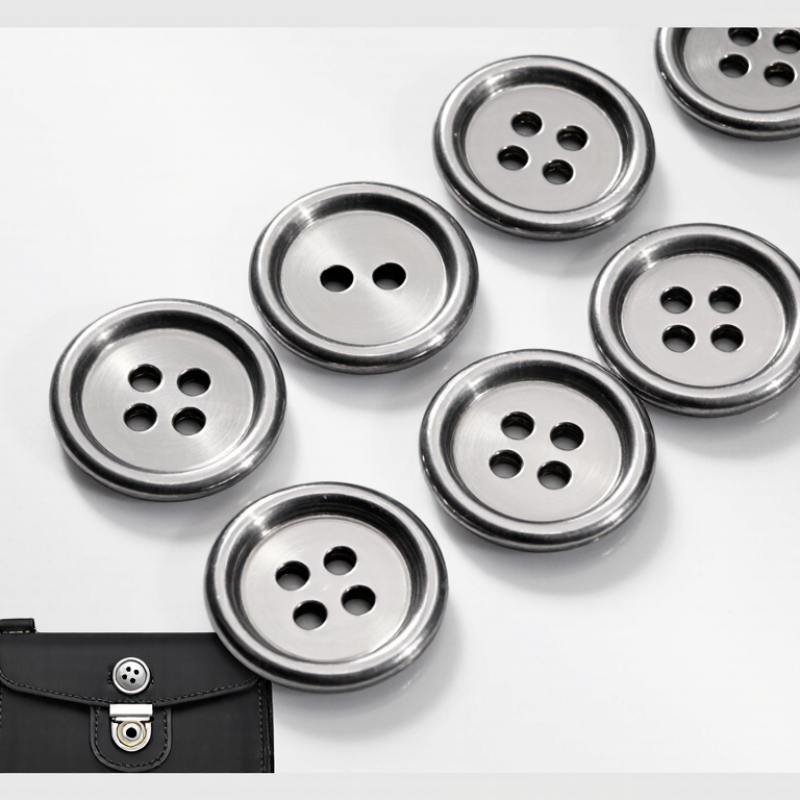
When product details face daily handling, small components can influence the entire customer experience. Stainless Steel Buttons offer a practical balance of strength, appearance, and long-term usability. They suit jackets, uniforms, bags, footwear, and selected home textile products. Their clean metallic surface can make a simple design feel more refined.
The details matter.
In real production, button performance depends on more than material choice. The alloy grade, surface treatment, button thickness, attachment method, and quality inspection all deserve attention. A well-made button should resist ordinary moisture, repeated pressing, and surface abrasion during normal use. However, stainless steel is not flawless. Poor finishing may create sharp edges, uneven color, or uncomfortable contact against fabric. That weakness should be acknowledged before large-scale production.
Experienced manufacturers usually test samples on the intended product, rather than judging buttons separately. They check attachment strength, surface consistency, dimensional accuracy, and performance after repeated handling. For a children’s garment, safety and secure attachment require especially careful review. For workwear, practical durability may matter more than decorative shine. Product designers should also consider weight, washing conditions, packaging, and the final user’s expectations.
Stainless Steel Buttons can support a dependable product image, but they cannot repair weak design decisions. Requesting material details, finish samples, and inspection records helps buyers make informed choices. A thoughtful selection process reduces replacement costs and protects brand credibility. Sometimes, the most attractive option is not the most suitable one. Practical testing reveals that difference.
Under ISO 15510, stainless steel grades contain at least 10.5% chromium by mass. Chromium forms a thin, self-healing oxide layer on the surface. This layer helps resist rust, stains, and daily handling. It is invisible, but valuable.
The International Stainless Steel Forum reported 58.4 million tonnes of crude stainless steel production in 2023. That volume reflects continued demand across construction, appliances, transport, and consumer products. Buttons benefit from the same material properties. They can withstand repeated pressing, abrasion, moisture, and frequent cleaning. In practical quality checks, a well-finished button should feel smooth around its rim. Sharp edges often reveal weak forming or inadequate polishing.
Still, chromium content alone does not guarantee performance. Grade selection matters. Nickel can improve structure and formability, while molybdenum may support resistance in saltier environments. A button used on outdoor clothing faces different conditions from one used on a handbag. ISO 15510 helps identify composition, but designers must also review hardness, finish, fastener compatibility, and corrosion test results. A reflective surface can hide small scratches. That deserves a closer inspection. According to the U.S. Geological Survey’s Mineral Commodity Summaries, chromium remains an essential alloying material for stainless steel production, linking raw-material quality to long-term product reliability.
Why Choose Stainless Steel Buttons for Your Products?
A button looks small, yet its alloy controls durability, appearance, and maintenance. Grade 304 contains about 18% chromium and 8% nickel. These figures match the familiar 18-8 stainless classification and ASTM A240 composition ranges. Chromium creates a passive surface film. Nickel improves ductility and corrosion resistance. For clothing, bags, and light hardware, 304 often balances finish, strength, and cost. The USGS 2024 Mineral Commodity Summaries identifies stainless and heat-resistant steel as consuming roughly 65% of primary nickel demand. Material pricing therefore deserves attention.
Grade 316 adds approximately 2–3% molybdenum, with commonly higher nickel content. Molybdenum improves resistance to pitting caused by chlorides, perspiration, seawater mist, and de-icing salt. Technical guidance from the Nickel Institute links molybdenum-bearing grades with better chloride performance. On a damp jacket, this may mean fewer tea-colored spots near scratches. Small detail, visible consequence.
Still, 316 is not automatically better. It costs more, while poor forming or polishing can reduce its advantage. I would test both grades. Use artificial perspiration, salt spray, rubbing, and laundering. ASTM B117 standardizes salt-spray exposure, but it cannot represent every garment environment. Test the finish. A well-finished 304 button may outperform poorly processed 316. The grade label is useful, but it is not the whole product.
Grade selection affects corrosion resistance and material performance. Stainless steel 304 typically contains about 18% chromium and 8% nickel, while 316 adds approximately 2–3% molybdenum for improved resistance in chloride-rich environments.
Note: The values shown are representative midpoint compositions based on commonly specified ranges. Actual composition may vary by applicable material standard and product specification.
Why Choose Stainless Steel Buttons for Your Products?
Corrosion resistance is not a marketing assumption. It needs controlled evidence. ISO 9227:2022 defines neutral salt-spray testing with a 5% sodium chloride solution at 35°C. The chamber exposes buttons to a steady, aggressive salt mist. This can reveal staining, pitting, and coating failure quickly. However, ISO 9227 does not set universal acceptance hours. That decision belongs to the product specification.
Compare 304, 316, and 430 stainless steel buttons under identical conditions. Grade chemistry matters. Molybdenum in 316 generally improves chloride resistance, while 430 often needs more cautious placement. Test identical dimensions, edge conditions, surface finishes, and production lots. Record exposure hours, first visible corrosion, pit density, and functional changes. A 240-hour result is not a 240-hour field guarantee. That distinction is easy to miss.
The NACE IMPACT study estimated global corrosion costs at US$2.5 trillion annually, or 3.4% of global GDP. The figure covers all industries, not buttons alone. Still, it shows why small components deserve disciplined testing. In practice, I would photograph each button beside a reference scale. I would also repeat questionable results. Salt spray can exaggerate some environments and underrepresent others. That is the uncomfortable part. Product teams should combine ISO 9227 data with humidity, sweat, cleaning, and outdoor exposure tests.
| Stainless Steel Grade | Typical Chemical Composition | Magnetism | Relative Salt-Spray Resistance | Suitable Button Applications |
|---|---|---|---|---|
| AISI 304 / EN 1.4301 | Cr: 17.5–19.5%; Ni: 8.0–10.5%; Mo: typically not added | Generally non-magnetic when annealed; may become slightly magnetic after cold working | Good in normal indoor and mild outdoor environments | General apparel, bags, footwear, accessories, and consumer products |
| AISI 316 / EN 1.4401 | Cr: 16.5–18.5%; Ni: 10.0–13.0%; Mo: 2.0–2.5% | Generally non-magnetic when annealed; may become slightly magnetic after cold working | Very good in chloride-rich, coastal, and humid environments | Premium buttons, marine-related products, swimwear accessories, and high-humidity applications |
| AISI 430 / EN 1.4016 | Cr: 16.0–18.0%; Ni: typically not intentionally added; Mo: not added | Magnetic | Moderate in dry indoor environments; less resistant to chloride exposure | Cost-sensitive indoor products, decorative components, and applications requiring magnetism |
| ISO 9227 Test Item | Recommended Specification | Purpose for Stainless Steel Buttons |
|---|---|---|
| Test method | ISO 9227:2022, Neutral Salt Spray (NSS) | Provides a controlled comparative environment for evaluating corrosion behavior |
| Salt solution | Approximately 5% sodium chloride solution prepared with suitable water quality | Simulates an aggressive chloride-containing atmosphere |
| Chamber temperature | 35 ± 2 °C | Maintains consistent test conditions between button grades |
| Collected spray rate | 1.0–2.0 mL per hour for a 80 cm² collection area | Confirms that the corrosive spray environment is operating within the standard range |
| Solution pH | 6.5–7.2 at 25 ± 2 °C | Prevents abnormal acidity or alkalinity from distorting the comparison |
| Suggested exposure intervals | 24, 48, 96, and 168 hours, or another period defined by the product specification | Shows the progression from early staining to more visible corrosion during development testing |
| Evaluation criteria | Record red rust, pits, blistering, coating damage, tarnish, and functional changes using photographs and a defined rating scale | Enables an objective comparison without assuming that ISO 9227 itself defines a universal pass/fail exposure time |
Strength starts with a realistic load, not a shiny surface. In production testing, I would measure button pull, edge stress, and repeated rubbing separately. ASTM F963-23 provides useful torque and tension principles for attached components, although it targets toys rather than every garment. For textile buttons, ASTM D5171 evaluates impact resistance, while ASTM D4846 examines abrasion resistance. These methods help convert vague claims like “high strength” into measurable performance.
Abrasion deserves equal attention. A button may survive one hard pull but lose its finish after months of contact with denim, zippers, or washing equipment. ASTM D4966 can assess textile abrasion under controlled rubbing cycles, while ASTM G65 offers a harsher dry-sand abrasion approach for metal surfaces. The test setup must reflect the product. A light shirt button should not be judged like industrial hardware. That mistake happens.
Industry scale also supports stainless steel’s practical appeal. The International Stainless Steel Forum reported approximately 58.4 million tonnes of stainless steel production in 2023, showing a mature and widely engineered material system. However, production volume does not guarantee button quality. Alloy selection, thickness, hole geometry, plating, and sewing tension still matter. I would record load loss after abrasion, not only the first failure force. The result may look less impressive. It is more useful. Testing every design variation can be expensive, but skipping wash and flex cycles creates false confidence.
Stainless steel buttons offer more than a polished surface and firm closure. Their lifecycle value deserves closer attention. Worldstainless reports that over 80% of stainless steel reaches recycling at the end of its useful life. This figure reflects strong material recovery, not a perfect system. Collection, sorting, and product design still influence the result.
That matters for apparel, bags, uniforms, and accessories. A stainless steel button can resist moisture, repeated handling, and surface wear for years. Longer service may reduce replacement demand. It can also preserve the product’s appearance through frequent washing and daily use. Careful grade selection remains essential. Marine exposure, sweat, and detergents can affect performance differently.
The material also supports circular manufacturing. Stainless steel contains valuable alloying elements, which recyclers can recover through established metal-processing systems. Worldstainless lifecycle studies identify recycling as a major factor in reducing resource pressure across the material’s life. However, designers should not treat recyclability as automatic. Mixed trims, heavy coatings, and unclear material specifications can complicate recovery. Simple construction helps.
Small details matter. A button’s weight, finish, and attachment method influence user experience. So does its final destination. Designing for durability is useful, but designing for separation is better. Some products will still be discarded incorrectly. That weakness deserves honest attention.
„Thanks to the LUVIR technology, the solder resist process could be switched directly from the previously used mask exposure to direct exposure. As an outstanding digital solution on the market, this technology has been able to demonstrate fast process times and superior quality on our certified conventional ink in production. This allowed us to fully digitize the solder mask process at low cost – without process or ink adjustments. An excellent benefit to our production in Rot am See.“
Ralf Göhringer (Head of Production WE Rot am See)
I would definitely recommend the Limata machine and team for a future company purchase
Michael Greenaway
Compunetics Inc.
“The Limata ldi has been amazing!! Best thing we did was buy this machine”
Richard Brady
GM
Circuitlabs
“Since 2019, we have been running the Limata X1000 LDI system (including LUVIR for solder mask imaging) in daily production as an addition to our current process with film. The machine was capable of properly exposing Taiyo PSR-4000 BN (DI) solder mask types on normal to high-copper boards using a new and unique direct imaging process. The machine operating interface is very user friendly which allowed for a quick technical training curve. The pre-registration processing reduced several seconds of production time at every print. Limata support and service staff is incomparable. They supported our team every step of the way at basically any time of the day or night, with literally, an immediate response time, customizing the software interface to best fit our Operations and needs.
We have exposed more than 8,000 prints since end of October, on various solder mask colors and some resist film panels. Limata, has proven to be very capable and innovative. They are a strong contender in the industry.
We have very much enjoyed this project, and working with the team!
Thank you Limata for the continued support and being a part of our growth.”
Bill Sezate
Vice President, GM
Summit Interconnect
As a replacement to our current contact exposure process with film, the LIMATA X2000 system including LUVIR-Technology was capable of properly exposing non-LDI solder mask types using a direct imaging process. The machine offers cutting edge software with a very intuitive operating interface which allowed for quick technician training curve. The dual drawer system combined with pre-registration processing reduced several seconds of production time at every machine cycle. Limata support and service staff is world class. They added software patches to keep production running at shortest possible response times, customized the software interface to best fit our in-house Operations system, and even wrote a step-by-step machine processing manual. As a result of the project, we have exposed more than 16,000 times on various product types and solder mask brands/colors. Limata, in a very short timeframe as a company, has definitely shown they are truly innovative and will be challenging the industry of direct imaging for the top spot.
Kevin Beattie
Process Engineer
TTM Technologies
Forest Grove Division
