Electricity is becoming more essential, yet household supply is not always dependable. The International Energy Agency’s Electricity 2024 report projects global electricity demand will grow by about 4% in 2024, driven partly by cooling, appliances, and digital services. This growing demand makes backup planning more practical for ordinary households. A Power Inverter For Home can convert battery power into usable alternating current for selected appliances, such as a refrigerator, router, lamp, or medical device. That matters during short outages.
The technology is more useful when matched with real household needs. A pure sine wave inverter can provide cleaner power for sensitive electronics, while a modified sine wave model may suit simpler loads. The U.S. Department of Energy emphasizes efficiency, battery storage, and safe system sizing in residential energy planning. Meanwhile, the IEA Renewables 2024 report expects renewable capacity to expand sharply through 2030, increasing interest in home solar and battery systems. In practical terms, an inverter may keep a modem running, preserve food in a refrigerator, and charge phones from a compact battery pack.
It is not magic.
A good system still needs correct wattage calculations, ventilation, battery protection, and professional installation where required. The inverter’s continuous output must exceed the appliance’s running load, while its surge rating must handle startup demands. A refrigerator may consume modest power after starting, but its compressor can briefly draw much more. These details are easy to underestimate. For that reason, this guide examines why homeowners use inverters, where they perform well, and where their limits deserve honest attention. Performance also depends on battery age, temperature, wiring quality, and local electrical standards.
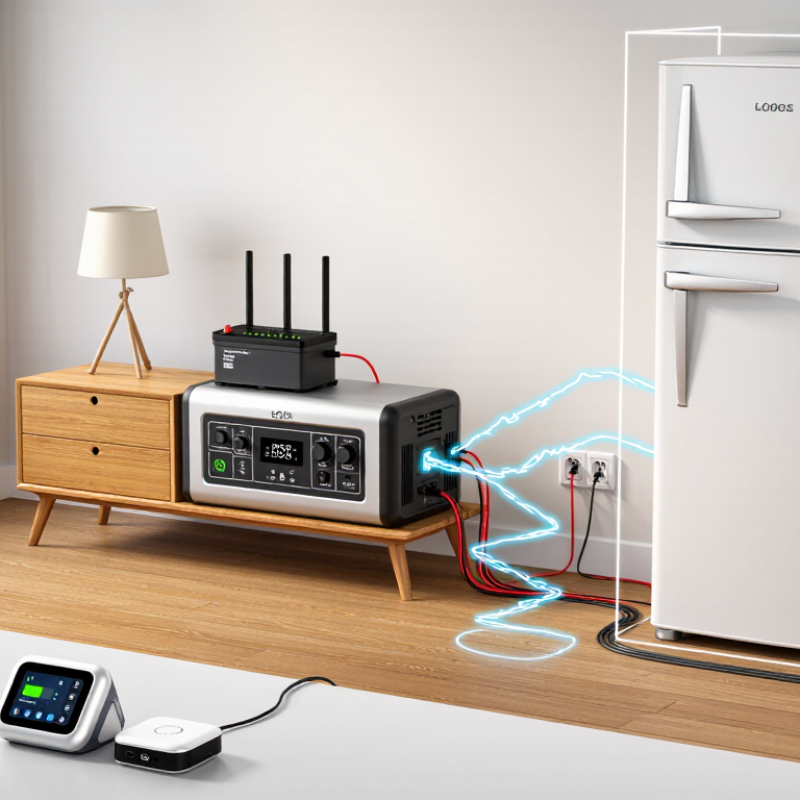
A home power inverter converts direct current (DC) from batteries or solar panels into alternating current (AC). AC powers common appliances, including refrigerators, routers, and lamps. The inverter rapidly switches electronic transistors, then filters the waveform into household electricity. A monitoring circuit controls voltage and frequency. The process is precise.
In a grid-connected system, the inverter synchronizes with the utility supply and sends surplus solar power outward. A battery inverter performs the reverse operation during charging. A hybrid inverter manages both directions and can isolate selected circuits during an outage. The U.S. Department of Energy identifies this conversion and control function as central to residential energy systems. NREL’s PVWatts model uses 96% as a default inverter efficiency, though real performance changes with temperature, load, and installation quality.
The numbers matter. A 1,000-watt appliance may draw more during startup than its label suggests. That brief surge can overload an undersized inverter. The International Energy Agency’s Electricity 2024 report expects global electricity demand to grow by about 4% in 2024 and 2025, increasing interest in flexible household power systems. Still, an inverter cannot create unlimited energy. Battery capacity, wiring, ventilation, and transfer protection set practical limits. I have found that advertised capacity often receives more attention than continuous output. That is a mistake. Check both ratings, and use a qualified electrician for fixed household connections.
Estimated backup runtime for common household loads using a 12 V, 100 Ah battery and a power inverter
A home power inverter converts direct current (DC) stored in a battery into alternating current (AC), allowing household devices to operate during a power outage or in locations without grid electricity.
The estimates assume 12 V × 100 Ah of battery capacity, 80% usable battery capacity, and 90% inverter efficiency, providing approximately 864 Wh of usable AC energy. Actual runtime varies with startup surges, battery age, temperature, and appliance operating cycles.
A power inverter can keep essential household devices running during an outage. In my experience, this matters most when the refrigerator, medical equipment, or internet router needs steady electricity. A charged battery and a correctly sized inverter can provide practical backup power without starting a fuel engine indoors. That is a safer arrangement when ventilation is limited.
Another key reason is power flexibility. An inverter can convert stored battery energy into usable household electricity for lamps, fans, small appliances, and communication devices. Some models also produce cleaner power, which may help sensitive electronics operate more reliably. Check the output rating carefully. A device that handles a laptop may not support a microwave or water pump.
Load planning is essential. Add the running watts of each appliance, then consider their starting surge. I once underestimated a motor’s startup demand, and the inverter shut down within seconds. That mistake was useful, but avoidable. Select certified equipment, protect it from moisture, and leave space for cooling. Regularly inspect cables, terminals, and battery condition. Small details matter. Power inverters are helpful tools, not unlimited electricity sources. Their real value depends on honest load calculations, safe installation, and realistic expectations.
A power inverter converts battery power into usable household electricity. During an outage, it can keep a router, phone charger, LED lamp, or laptop running. These small comforts matter when the room becomes quiet and dark. An inverter can also support a television, fan, or small kitchen appliance, depending on its rated output. However, appliances with motors need extra starting power. A refrigerator may exceed its normal wattage for several seconds. Checking both running watts and surge watts prevents unpleasant surprises.
In a home office, an inverter can protect work continuity during short power cuts. It may power a modem, monitor, and computer for limited periods. Some households use one for a sump pump, aquarium equipment, or emergency lighting. Medical equipment requires special caution and approval from its manufacturer. A basic inverter is not automatically suitable for every sensitive device. It is easy to overestimate battery life, especially during winter or heavy use. No setup is perfect.
Tips: Add the wattage of every connected device before choosing an inverter. Leave extra capacity for startup surges. Keep the battery ventilated, dry, and away from heat. Test the system occasionally, not only during an emergency. Use the correct cables and fuses. Never connect an inverter directly to household wiring without a qualified electrician. A simple trial with one lamp and a charger can reveal charging limits, noise, and cable heating before a real outage.
Choosing a home power inverter starts with actual demand, not the largest number on a box. List essential devices during an outage, such as a refrigerator, router, lights, or sump pump. Record each device’s running watts, then check its starting surge. Motors may briefly require two to five times more power. A simple spreadsheet helps, although mine is never perfect.
Choose continuous power above your calculated load and peak power above the highest startup demand. Pure sine wave output is generally safer for sensitive electronics and modern appliances. Check efficiency, idle consumption, and low-voltage shutdown settings. These details affect battery life. They are easy to overlook.
Battery compatibility matters just as much. Confirm voltage, capacity, charging method, and expected runtime. A 1,000-watt load can drain a small battery surprisingly fast. For occasional lighting, a compact system may be enough. Refrigeration and longer outages require more capacity. Allow ventilation around the inverter. Keep cables short, thick, and properly fused. Never connect an inverter directly to household wiring without an approved transfer switch and qualified electrician. Local installation rules vary, so verify current requirements. Extra capacity sounds wise, but oversizing can waste money and energy. Recheck your plan after measuring real usage.
A power inverter can convert stored battery energy into household AC power during outages or outdoor work. However, safe installation matters more than convenience. Begin by listing every appliance you may operate, including refrigerators, pumps, and chargers. Check both running watts and starting watts. Motors often need several times more power briefly.
Place the inverter in a dry, cool, and well-ventilated area. Keep it away from curtains, water, gas appliances, and direct sunlight. Batteries also need careful handling. Lead-acid batteries can release gas, so they require suitable ventilation and secure positioning. Use cables with the correct gauge, tight terminals, and a properly rated fuse close to the battery. Reverse polarity can damage equipment instantly.
Never connect an inverter to a wall outlet to energize home wiring. This can send electricity into external lines and seriously injure workers. A transfer switch should be installed by a qualified electrician, following local electrical requirements. Grounding arrangements also depend on the inverter design and household system. Read the installation manual carefully.
I once underestimated refrigerator startup demand. The inverter shut down within seconds. That mistake showed why appliance labels are not enough. Test the setup with essential loads, inspect cables for heat, and leave space around cooling vents. Small oversights remain possible, especially during a power cut. Keep the system simple and accessible.
„Thanks to the LUVIR technology, the solder resist process could be switched directly from the previously used mask exposure to direct exposure. As an outstanding digital solution on the market, this technology has been able to demonstrate fast process times and superior quality on our certified conventional ink in production. This allowed us to fully digitize the solder mask process at low cost – without process or ink adjustments. An excellent benefit to our production in Rot am See.“
Ralf Göhringer (Head of Production WE Rot am See)
I would definitely recommend the Limata machine and team for a future company purchase
Michael Greenaway
Compunetics Inc.
“The Limata ldi has been amazing!! Best thing we did was buy this machine”
Richard Brady
GM
Circuitlabs
“Since 2019, we have been running the Limata X1000 LDI system (including LUVIR for solder mask imaging) in daily production as an addition to our current process with film. The machine was capable of properly exposing Taiyo PSR-4000 BN (DI) solder mask types on normal to high-copper boards using a new and unique direct imaging process. The machine operating interface is very user friendly which allowed for a quick technical training curve. The pre-registration processing reduced several seconds of production time at every print. Limata support and service staff is incomparable. They supported our team every step of the way at basically any time of the day or night, with literally, an immediate response time, customizing the software interface to best fit our Operations and needs.
We have exposed more than 8,000 prints since end of October, on various solder mask colors and some resist film panels. Limata, has proven to be very capable and innovative. They are a strong contender in the industry.
We have very much enjoyed this project, and working with the team!
Thank you Limata for the continued support and being a part of our growth.”
Bill Sezate
Vice President, GM
Summit Interconnect
As a replacement to our current contact exposure process with film, the LIMATA X2000 system including LUVIR-Technology was capable of properly exposing non-LDI solder mask types using a direct imaging process. The machine offers cutting edge software with a very intuitive operating interface which allowed for quick technician training curve. The dual drawer system combined with pre-registration processing reduced several seconds of production time at every machine cycle. Limata support and service staff is world class. They added software patches to keep production running at shortest possible response times, customized the software interface to best fit our in-house Operations system, and even wrote a step-by-step machine processing manual. As a result of the project, we have exposed more than 16,000 times on various product types and solder mask brands/colors. Limata, in a very short timeframe as a company, has definitely shown they are truly innovative and will be challenging the industry of direct imaging for the top spot.
Kevin Beattie
Process Engineer
TTM Technologies
Forest Grove Division
