An x ray protection apron is worn to reduce a wearer’s exposure to scattered radiation during certain imaging procedures. It is commonly used by radiology staff who work near patients and X-ray equipment. The apron’s protective material helps attenuate scatter; it does not make exposure risk-free or replace careful positioning, distance, and exposure optimization.
The scale of medical exposure deserves context. NCRP Report No. 160 estimated that medical procedures contributed about 3.0 mSv per person to the average annual U.S. radiation dose in 2006. That figure describes population exposure, not the dose prevented by an apron. The distinction matters. An apron’s benefit depends on the procedure, the wearer’s position, and the equipment.
Medical physicist Dr. Madan M. Rehani has worked on radiation protection through the IAEA. A fair summary of his broader safety approach is: “Protect people while optimizing exposure.” This is a paraphrase, not a verbatim quotation. In practice, an apron is one layer of protection—not a substitute for training or sound technique. AAPM guidance also distinguishes occupational protection from routine shielding of patients, which it does not recommend in many situations. The details can feel less simple than a product label suggests. Inspect the garment, check its fit, and follow local clinical procedures. A folded edge, loose closure, or damaged section deserves attention. X-ray protection is practical, but never automatic.
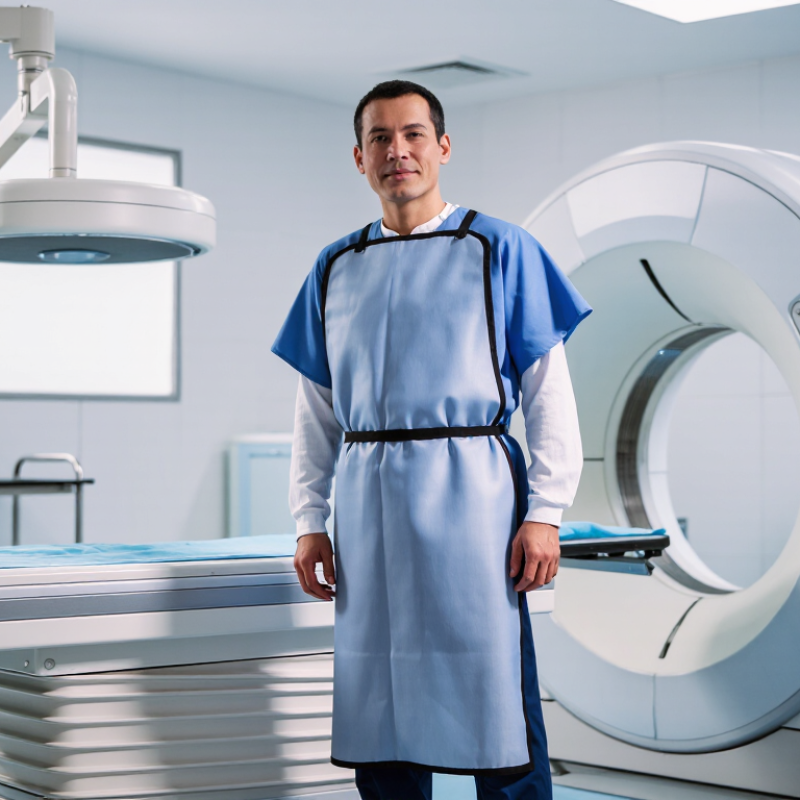
An X-ray protection apron is a garment containing lead or another shielding material. It is worn over body areas that should receive less scattered radiation during some imaging procedures. Patients may wear one over the torso, while imaging staff may use protective garments when their work requires them to remain near an X-ray source. The apron’s purpose is to reduce exposure to scattered X-rays; it does not make exposure impossible or replace careful equipment use.
Not a force field.
Protection depends on the apron’s fit, condition, and proper use. It should cover the intended area without obstructing the examination or entering the primary beam unless a qualified professional directs otherwise. Guidance on patient shielding can vary by procedure and current clinical recommendations, so an apron is not automatically needed for every scan. Staff should follow their facility’s protocol and ask a qualified imaging professional when unsure.
A quick visual check can reveal tears or damaged seams, but it cannot confirm the apron’s shielding performance.
That part is easy to overlook.
Regular inspection and appropriate testing help identify damage that may not be obvious, such as a weakened section inside the material.
What Is an X Ray Protection Apron Used For?
How the Apron Helps Reduce Radiation Exposure
An X-ray protection apron reduces exposure to scattered radiation during imaging procedures. Staff typically wear it when they must remain in the room, positioned away from the primary beam. The apron’s lead-equivalent material absorbs some scattered X-rays before they reach the body. Coverage matters: an open side, uncovered shoulder, or poor fit can leave areas exposed. The apron is a barrier, not a force field.
The NCRP’s Report No. 160 estimated average U.S. medical radiation exposure at 3.0 mSv per person in 2006, compared with 0.53 mSv in 1980. Those figures describe population exposure, not the amount an apron removes. Actual protection varies with beam energy, apron thickness, fit, and how much scatter reaches the wearer. Aprons also do not replace distance, shorter exposure time, or careful positioning. A small practical flaw: heavy garments can cause strain, so damaged or poorly fitting aprons may be avoided or worn incorrectly. Regular inspection and sensible fit checks help keep protection usable.
An X-ray apron uses a flexible shielding layer to reduce exposure to scattered radiation. It commonly contains lead or a lead-composite material. Some use non-lead composites. Their protection depends on thickness and X-ray energy, not just a label. The outer fabric helps guard the shielding layer against spills and abrasion. An inner lining can help the apron sit smoothly over clothing. Feel the weight. A stiff, poorly fitted apron may be worn incorrectly or left unused. Comfort matters alongside attenuation.
Design details support dependable use. A front panel usually covers the torso, while wraparound styles add side coverage. The right design depends on work position and facility radiation-safety guidance. An apron does not replace distance, a barrier, or other controls. Check seams, fasteners, and the surface for tears, deep creases, or damage. Store the apron flat or on a suitable hanger, not folded. Repeated sharp creases can weaken shielding. Visual checks help, but they cannot reveal every internal defect. Follow the facility’s inspection process and the maker’s care instructions. Small habits matter. Fit is easy to underestimate.
X-ray protection aprons are commonly worn by radiologic technologists, radiologists, and other clinical staff who may stay near a patient during imaging. Dental teams use them during some procedures, while veterinary staff may wear them when assisting with animal X-rays. In interventional imaging rooms, clinicians can spend longer periods near the equipment, so protective clothing is part of their routine. Small details matter.
These aprons are found in hospitals, outpatient imaging centers, dental practices, and veterinary clinics. Their purpose is to reduce exposure from scattered X-rays, not to make someone safe in every situation. The imaging team still follows local safety procedures, uses distance and shielding where practical, and avoids standing in the primary beam. Not every room is alike.
Patients may also be offered an apron in certain settings, depending on the procedure and the facility’s current guidance. Staff should choose a size that covers the intended area without restricting movement, then check the garment for visible damage and arrange testing as required by workplace policy. A cracked or poorly fitted apron can create false confidence. Even experienced teams can overlook wear near seams or folds, so careful checks are worth the extra minute.
What Is an X-Ray Protection Apron Used For?
Choosing, Wearing, and Caring for an Apron
An X-ray protection apron helps reduce exposure to scattered radiation during certain imaging procedures. Choose one that covers the areas recommended for your role and fits your body without restricting movement. A loose neckline or gaps at the sides can leave areas uncovered. Weight matters, too: an apron that feels manageable at first may become tiring during a long shift. It is tempting to pick the lightest option, but coverage and fit deserve equal attention.
Tips: Check the apron before each use. Look for worn seams, tears, or unusual creases. Follow your facility’s inspection process if you notice damage. Wear the apron as instructed, and fasten it securely. A rushed check can miss small problems.
After use, clean the surface according to the care instructions. Avoid folding or crumpling the apron, since repeated sharp creases may damage its protective layers. Store it on a suitable hanger or support, not over a chair back. Keep it away from heat and heavy objects. If you are unsure whether an apron remains serviceable, ask the radiation safety lead or follow your facility’s guidance rather than guessing. A quick visual check is useful, but it cannot reveal every internal defect.
Protective aprons are worn to reduce scatter-radiation exposure to covered parts of the body during appropriate imaging procedures. Common apron ratings are expressed as lead equivalence.
Choosing and caring: Select a rating according to your facility’s radiation-safety guidance and the procedure. Wear the apron so the intended area is covered, and inspect it regularly for cracks or damage; follow the manufacturer’s instructions for cleaning and storage. Lead equivalence alone does not indicate a fixed protection level, which varies with beam energy and apron design.
„Thanks to the LUVIR technology, the solder resist process could be switched directly from the previously used mask exposure to direct exposure. As an outstanding digital solution on the market, this technology has been able to demonstrate fast process times and superior quality on our certified conventional ink in production. This allowed us to fully digitize the solder mask process at low cost – without process or ink adjustments. An excellent benefit to our production in Rot am See.“
Ralf Göhringer (Head of Production WE Rot am See)
I would definitely recommend the Limata machine and team for a future company purchase
Michael Greenaway
Compunetics Inc.
“The Limata ldi has been amazing!! Best thing we did was buy this machine”
Richard Brady
GM
Circuitlabs
“Since 2019, we have been running the Limata X1000 LDI system (including LUVIR for solder mask imaging) in daily production as an addition to our current process with film. The machine was capable of properly exposing Taiyo PSR-4000 BN (DI) solder mask types on normal to high-copper boards using a new and unique direct imaging process. The machine operating interface is very user friendly which allowed for a quick technical training curve. The pre-registration processing reduced several seconds of production time at every print. Limata support and service staff is incomparable. They supported our team every step of the way at basically any time of the day or night, with literally, an immediate response time, customizing the software interface to best fit our Operations and needs.
We have exposed more than 8,000 prints since end of October, on various solder mask colors and some resist film panels. Limata, has proven to be very capable and innovative. They are a strong contender in the industry.
We have very much enjoyed this project, and working with the team!
Thank you Limata for the continued support and being a part of our growth.”
Bill Sezate
Vice President, GM
Summit Interconnect
As a replacement to our current contact exposure process with film, the LIMATA X2000 system including LUVIR-Technology was capable of properly exposing non-LDI solder mask types using a direct imaging process. The machine offers cutting edge software with a very intuitive operating interface which allowed for quick technician training curve. The dual drawer system combined with pre-registration processing reduced several seconds of production time at every machine cycle. Limata support and service staff is world class. They added software patches to keep production running at shortest possible response times, customized the software interface to best fit our in-house Operations system, and even wrote a step-by-step machine processing manual. As a result of the project, we have exposed more than 16,000 times on various product types and solder mask brands/colors. Limata, in a very short timeframe as a company, has definitely shown they are truly innovative and will be challenging the industry of direct imaging for the top spot.
Kevin Beattie
Process Engineer
TTM Technologies
Forest Grove Division
