An automated system uses sensors, software, machines, or a combination of them to perform tasks with limited ongoing human input. It might regulate a factory conveyor, adjust a building’s temperature, or route customer orders. Some systems follow fixed rules; others respond to changing data. The distinction matters: automation is not one machine or one technology, but a spectrum of designs and capabilities.
The International Federation of Robotics reported 4,281,585 industrial robots operating in factories worldwide in 2023, in its World Robotics 2024 report. That figure shows automation’s industrial reach, but it does not measure every automated process. Not every setting. AI educator Andrew Ng captured one part of the shift with his phrase, “AI is the new electricity.” The comparison is vivid, though imperfect: an automated system can work without AI, and AI alone does not make a process reliably automatic.
This overview introduces the main types, from simple rule-based controls and programmable machinery to robotic, software-based, and AI-enabled systems. Each brings different trade-offs in cost, flexibility, accuracy, and oversight. A barcode scanner at a warehouse gate is not equivalent to an adaptive production line. It is easy to group both under automation; it is harder, and more useful, to ask what decisions they make, what data they rely on, and where human review remains necessary. These questions help readers assess both practical benefits and limitations.
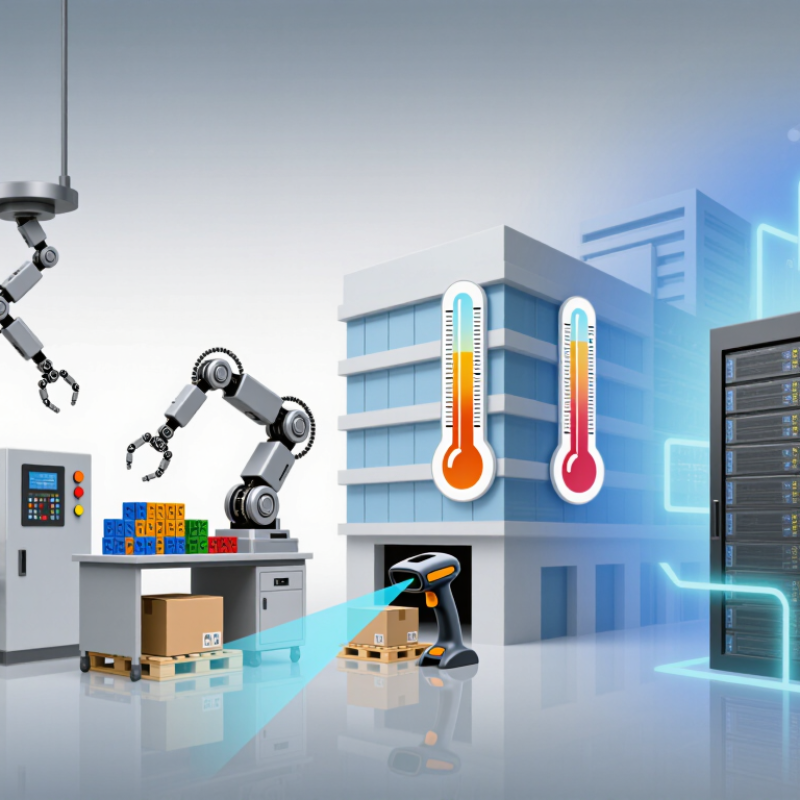
An automated system uses sensors, control logic, and actuators to perform tasks with limited ongoing human input. A room thermostat is a simple example: it measures temperature, compares it with a set point, and switches heating on or off. More complex systems may coordinate conveyor belts, inspection cameras, and robotic arms. The defining feature is not complexity. It is a repeatable process guided by rules or data.
The scope ranges from a single device to a connected operation. It can include software, physical equipment, data flows, safety controls, and the people who monitor results. Some systems follow fixed instructions; others adjust their actions using incoming data. Automation does not always mean full independence. A person may still approve unusual cases or take over when a sensor fails. The boundary can be blurry, and real systems rarely behave perfectly in every condition.
Tips: Map the task before choosing equipment. Note what the system senses, what decision it makes, and what action follows. Test ordinary conditions and likely failures, such as a blocked sensor or missing input. Keep a clear manual fallback. Track errors after deployment; a process that looks efficient on paper may create extra work in practice.
An automated system uses sensors, controllers, and actuators to perform tasks with limited human intervention. Sensors measure conditions such as temperature, position, or fluid level. The controller compares those readings with a target, then sends commands to actuators. On a packaging line, a photoelectric sensor detects a bottle; the controller signals a valve to fill it. Simple in concept. Harder in practice.
The International Federation of Robotics’ World Robotics 2024 report counted 4,281,585 industrial robots operating worldwide in 2023. That scale makes dependable sensing and control more than a design detail. Feedback closes the loop: a level sensor checks the fill, and the controller adjusts the valve if the reading falls short. Without feedback, small changes in pressure or flow can produce inconsistent results. Small errors accumulate. The diagram is useful, but a little too tidy: sensors can drift, wiring can fail, and actuators may respond slowly. Engineers therefore check calibration, set safe operating limits, and test how the system behaves when readings are missing or unexpected. A controller is only as reliable as the signals and mechanisms it depends on.
| System Type | Typical Purpose | Sensors | Controller | Actuators | Feedback and Example |
|---|---|---|---|---|---|
| Open-loop | Performs a preset action without checking whether the desired result was achieved. | May use a timer or input trigger; process-result sensing is not required. | Executes a fixed sequence or time-based command. | Motor, heater, valve, or other output device. | No process feedback is used to correct the output. Example: a timer-operated irrigation cycle that runs for a set duration. |
| Closed-loop process control | Maintains a measured variable near a target value despite changing conditions. | Temperature, pressure, flow, or level sensor. | Compares the measured value with a setpoint and adjusts its output, often using proportional-integral-derivative control. | Control valve, pump, heater, or variable-speed drive. | The sensor continuously measures the process and returns the result to the controller. Example: temperature regulation in an industrial tank. |
| Discrete manufacturing automation | Coordinates equipment to produce or assemble individual parts and products. | Proximity, photoelectric, position, limit, and safety sensors. | Programmable logic controller or industrial computer running a defined sequence. | Robotic joints, pneumatic cylinders, conveyors, and grippers. | Sensor signals confirm part presence and machine position before the next step. Example: an automated assembly station that places and fastens components. |
| Building automation | Manages building services for comfort, energy use, and equipment operation. | Temperature, humidity, occupancy, light, and air-quality sensors. | Building controller applying schedules, setpoints, and control rules. | Air dampers, heating and cooling valves, fans, and lighting relays. | Measured room and equipment conditions are used to adjust building services. Example: ventilation that responds to occupancy and indoor air quality. |
| Mobile robotic automation | Moves a machine through an environment while performing transport or inspection tasks. | Encoders, inertial sensors, cameras, laser range sensors, and safety scanners. | Onboard computer combining localization, route planning, and motion control. | Drive motors, steering mechanisms, brakes, and lifting mechanisms. | Position and obstacle measurements update the motion plan during travel. Example: a mobile robot navigating a warehouse route and avoiding obstacles. |
| Safety automation | Detects hazardous conditions and moves equipment to a safer state. | Guard-door switches, light curtains, emergency-stop devices, and safety-rated sensors. | Safety relay or safety controller designed to monitor safety inputs and outputs. | Contactors, safe-drive outputs, brakes, and shutoff valves. | Safety devices are monitored for faults and unsafe states; a detected hazard can stop or isolate equipment. Example: opening a machine guard initiates a protective stop. |
Automated systems execute tasks by turning rules, schedules, or sensor readings into actions. A controller may open a valve when a tank reaches a set level, then stop the pump when the target is met. In a warehouse, sensors can confirm an item’s location before a conveyor routes it onward. These steps repeat quickly, but they depend on clean inputs and sensible thresholds.
Monitoring closes the loop. Sensors report temperature, speed, pressure, or task status; software compares each reading with an expected range. If a motor vibrates beyond its limit, the system can slow it, raise an alert, or stop the line. Operators should investigate the cause, not just clear the warning. Small changes matter. A dusty sensor or delayed network signal can make a process appear healthy when it is not.
The International Federation of Robotics’ World Robotics 2024 report counted 4,281,585 industrial robots operating worldwide in 2023, with 541,302 installed that year. At this scale, logging, alarms, and scheduled maintenance are practical necessities. Useful monitoring tracks missed cycles, downtime, and repeated overrides, then uses those findings to adjust settings. Yet dashboards can create false confidence. Not always. A system may meet its target while wasting energy or producing uneven results, so people still need to review what the metrics leave out.
Fixed, programmable, and flexible automation differ in how easily equipment can change tasks. Fixed systems repeat one operation at high speed, such as a conveyor guiding identical parts to a welding station. They suit stable, high-volume production, but a product redesign may require costly tooling changes. Reliable, yes; adaptable, not much.
Programmable systems can switch between batches by loading new instructions and adjusting settings. A machine shop might produce one component today and another tomorrow, with setup time between runs. Flexible systems go further: connected machines and material-handling equipment can change products with little manual reconfiguration. In practice, the boundary is not always neat. A system may be flexible in software but still depend on slow fixture changes.
The International Federation of Robotics reported 4.28 million industrial robots operating worldwide at the end of 2023, with 541,302 installed that year in its World Robotics 2024 report. These figures show automation’s industrial scale, though they do not indicate which system type is best. That matters. A small workshop may gain more from programmable equipment than from a fully integrated flexible line. Before choosing, compare product variety, batch size, changeover time, and the cost of downtime. Even a well-designed system can disappoint when real production varies from the plan.
In 2023, 4.28 million industrial robots were operating worldwide, according to the International Federation of Robotics (IFR). This figure shows how deeply automation has entered factories, from vehicle assembly lines to electronics production. A robot arm can repeat a precise welding path, while sensors and control software help coordinate its movement with nearby equipment. Still, robot numbers alone do not reveal how safely, efficiently, or fairly a production line performs. It is an impressive benchmark, but not the whole picture.
Tips: When assessing an automated system, look beyond its robot count. Check what tasks it handles, how workers interact with it, and whether maintenance is planned. A small packaging line may benefit more from simple conveyor controls than from a complex robotic cell.
Automated systems range from fixed equipment built for one repeated task to programmable machines that can switch between operations. Flexible systems connect robots, sensors, and software so production can adapt to changing products. Each type has trade-offs in cost, speed, and upkeep. The best choice depends on the real workflow, not the appeal of advanced machinery. Even experienced teams can misjudge setup needs; reviewing actual downtime and operator feedback often exposes gaps in the plan.


„Thanks to the LUVIR technology, the solder resist process could be switched directly from the previously used mask exposure to direct exposure. As an outstanding digital solution on the market, this technology has been able to demonstrate fast process times and superior quality on our certified conventional ink in production. This allowed us to fully digitize the solder mask process at low cost – without process or ink adjustments. An excellent benefit to our production in Rot am See.“
Ralf Göhringer (Head of Production WE Rot am See)
I would definitely recommend the Limata machine and team for a future company purchase
Michael Greenaway
Compunetics Inc.
“The Limata ldi has been amazing!! Best thing we did was buy this machine”
Richard Brady
GM
Circuitlabs
“Since 2019, we have been running the Limata X1000 LDI system (including LUVIR for solder mask imaging) in daily production as an addition to our current process with film. The machine was capable of properly exposing Taiyo PSR-4000 BN (DI) solder mask types on normal to high-copper boards using a new and unique direct imaging process. The machine operating interface is very user friendly which allowed for a quick technical training curve. The pre-registration processing reduced several seconds of production time at every print. Limata support and service staff is incomparable. They supported our team every step of the way at basically any time of the day or night, with literally, an immediate response time, customizing the software interface to best fit our Operations and needs.
We have exposed more than 8,000 prints since end of October, on various solder mask colors and some resist film panels. Limata, has proven to be very capable and innovative. They are a strong contender in the industry.
We have very much enjoyed this project, and working with the team!
Thank you Limata for the continued support and being a part of our growth.”
Bill Sezate
Vice President, GM
Summit Interconnect
As a replacement to our current contact exposure process with film, the LIMATA X2000 system including LUVIR-Technology was capable of properly exposing non-LDI solder mask types using a direct imaging process. The machine offers cutting edge software with a very intuitive operating interface which allowed for quick technician training curve. The dual drawer system combined with pre-registration processing reduced several seconds of production time at every machine cycle. Limata support and service staff is world class. They added software patches to keep production running at shortest possible response times, customized the software interface to best fit our in-house Operations system, and even wrote a step-by-step machine processing manual. As a result of the project, we have exposed more than 16,000 times on various product types and solder mask brands/colors. Limata, in a very short timeframe as a company, has definitely shown they are truly innovative and will be challenging the industry of direct imaging for the top spot.
Kevin Beattie
Process Engineer
TTM Technologies
Forest Grove Division